Instruments Review
Novation Launchkey 61 MK4 MIDI Review: Seven DAW Workflow Claims
The Novation Launchkey 61 MK4 MIDI pairs a 61 key semi weighted keybed with 16 aftertouch enabled pads, 9 faders and an OLED display, with stated integration across seven major DAWs. This review covers its control layout, bundled software and connectivity based strictly on the published listing.
Our Verdict
Research Score 77/100The Novation Launchkey 61 MK4 MIDI combines a 61 key semi weighted keybed with 16 FSR pads carrying polyphonic aftertouch, 9 faders, pitch and modulation wheels, and an OLED display for navigation feedback. Its stated integration spans seven major DAWs, which is unusually broad, and the bundled software, including Ableton Live Lite, Cubase LE and Novation Play, adds genuine starting value. Native Kontrol Standard readiness extends that reach into Native Instruments software as well. The listing leaves weight, power and 5 pin MIDI connectivity unaddressed, so hardware synth owners should check those details separately. For a producer who wants one keybed that claims to work smoothly across most major DAWs, this is a strong, well featured option.
Editorial research score based on published specifications and documented features, not a customer rating or lab test.

Novation
Novation Launchkey 61 MK4 MIDI
Best for: Best for a producer who wants one controller with stated deep integration across most major DAWs plus a premium feeling semi weighted keybed.
Skip it if: Avoid it if you specifically need a 5 pin MIDI DIN output for connecting older hardware synths directly.
Check Price on AmazonWe may earn a commission at no extra cost to you.
Listing verified: November 2026
Who Should Buy It
Buy it if
- Producers who switch between multiple DAWs and want stated integration across most of the major platforms
- Beat makers who want 16 aftertouch enabled FSR pads for drumming and clip launching in one unit
- Players who want chord triggering and an arpeggiator for fast musical experimentation
- Anyone who wants a wide bundled software selection spanning several different partner libraries
Skip it if
- You need a 5 pin MIDI DIN output for older hardware synths
- You need published weight or power specifications before purchase
- You specifically want separate assignable knobs in addition to faders
Key Specifications
| Keys | 61 semi weighted keys, described in the listing as a premium keybed |
| Key type | Semi weighted, premium keybed |
| Pads | 16 FSR pads with polyphonic aftertouch, used for drumming, clip launching, step sequencing and chord triggering |
| Knobs and faders | 9 faders plus pitch and modulation wheels; no separate knobs are mentioned in listing |
| DAW integration | Seamless integration described for Ableton Live, Logic, Cubase, Reason, Reaper, FL Studio and Ardour, plus Native Kontrol Standard readiness for Native Instruments software |
| Bundled software | Ableton Live Lite, Cubase LE, Novation Play, sounds from GForce, Klevgrand and Orchestral Tools, Native Instruments content, and free Melodics lessons |
| Connectivity | USB-C connectivity is stated in the listing title; a 5 pin MIDI DIN output is not mentioned anywhere in the listing |
| Power | Not published in listing |
| Weight | Not published in listing |
| Included accessories | Not published in listing beyond access to the bundled software titles |
Overview
The Novation Launchkey 61 MK4 MIDI is a 61 key USB-C controller built around what the listing calls a premium, semi weighted keybed paired with 16 FSR pads carrying polyphonic aftertouch. The listing positions it as an all in one DAW controller rather than a general purpose keyboard, leaning heavily on its software integration claims.
Those claims are unusually broad for this profile. The listing states seamless workflows across Ableton Live, Logic, Cubase, Reason, Reaper, FL Studio and Ardour, which covers most of the major DAWs a producer might already use, rather than focusing tightly on just one or two.
An OLED display, 9 faders, pitch and modulation wheels, and Native Kontrol Standard readiness for Native Instruments software round out the feature list. This review treats each of these as stated in the listing, while noting where detail runs thin, particularly around connectivity, power and weight.
Keys, Pads and Feel
The keybed spans 61 keys and is described in the listing as premium and semi weighted, aimed at giving both chordal and melodic playing a solid feel without the full resistance of a hammer action piano keybed. No separate velocity curve or aftertouch detail is given for the keys themselves.
The 16 pads use FSR, or force sensing resistor, technology with polyphonic aftertouch, meaning each pad can respond individually to pressure after the initial hit rather than sharing one aftertouch value across the whole pad bank. The listing describes these pads serving multiple roles, including drumming, clip launching, step sequencing and chord triggering.
That multi role pad design is a genuine strength, since it means the same 16 pads adapt to very different tasks depending on the mode selected rather than being locked into a single function. The listing does not state an exact pad size or spacing, so players who care about precise pad dimensions should confirm that separately.
Knobs, Faders and DAW Integration
Nine faders sit on the control surface alongside pitch and modulation wheels, though the listing does not mention any separate assignable knobs beyond these faders. That is a narrower control layout than some competing controllers in this profile that pair both knobs and faders together.
DAW integration is the clear centerpiece of this product's marketing. The listing names seven specific platforms, Ableton Live, Logic, Cubase, Reason, Reaper, FL Studio and Ardour, as receiving intuitive workflow support, which is a notably wide claim compared to controllers that focus on just one DAW.
Native Kontrol Standard readiness adds a further layer, letting the unit work directly with Native Instruments software according to the listing. Scale Mode, chord triggering from a single key or pad, and an arpeggiator described as able to mutate patterns round out the musical tools built into this control section.
Software, Sounds and Features
The bundled software list is broad and varied. The listing states it includes Ableton Live Lite, Cubase LE, and Novation's own Play software, giving a player multiple production environments and sound sources without separate purchases.
Beyond those core titles, the listing lists sounds from GForce, Klevgrand and Orchestral Tools, along with content tied to Native Instruments, spreading the included sonic palette across several different partner developers rather than a single in house library. Free lessons through Melodics are also mentioned for building pad based playing skills.
Exact file sizes, preset counts or lesson counts for any of these are not specified in the listing, so the practical depth of each included title should be treated as unconfirmed until verified directly. The breadth of named partners alone, though, suggests a reasonably varied starting sound set.
- Ableton Live Lite
- Cubase LE
- Novation Play
- Sounds from GForce, Klevgrand and Orchestral Tools
- Native Instruments content
- Free Melodics lessons
Build, Design and Portability
Build details are limited in the listing beyond the premium keybed description and the inclusion of an OLED display for navigation feedback. No chassis material, exact dimensions or weight figure accompanies the feature list.
The OLED display is worth calling out specifically, since it suggests more deliberate attention to showing mode, parameter or mapping information than a controller relying only on backlit buttons. The listing does not describe display resolution or exactly what information appears on it during use.
With 61 keys, 16 pads and 9 faders all on one chassis, this is clearly a full size controller rather than a compact unit. Without a published weight or dimension figure, exact portability comparisons against other 61 key controllers are not possible from the listing alone.
Connectivity and Power
Connectivity centers on USB-C, confirmed through the listing title, which is a modern connector choice offering faster data transfer than older USB standards. The listing does not mention a 5 pin MIDI DIN output anywhere, which is a notable omission for anyone wanting to connect older hardware synths directly.
No CV, gate or expression pedal input is described either, keeping the connectivity focus narrowly on a computer connected USB-C workflow rather than hybrid hardware and software use. Power requirements are not published, so whether the unit draws power entirely from USB-C or needs anything additional is unconfirmed.
For a producer working entirely inside a DAW on a modern computer, USB-C alone may be sufficient. For anyone building a hybrid setup with older hardware gear, the absence of a stated 5 pin MIDI output is worth checking before purchase.
Setup and Daily Use
Daily use would likely revolve around the stated DAW integration, with a player moving between whichever of the seven supported platforms they use and relying on the controller's mapping to stay consistent. The OLED display would presumably support this by showing current mode or parameter information as settings change.
The 16 FSR pads, switching between drumming, clip launching, step sequencing and chord triggering roles, would see heavy use across a typical session, supported by Scale Mode and chord triggering features for staying musically safe while experimenting. The arpeggiator adds a further layer of generative play on top of manual input.
For Native Instruments users specifically, NKS readiness would add another daily use path, letting that software be controlled directly from the keybed. The listing does not detail exactly how switching between these different integration modes feels in practice, so some of this remains based on the stated feature list rather than confirmed detail.
Who Should Buy It
The strongest buyer is a producer who works across multiple DAWs and wants one controller that claims consistent integration rather than switching gear for each platform. The stated support for seven major DAWs is the clearest differentiator in this listing compared to many single DAW focused controllers.
Beat makers who want pads that can flexibly switch between drumming, sequencing and chord triggering roles will also find the 16 FSR pad section genuinely useful. Native Instruments users who want NKS readiness without buying a dedicated NKS only controller get an added benefit here as well.
Buyers who specifically need a 5 pin MIDI DIN connection for older hardware gear should look elsewhere. The same goes for anyone who needs confirmed weight and power specifications before purchase, since neither is addressed in this listing.
Alternatives Worth Considering
Producers who want a similar multi DAW focus but with a different pad technology or software bundle should compare this against other full size controllers in this profile. Checking specifically for 5 pin MIDI support is worthwhile if that connectivity matters to a particular setup.
Players who want deeper Native Instruments integration as the primary focus, rather than one feature among several, should consider a controller built specifically around NKS. This unit treats that readiness as a secondary feature alongside its broader DAW claims rather than its main selling point.
Anyone who wants a smaller or lower cost unit with a similar control philosophy should look at shorter key count controllers in the same family. Those typically keep the pad and fader layout similar while reducing the keybed length and overall price.
Verdict
The Novation Launchkey 61 MK4 MIDI combines a 61 key semi weighted keybed with 16 FSR pads carrying polyphonic aftertouch, 9 faders, pitch and modulation wheels, and an OLED display for navigation feedback. Its stated integration spans seven major DAWs, which is unusually broad, and the bundled software, including Ableton Live Lite, Cubase LE and Novation Play, adds genuine starting value.
Native Kontrol Standard readiness extends that reach into Native Instruments software as well. The listing leaves weight, power and 5 pin MIDI connectivity unaddressed, so hardware synth owners should check those details separately. For a producer who wants one keybed that claims to work smoothly across most major DAWs, this is a strong, well featured option.
Strengths and Limitations
Strengths
- 61 semi weighted premium keybed paired with 16 FSR pads that carry polyphonic aftertouch
- Stated DAW integration across seven major platforms, covering Ableton Live, Logic, Cubase, Reason, Reaper, FL Studio and Ardour
- 9 faders plus pitch and modulation wheels for a substantial tactile mixing surface
- OLED display supports navigation feedback while switching between modes
- Broad software bundle spanning Ableton Live Lite, Cubase LE, Novation Play and several partner sound libraries
Limitations
- No 5 pin MIDI DIN output is mentioned, limiting direct connection to older hardware synths
- Weight and power requirements are not published in the listing
- No separate assignable knobs are listed alongside the 9 faders
- Exact Melodics lesson count and sound library size are not specified
How We Scored It
Scores reflect published specifications, documented features and value against the alternatives below. They are editorial research scores, not laboratory measurements.
Alternatives to Consider

Yamaha Montage M6 61-Key
Professional synth players and producers who want a flagship 61-key instrument with massive polyphony, analog style synthesis and a matching software plugin.
Read the Yamaha Montage M6 61-Key review →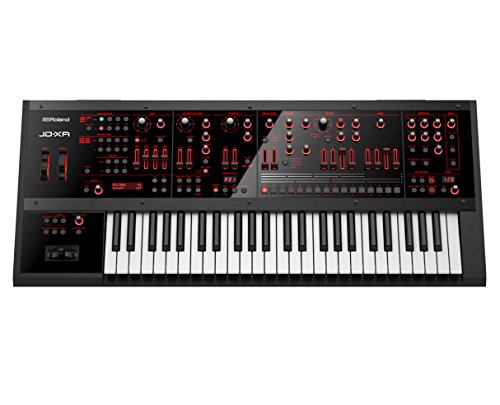
Roland JD-XA 49-Key
Synthesists who want genuine discrete analog voices and a digital engine in one 49-key crossover instrument with deep real time filter control.
Read the Roland JD-XA 49-Key review →
Pioneer DJ DDJ-FLX10 4-Channel
Mobile and open-format DJs who want a 4-channel club style controller with live stem separation and lighting control from one unit.
Read the Pioneer DJ DDJ-FLX10 4-Channel review →Questions Buyers Ask
Novation Launchkey 61 MK4 MIDI
See the current listing, price and included accessories.
About This Review
Mandrillis Team
The Mandrillis editorial team researches and compares audio and music gear using manufacturer documentation, verified specs and real buyer feedback, so you can make a confident purchase without wading through marketing claims.
Read our full research methodology.