Instruments Review
Numark M6 4-Channel Review: A Portable DJ Mixer With USB Recording
The Numark M6 4-Channel is a budget four-channel DJ mixer with a replaceable, slope-adjustable crossfader, three independent RCA outputs and a plug and play USB link for recording a set. Preamp gain, USB resolution and included accessories are not published, leaving some real-world performance questions open for buyers to confirm themselves.
Our Verdict
Research Score 60/100The Numark M6 4-Channel is a straightforward four-channel DJ mixer that puts its budget into the controls that matter most during a live set: a replaceable, slope-adjustable crossfader, dedicated cue switching and three independent RCA outputs for master, record and booth feeds. The USB link adds basic set recording without turning the unit into a dedicated audio interface, and the listing frames it for weddings, club nights and home practice. What holds the score back is how little is published about preamp performance, USB resolution and included accessories, leaving several real-world questions unanswered. For a working or practicing DJ who wants a dependable mixer with a serviceable crossfader, it is a sensible budget pick, though buyers needing documented audio specs should look elsewhere.
Editorial research score based on published specifications and documented features, not a customer rating or lab test.

Numark
Numark M6 USB 4-Channel DJ Mixer
Best for: Mobile, wedding and club DJs who want a dependable four-channel mixer with a serviceable crossfader and a basic USB recording link.
Skip it if: You need documented preamp specs, phantom power for a condenser microphone, or bundled recording software.
Check Price on AmazonWe may earn a commission at no extra cost to you.
Listing verified: November 2026
Who Should Buy It
Buy it if
- Wedding and club DJs who need three separate RCA outputs
- Scratch DJs who want a replaceable, slope-adjustable crossfader
- Home practice setups that benefit from USB set recording
- Buyers prioritizing a serviceable crossfader over channel count
Skip it if
- You need documented preamp or USB resolution specs
- You want bundled DAW or recording software
- You need phantom power for a condenser microphone
Key Specifications
| Type | 4-channel DJ mixer with a built-in USB audio link for Mac and PC |
| Inputs | Multiple phono, line and mic inputs across four channels; exact per-channel split not published in listing |
| Outputs | Master (RCA), record (RCA), booth (RCA), headphone (1/4-inch stereo) |
| Preamps | Not published in listing beyond the presence of phono, line and mic inputs |
| Resolution | Not published in listing |
| Phantom power | Not published in listing |
| Connection | USB, described as seamless plug and play for Mac and PC |
| Monitoring | 1/4-inch stereo headphone output; radiant LED panel monitoring |
| Bundled software | Not published in listing |
| Included accessories | Not published in listing |
Overview
The Numark M6 4-Channel is a compact DJ mixer built around four input channels, aimed at DJs working weddings, clubs, parties and home practice setups. Numark's own pitch covers that full range of settings, which signals a mixer designed for general versatility rather than one specialized use. A built-in USB link lets the same box double as a basic recording source for a laptop.
Numark is a long-established name in DJ hardware, and the M6 USB sits at the budget end of that catalog. It trades the channel count and onboard effects of pricier mixers for a simple four-channel layout built around a replaceable crossfader, which is the single component DJs tend to value most since it wears out fastest under heavy use.
This review draws only on the facts published in the product listing, since no personal use of the unit informs it. Numark states the inputs, the output jacks, the crossfader design and the USB connection clearly, but leaves preamp gain, resolution and any bundled software unstated. Those gaps are called out section by section below.
Preamps and Sound Quality
Each of the four channels accepts phono, line and microphone sources, which the listing confirms, meaning every channel carries its own preamp stage for whichever input is active. Gain range, noise floor and headroom for that preamp stage are not published, so the real-world sound on a quiet vocal mic or a hot turntable signal cannot be verified from the spec sheet alone.
Numark markets the M6 USB as feature packed rather than audiophile, and nothing in the listing contradicts that framing. There is no named preamp circuit, no class-A claim and no stated noise figure, which puts it well behind interfaces that publish a discrete preamp design. For DJ use, where the source is usually a controller or a line-level turntable signal rather than a sensitive microphone, this gap matters less than it would for a dedicated podcast mixer.
The 3-band EQ on each channel is the main tone shaping tool, and Numark gives no detail on its center frequencies or its boost and cut range. Dedicated cue controls let a DJ preview a channel on headphones before bringing it into the mix, a basic but essential feature for beat matching. Together the EQ and cue section make the signal path usable for live mixing even without documented preamp numbers.
Inputs, Outputs and Routing
The output section is the most specific part of the published spec: a master RCA pair, a dedicated record RCA pair, a booth RCA output and a quarter-inch stereo headphone jack. Having a separate record output is a genuine convenience, since it lets a DJ send a clean mix to a recorder without touching the booth or master levels. A booth output on top of that covers a second set of monitors at a live event.
On the input side, the listing describes multiple phono, line and mic inputs spread across the four channels, but it does not give an exact per-channel breakdown of how many accept turntables versus line sources. Vinyl DJs should confirm the phono count before assuming every channel supports a turntable.
Routing beyond the crossfader is simple: there are no aux sends, no effects loop and no send and return pair mentioned anywhere in the listing. That keeps the signal path short, which suits a mobile DJ who wants a mixer that behaves the same way every time rather than a routing matrix to relearn. Anyone wanting an outboard effects unit in the chain will need to patch it between a channel and the mixer rather than through a dedicated loop.
Features, Monitoring and Software
The feature set centers on DJ mixing rather than studio production: a replaceable, slope-adjustable crossfader, dedicated channel level faders, per-channel slope controls and cue switching for headphone preview. A replaceable crossfader is a meaningful feature at this price, since the crossfader is the component that wears fastest under scratch use, and a sealed one forces a full mixer replacement when it eventually fails.
Monitoring is limited to the quarter-inch stereo headphone output and the radiant LED level indicators on the panel, with no further detail on whether the LEDs show peak level, signal presence or both. The listing does not mention a dedicated cue level knob separate from the main headphone volume, so cueing a channel while the main mix plays likely shares the same output stage.
No bundled software is mentioned anywhere in the listing. The USB connection is described as working with virtually any audio recording application, which suggests class-compliant operation rather than a dedicated driver, though Numark does not confirm this directly. Buyers who want a DAW included in the box should plan on supplying their own.
- Replaceable, slope-adjustable crossfader
- Dedicated channel level faders and slope controls
- 3-band EQ per channel
- Dedicated cue controls
- USB plug and play recording link
Build, Design and Controls
Numark describes the design as sleek, robust and ultra-portable, with radiant LED monitoring built into the panel. No dimensions, weight or chassis material are published, so the actual size and sturdiness of the unit cannot be confirmed beyond Numark's own description.
The replaceable crossfader is also a build feature, not just a performance one, since a mixer that lets a worn fader be swapped rather than replacing the whole unit tends to last longer under regular DJ use. Slope controls on each channel let a DJ adjust how sharply the crossfader cuts between channels, a detail usually reserved for mixers aimed at scratch-style performance.
Dedicated level faders per channel, separate from the crossfader, give a DJ independent control over each source's volume before it reaches the mix. Combined with the per-channel EQ and cue switching, the control layout reads as a conventional four-channel club mixer rather than a stripped-down budget unit, even though several build details remain unpublished.
Connectivity, Drivers and Latency
USB connectivity is described as seamless plug and play for both Mac and PC, with no driver installation mentioned anywhere in the listing. That phrasing points toward class-compliant USB audio, which most current operating systems recognize without a separate download, though Numark never states this outright.
Sample rate, bit depth and latency for the USB link are not published, so the quality of a recorded set cannot be compared numerically against a dedicated audio interface. For capturing a DJ set rather than tracking a vocal, this gap matters less, since timing precision is not as critical as it would be for overdubbing a performance.
In practice, the USB output most likely carries a stereo mix of whatever is playing through the master bus, letting a laptop running almost any recording application capture the set directly. There is no mention of multitrack USB output, so individual channels cannot be captured separately through this connection.
Setup and Daily Use
Setting up the M6 USB should be quick: connect turntables or a controller to the phono and line inputs, patch the master output to powered speakers or an amplifier, and plug a USB cable into a laptop if recording is wanted. There is no software to install if the recording application on hand supports class-compliant USB audio directly.
For a working DJ, the booth and record outputs matter as much as the master output, since they let monitors and a recording device run independently of whatever the crowd actually hears. The replaceable crossfader and slope controls mean a scratch DJ can dial in a tight cut without worrying that long-term wear will kill the unit.
Daily use at a wedding or club night should be straightforward given the simple four-channel layout and dedicated cue system, though the unpublished preamp and gain details mean a DJ running sensitive microphones for announcements should test levels carefully beforehand. Practice setups at home benefit from the same simplicity, with headphone cueing covering the need to rehearse transitions quietly.
Who Should Buy It
This mixer suits mobile and wedding DJs who need a dependable four-channel layout with three separate RCA outputs and a crossfader that can be replaced rather than discarded when it wears. Club DJs who scratch heavily will also appreciate the slope-adjustable crossfader.
It is a reasonable choice for a home practice setup too, since the USB link lets a DJ record and review a mixed set without extra gear. The cue system supports quiet headphone practice, which matters for anyone rehearsing transitions without disturbing a household.
It is the wrong mixer for a buyer who needs documented preamp performance, phantom power for a condenser microphone, or bundled production software, since none of those are confirmed in the listing. A studio-focused buyer should look at a dedicated audio interface instead of a DJ mixer with an incidental USB link.
Alternatives Worth Considering
Within DJ mixers at a similar budget, the Pyle PMXU128BT 12-Channel offers more channels, Bluetooth input and onboard effects, trading the Numark's scratch-oriented crossfader for a console-style layout better suited to a wedding than club scratching. Buyers who value crossfader feel over channel count should stay with a dedicated DJ mixer like this one instead.
For buyers who actually want to record multitrack audio rather than a stereo set, a mixer such as the Behringer XENYX X1204USB pairs its channels with a documented USB audio interface and bundled recording software, something the Numark listing does not offer. That makes it a better fit for podcasting or band rehearsal recording than for club DJing.
Numark's own catalog includes mixers with more channels and onboard effects for DJs who outgrow the M6 USB's four-channel layout. Choosing between them mostly comes down to how many sources need to be live at once and whether onboard effects are worth the added cost.
Verdict
The Numark M6 4-Channel is a straightforward four-channel DJ mixer that puts its budget into the controls that matter most during a live set: a replaceable, slope-adjustable crossfader, dedicated cue switching and three independent RCA outputs. The USB link adds basic set recording without turning the unit into a dedicated audio interface.
What holds the score back is how little the listing says about preamp performance, USB resolution and included accessories, leaving several real-world questions unanswered. It reads as a mixer built for working DJs rather than a fully documented piece of recording gear.
For weddings, clubs, parties and home practice, it is a sensible budget pick from an established DJ brand. Buyers who need documented audio specs or studio features should look at a dedicated interface instead.
Strengths and Limitations
Strengths
- Replaceable, slope-adjustable crossfader
- Three independent RCA outputs: master, record and booth
- Dedicated cue controls and a 3-band EQ per channel
- USB plug and play link for recording a set
- Ultra-portable design with LED panel monitoring
Limitations
- Preamp gain, noise and headroom not published
- No bundled software mentioned
- No included accessories listed
- Phantom power for condenser microphones not stated
How We Scored It
Scores reflect published specifications, documented features and value against the alternatives below. They are editorial research scores, not laboratory measurements.
Alternatives to Consider

Pioneer DJ XDJ-RX3
DJs who want club-standard standalone playback from USB with a large touchscreen and a familiar two-channel layout.
Read the Pioneer DJ XDJ-RX3 review →
Yamaha DM3-D 22
Small venues, houses of worship and production companies that want a compact 96 kHz digital console with Dante networking for stage boxes and multitrack recording.
Read the Yamaha DM3-D 22 review →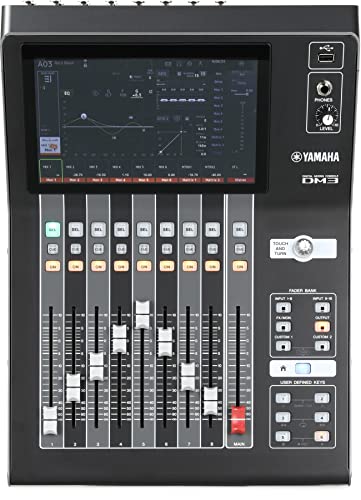
Yamaha DM3
Bands, small venues and project studios that want a compact 96 kHz digital console that doubles as an 18x18 USB recording interface.
Read the Yamaha DM3 review →Questions Buyers Ask
Numark M6 USB 4-Channel DJ Mixer
See the current listing, price and included accessories.
About This Review
Mandrillis Team
The Mandrillis editorial team researches and compares audio and music gear using manufacturer documentation, verified specs and real buyer feedback, so you can make a confident purchase without wading through marketing claims.
Read our full research methodology.