Studio Gear Review
Yamaha DM3 Review: 22-Channel Digital Mixer With 18x18 USB
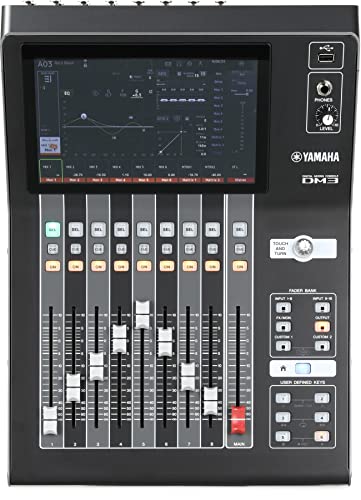
The Yamaha DM3 is the standard version of Yamaha's ultracompact digital console, combining 22 channels, 16 preamps, 96 kHz processing and a 9-inch touchscreen with an 18x18 USB audio interface and a 2x2 USB recorder. It lands in the upper mid-range tier and aims at bands, venues and studios that record over USB.
Our Verdict
Research Score 87/100The Yamaha DM3 is the version of this console most buyers should pick unless they already run a Dante network. It carries the same 16 preamps, 22 channels, 96 kHz sample rate and 9-inch touchscreen as its networked sibling, and trades the Dante port for an 18x18 USB audio interface plus a 2x2 USB recorder. That makes it a live console and a multitrack recording interface in one compact chassis, which is a strong proposition for bands and small venues. The listing omits phantom power, headphone and bit depth details and does not list bundled software. Those are small gaps against a well-specified feature set, and the upper mid-range tier is fair. It scores 87 out of 100.
Editorial research score based on published specifications and documented features, not a customer rating or lab test.
Yamaha
Yamaha DM3
Best for: Bands, small venues and project studios that want a compact 96 kHz digital console that doubles as an 18x18 USB recording interface.
Skip it if: You need Dante networking for stage boxes or a networked recording system, because that requires the DM3-D model.
Check Price on AmazonWe may earn a commission at no extra cost to you.
Listing verified: October 2026
Who Should Buy It
Buy it if
- Bands that want to multitrack rehearsals and gigs straight to a laptop
- Small venues and clubs replacing an analog mixer with scene recall
- Project studios that need 16 preamps and a mixing surface in one unit
- Streamers and podcasters running multiple guests with hardware control
Skip it if
- Your system is built around Dante stage boxes
- You only need two inputs and would rather buy a desktop interface
- You want one physical knob for every channel function
Key Specifications
| Type | Ultracompact 22-channel digital mixing console with USB audio interface |
| Inputs | 22 channels: 16 mono, 1 stereo, 2 stereo FX returns; 16 analog mic inputs (12 XLR plus 4 combo jack); 18 USB input channels |
| Outputs | 8 analog XLR outputs; 18 USB output channels; 6 mono or 3 stereo mixes, 2 matrixes, 1 stereo bus |
| Preamps | 16 Yamaha professional preamps |
| Resolution | 96 kHz sample rate; bit depth not published in listing |
| Phantom power | Not published in listing |
| Connection | 18x18 USB audio interface plus 2x2 USB recorder; USB connector type not published in listing |
| Monitoring | Not published in listing |
| Bundled software | Not published in listing |
| Included accessories | Not published in listing |
Overview
The Yamaha DM3 is a 22-channel digital mixing console built around an 18x18 USB audio interface and a 96 kHz processing engine. It is the standard model in the DM3 series, meaning it omits the Dante network port found on the DM3-D and instead concentrates on direct computer recording and playback. Yamaha describes the chassis as ultracompact.
The appeal is straightforward. A band or small venue gets 16 professional preamps, scene recall, onboard effects and a touchscreen in a desk that fits on a side table, and the same desk captures every channel to a laptop over one USB cable. A separate 2x2 USB recorder handles quick stereo captures when a computer is not around.
Pricing sits in the upper mid-range tier, which places it below the Dante model. For anyone whose recording and playback needs are met by USB, that difference is pure savings. The review below works through what the listing confirms and where it stays quiet.
Preamps and Sound Quality
The DM3 carries 16 professional Yamaha preamps, with 12 on XLR connectors and 4 on combo jacks. The combo inputs give flexibility for line-level keyboards, direct bass or a laptop feed without tying up an XLR channel. Gain range and noise figures are not published in the listing.
Processing at 96 kHz is the specification Yamaha leads with. A higher internal sample rate reduces latency through the console and gives the EQ and dynamics algorithms more headroom at the top of the audible band. Yamaha calls the result renowned sound quality, and while that phrase is promotional, the sample rate is a verifiable number.
What the listing does not say is the bit depth of the converters or the dynamic range of the preamps. These are standard data sheet items and should be confirmed by anyone designing a recording chain around the console. On paper, a 96 kHz Yamaha digital desk is expected to be clean enough for multitrack recording of live performances.
Inputs, Outputs and Routing
Analog inputs total 16 mic channels plus 1 stereo input, and the 2 stereo effect returns bring the console to its 22-channel count. Eight XLR outputs sit on the rear, which is enough for stereo mains, several monitor mixes and a recording or overflow feed. Everything can be routed inside the console to the output of choice.
The bus structure gives 6 mono or 3 stereo mixes, 2 matrixes and 1 stereo bus. For a typical club or church this covers the main mix, a few wedge or in-ear sends and matrix feeds for a stream or a second room. Stereo mix pairs are especially useful for in-ear monitoring.
The 18x18 USB interface is what sets the standard DM3 apart. Eighteen channels to the computer allow every preamp plus a stereo mix to be recorded at once, and 18 channels back allow playback tracks, click and virtual soundcheck. The 2x2 USB recorder is a separate function for simple stereo recording and playback from a drive.
Features, Monitoring and Software
Control runs through the 9-inch touchscreen, which Yamaha describes as best in class for a console of this size. Channel strips, routing, effects and scene management all live on the screen, with a smaller set of physical controls alongside. The presence of two stereo effect returns confirms built-in effects processing, though the listing does not enumerate the effect types.
Recording options are the strongest feature set on this model. Multitrack capture through the 18x18 USB interface serves bands and studios, while the 2x2 USB recorder provides a quick stereo backup or playback source. Virtual soundcheck, where recorded tracks are played back through the console as if they were live inputs, becomes practical with 18 return channels.
Monitoring specifics such as headphone output, cue bus and solo-in-place are not published in the listing. Phantom power is also unstated, although it is a standard feature on professional preamps. Bundled software, including any remote control application for a tablet, is not listed.
- 18x18 USB audio interface for multitrack recording and playback
- 2x2 USB recorder for stereo capture without a computer
- 22 channels with 16 mono, 1 stereo and 2 stereo FX returns
- 6 mono or 3 stereo mixes, 2 matrixes and 1 stereo bus
- 9-inch touchscreen control surface
Build, Design and Controls
Yamaha builds its live consoles for repeated transport, and the DM3 follows that tradition in a smaller frame. The rear panel carries 16 inputs and 8 XLR outputs, so despite the compact size the connector density is high. Weight, dimensions and chassis materials are not published in the listing.
The touchscreen-centered design is a trade-off. It allows the ultracompact footprint and simplifies scene-based operation, but engineers who mix by feel on a knob-laden analog desk will need time to adapt. Fader count and assignable keys are not described, so the physical control surface should be reviewed before a purchase decision.
In a fixed installation the compact size is an asset because the console fits in a booth or on a balcony rail. For mobile use it packs into a small case, and the single USB cable to a laptop replaces a rack of outboard recording gear. Build quality in this series is generally regarded as professional, though the listing does not make specific claims.
Connectivity, Drivers and Latency
USB is the computer connection, with 18 channels in each direction for the audio interface and 2 channels in each direction for the recorder. The connector type and the operating systems supported are not published in the listing. Yamaha typically provides a driver for Windows and relies on class compliance on macOS, but that is general knowledge rather than a published fact here.
Latency through the USB interface is not stated. The 96 kHz internal rate helps, and for live use the console's own processing handles monitoring without routing through the computer, so round-trip latency only matters for playback tracks and virtual soundcheck. In those cases it is rarely a problem.
There is no Dante port on this model, which is the main connectivity limitation. Buyers who later want a networked stage box will not be able to add one. The connectivity score of 9 out of 10 reflects a very capable USB implementation with a small deduction for the missing network option and the unpublished connector details.
Setup and Daily Use
Setup begins with patching the 16 inputs, naming channels on the touchscreen and building scenes for the room's regular events. The USB interface appears to the computer as a multichannel device, and once a recording template is saved in the DAW, capturing a show is a matter of pressing record.
Day-to-day, the console runs like any modern digital desk. Scenes recall gains, EQ, dynamics and routing, so a volunteer can bring up Sunday morning or Friday night with one touch. The 2x2 USB recorder is handy for grabbing a stereo mix of a rehearsal or a sermon without opening a laptop.
For a band on the road the DM3 can serve as both front of house console and recording rig. Running 16 channels into a laptop every night builds a library of multitracks for live albums or social clips. The compact size means it travels in a case that one person can carry.
Who Should Buy It
Bands and small venues that want to replace an analog mixer are the clearest audience. The DM3 delivers scene recall, onboard effects and 96 kHz processing while adding a full 18x18 recording interface, which no analog desk in the same price tier can match.
Project studios that track full bands are a second group. Sixteen preamps with a mixing surface and a USB interface in one box replace a separate interface, preamp rack and monitor controller for many sessions. The 18 return channels allow a mix to be routed back through the console for hardware monitoring.
Buyers who run or plan to run a Dante network should choose the DM3-D instead. Those who only need a couple of inputs for home recording will be better served by a desktop interface, since the DM3's channel count and price are aimed at a larger input list.
Alternatives Worth Considering
The Yamaha DM3-D 22 is the obvious sibling. It swaps the 18x18 USB interface and 2x2 recorder for a 16x16 Dante port and sits in the premium tier. Choose it only if networked audio is part of the plan, because otherwise the standard DM3 delivers the same console at a lower cost.
For buyers who want a hardware mixer with USB recording but do not need scenes or 96 kHz processing, an analog USB mixer such as the Yamaha MG10XU or a larger MG series desk is far cheaper. The trade is simplicity for flexibility: analog desks record a stereo mix rather than 18 channels and have no recall.
Compact desktop interfaces such as the Focusrite Scarlett 2i2, Universal Audio Volt 2 and MOTU M2 are the right answer for solo recordists. They offer two preamps and low-latency drivers at a fraction of the cost. The DM3 only makes sense when the input list is long enough to need a console.
Verdict
The Yamaha DM3 is a compact digital console that earns its upper mid-range tier by doubling as a serious 18x18 USB recording interface. Sixteen preamps, 22 channels, a flexible bus layout and 96 kHz processing cover bands, small venues, worship rooms and project studios with room to spare.
The listing leaves phantom power, headphone output, bit depth and bundled software unstated, which is a reporting gap rather than a product weakness. Against the Dante model it is the smarter buy for anyone whose recording lives on USB. It scores 87 out of 100 in this research review.
Strengths and Limitations
Strengths
- 18x18 USB audio interface built into a 22-channel digital console
- 16 Yamaha preamps with 12 XLR and 4 combo jack inputs
- 96 kHz processing throughout
- 2x2 USB recorder for quick stereo capture without a computer
- 6 mono or 3 stereo mixes, 2 matrixes and a stereo bus
- 9-inch touchscreen keeps the footprint ultracompact
Limitations
- No Dante networking on this version
- Phantom power, headphone output and USB connector type not published
- Bit depth and converter figures not stated in the listing
- Touchscreen-driven workflow takes adjustment for analog mixer users
How We Scored It
Scores reflect published specifications, documented features and value against the alternatives below. They are editorial research scores, not laboratory measurements.
Alternatives to Consider

Rode RODECaster Pro 2
Podcast and streaming teams of up to four people who want a complete desk-mounted studio with broadcast processing and standalone SD recording in one purchase.
Read the Rode RODECaster Pro 2 review →
Pioneer DJ XDJ-RX3
DJs who want club-standard standalone playback from USB with a large touchscreen and a familiar two-channel layout.
Read the Pioneer DJ XDJ-RX3 review →
Yamaha MG10XU
Bands, mobile DJs and worship teams that want a complete small-venue PA with a USB mixer, two 12-inch powered mains and monitoring headphones in one order.
Read the Yamaha MG10XU review →Questions Buyers Ask
Yamaha DM3
See the current listing, price and included accessories.
About This Review
Mandrillis Team
The Mandrillis editorial team researches and compares audio and music gear using manufacturer documentation, verified specs and real buyer feedback, so you can make a confident purchase without wading through marketing claims.
Read our full research methodology.