Studio Gear Review
Yamaha DM3-D 22 Review: Compact Dante Console at 96 kHz
The Yamaha DM3-D 22 is an ultracompact digital mixing console with 22 channels, 16 Yamaha preamps, a 9-inch touchscreen and a 16x16 Dante interface running at 96 kHz. It targets small venues and installers who want networked audio in a small footprint, and it sits in the premium price tier.
Our Verdict
Research Score 88/100The Yamaha DM3-D 22 packs a serious amount of console into an ultracompact frame. Sixteen Yamaha preamps across 12 XLR and 4 combo inputs, a 96 kHz sample rate, 6 mono or 3 stereo mixes with 2 matrixes, and a 16x16 Dante interface cover the needs of small venues, worship rooms and corporate production. The 9-inch touchscreen is the main control surface, which keeps the footprint down. The listing does not publish phantom power, headphone output, bit depth or USB details, and bundled software is unstated. Those gaps are minor for a console of this pedigree, but they are worth confirming. For buyers committed to Dante, the premium tier is justified. It scores 88 out of 100.
Editorial research score based on published specifications and documented features, not a customer rating or lab test.

Yamaha
Yamaha DM3-D 22
Best for: Small venues, houses of worship and production companies that want a compact 96 kHz digital console with Dante networking for stage boxes and multitrack recording.
Skip it if: You only need USB recording and have no plan to run a Dante network, because the standard DM3 covers that at a lower tier.
Check Price on AmazonWe may earn a commission at no extra cost to you.
Listing verified: October 2026
Who Should Buy It
Buy it if
- Installers building a networked audio system around Dante stage boxes
- Houses of worship that need a compact console with 16 preamps
- Production companies that want a 96 kHz desk for corporate and small-stage work
- Engineers who record multitrack through Dante to a computer or recorder
Skip it if
- You will never connect a Dante device and want to save money
- You need more than 16 local analog preamps without a stage box
- You prefer physical knobs on every channel instead of a touchscreen
Key Specifications
| Type | Ultracompact 22-channel digital mixing console with Dante networking |
| Inputs | 22 channels: 16 mono, 1 stereo, 2 stereo FX returns; 16 analog mic inputs (12 XLR plus 4 combo jack); 16 Dante input channels |
| Outputs | 8 analog XLR outputs; 16 Dante output channels; 6 mono or 3 stereo mixes, 2 matrixes, 1 stereo bus |
| Preamps | 16 Yamaha professional preamps |
| Resolution | 96 kHz sample rate; bit depth not published in listing |
| Phantom power | Not published in listing |
| Connection | 16x16 Dante network audio; USB connectivity not published in listing |
| Monitoring | Not published in listing |
| Bundled software | Not published in listing |
| Included accessories | Not published in listing |
Overview
The Yamaha DM3-D 22 is the Dante-equipped version of Yamaha's ultracompact digital mixing console. It offers 22 channels made up of 16 mono inputs, 1 stereo input and 2 stereo effect returns, all processed at a 96 kHz sample rate. The D in the name signals the built-in 16x16 Dante interface, which is the main reason to choose this model over the standard DM3.
Yamaha has a long history in digital live consoles, and the DM3 series brings that lineage down to a desk small enough for a corporate lectern or a church balcony. The 9-inch touchscreen handles most of the interaction, and the physical footprint is described as ultracompact. This is a professional tool, and the price tier is premium.
The core question for any buyer is whether the Dante interface earns its place. For installers running stage boxes over a network, or engineers who record multitrack to a computer through a Dante card, the answer is yes. For a band that just needs a small mixer with USB recording, the standard DM3 is the more sensible pick.
Preamps and Sound Quality
Sixteen professional Yamaha preamps feed the console, split between 12 XLR inputs and 4 combo jacks that accept either XLR or quarter-inch connectors. Those four combo inputs are the natural home for direct instruments such as keyboards and bass, while the 12 XLR inputs handle microphones. The listing does not state the gain range or equivalent input noise.
The 96 kHz sample rate is the headline audio specification. Running the whole console at 96 kHz halves the processing latency compared with a 48 kHz design and extends the usable bandwidth of every effect and EQ stage. Yamaha describes the result as its renowned sound quality, which is marketing language, but the sample rate itself is a concrete published figure.
Bit depth, dynamic range and converter specifications are not published in the listing. For a console in this class those figures are typically professional grade, but a research review can only report what is stated. Buyers who need the numbers for a system design should pull the manufacturer data sheet.
Inputs, Outputs and Routing
On the analog side the DM3-D 22 provides 16 mic inputs and 8 XLR outputs. The output count is generous for a desk this size and allows a main left and right pair, several monitor mixes and a matrix feed or two without touching the network. The stereo input and the two stereo effect returns bring the channel count to 22.
Bus architecture is where the console shows its professional roots. There are 6 mono or 3 stereo mixes, 2 matrixes and 1 stereo bus. In a worship or small-venue setting that typically translates to a stereo main, a handful of wedge or in-ear mixes, and matrix sends for a lobby feed or a recording.
The Dante interface adds 16 channels in and 16 out over a standard network cable. That means a Dante stage box can bring 16 more inputs from the stage, or the 16 outputs can feed a Dante-enabled amplifier rack or a computer for multitrack capture. Routing between analog and network sources is handled inside the console.
Features, Monitoring and Software
The 9-inch touchscreen is the primary interface for channel processing, routing and scene management. Yamaha positions it as best in class for the size, and on a desk this compact the screen replaces the per-channel knobs found on an analog mixer. The listing does not list the specific EQ, dynamics or effect types, but the two stereo effect returns confirm that onboard effects are present.
Monitoring details such as a headphone output, cue bus behavior and solo options are not published in the listing. Every digital console in this category provides a cue system, but the specifics should be confirmed in the manual. Bundled software, including any remote control or offline editor application, is also not stated.
The listing is silent on phantom power, which is almost certainly available on the preamps but is not published. The same goes for the recording features that the standard DM3 lists, such as a USB recorder. For the Dante model, multitrack recording is expected to run over the network rather than over USB.
- 22 channels: 16 mono, 1 stereo, 2 stereo FX returns
- 6 mono or 3 stereo mixes, 2 matrixes, 1 stereo bus
- 16x16 Dante network audio interface
- 9-inch touchscreen as the primary control surface
- 96 kHz sample rate across the console
Build, Design and Controls
Ultracompact is the listing's description of the form factor, and the 16 preamps with 8 XLR outputs suggest a dense rear panel. Yamaha's digital consoles are built for touring and installation, and the DM3 series follows that pattern. Weight, dimensions and chassis material are not published in the listing.
The control philosophy centers on the touchscreen with a limited set of physical faders and encoders. This keeps the desk small but means that operators used to one knob per function will need an adjustment period. For installed systems where a volunteer runs the desk, Yamaha's screen-driven workflow is typically easier to teach than a bank of analog knobs.
Fader count, encoder count and the presence of user-assignable keys are not described in the listing. These details matter for live mixing speed, so engineers who will mix a full band on the console should confirm the surface layout before committing.
Connectivity, Drivers and Latency
Dante is the defining connection on this model. The 16x16 interface runs over standard network infrastructure and interoperates with the wide range of Dante stage boxes, amplifiers, recorders and computer cards on the market. Network configuration requires some familiarity with IP addressing and the Dante routing software, which is the main learning curve.
USB connectivity is not published in the listing for the DM3-D 22, so buyers should not assume the 18x18 USB interface of the standard DM3 is present here. Driver requirements for computer recording through Dante depend on the Dante software or card used on the computer side rather than on the console itself.
Latency figures are not published, but the 96 kHz processing rate and the deterministic nature of Dante networks both work in the operator's favor. In practical terms, in-ear monitor mixes through a Dante stage box should feel immediate. The connectivity score of 9 out of 10 reflects the strength of Dante with a small deduction for the unpublished USB and headphone details.
Setup and Daily Use
Initial setup involves patching the 16 analog inputs, configuring the Dante network if stage boxes or recorders are used, and building scenes for the room's typical events. Once scenes are stored, daily operation is largely a matter of recalling the right scene and adjusting levels on the touchscreen.
For a worship or corporate installation the console can run for years with minimal intervention. The 8 analog outputs cover the main system and monitor mixes, and the matrixes handle overflow rooms or recording feeds. Volunteers can be trained on a simplified screen layout while the engineer keeps the deeper processing locked away.
Mobile production is also realistic given the compact size. A DM3-D 22 with a Dante stage box lets the engineer place the console at front of house with only a network cable running to the stage. That removes the heavy analog snake from the load-in.
Who Should Buy It
Installers and integrators are the primary audience. A compact 96 kHz console with Dante networking fits naturally into a system that already includes networked amplifiers, stage boxes or a recording computer with a Dante card. The 16 local preamps mean a stage box is optional rather than mandatory for smaller rooms.
Houses of worship with a band and a modest input list are a second strong fit. Sixteen preamps cover drums, bass, keys, guitars and several vocal mics, and the 6 mixes handle in-ear or wedge monitors for the musicians. The touchscreen workflow suits volunteer operators once scenes are built.
Buyers who have no Dante plans should look at the standard DM3 instead, because they will pay the premium tier for a network interface they will never use. Engineers who need more than 16 local preamps without a stage box, or who want a traditional knob-per-function surface, should look at a larger console.
Alternatives Worth Considering
The most direct alternative is the standard Yamaha DM3, which shares the same channel count, preamps, touchscreen and 96 kHz processing but replaces Dante with an 18x18 USB audio interface and a 2x2 USB recorder. For a band or small venue that records to a laptop over USB, that model is the better value and sits in the upper mid-range tier.
Analog mixers with USB such as the Yamaha MG10XU or a larger MG series desk cost far less and are simpler to operate, but they offer no scenes, no network audio and no 96 kHz digital processing. They make sense for bars and rehearsal rooms where recall and networking are not priorities.
Desktop interfaces like the Focusrite Scarlett 2i2, PreSonus AudioBox or MOTU M2 are not competitors in the live sense but are relevant for a buyer who primarily records at home. If live mixing is secondary, a small interface plus a basic analog mixer may be a more sensible combination than a networked digital console.
Verdict
The Yamaha DM3-D 22 is a professional digital console in a frame small enough to fit almost anywhere. The combination of 16 preamps, 96 kHz processing, a flexible bus structure and 16x16 Dante networking is unusual at this size and is the reason it scores 88 out of 100.
The unpublished details around phantom power, headphone monitoring, USB and bundled software are minor and typical for a listing rather than a data sheet. The real buying decision is simple: if Dante is part of your system, this is the DM3 to choose; if it is not, the standard model saves money and loses nothing you would use.
Strengths and Limitations
Strengths
- 16 Yamaha preamps with 12 XLR and 4 combo jack inputs in an ultracompact frame
- 96 kHz sample rate on a 22-channel digital console
- 16x16 Dante interface for networked stage boxes and recording
- 6 mono or 3 stereo mixes plus 2 matrixes and a stereo bus
- 9-inch touchscreen for direct mix control
- 8 balanced XLR analog outputs
Limitations
- Premium price tier compared with the USB-only DM3 model
- Listing does not publish phantom power, headphone or USB details
- Bit depth and converter specifications not stated
- Dante requires network knowledge that casual users may not have
- Bundled software and included accessories are not listed
How We Scored It
Scores reflect published specifications, documented features and value against the alternatives below. They are editorial research scores, not laboratory measurements.
Alternatives to Consider

Pioneer DJ XDJ-RX3
DJs who want club-standard standalone playback from USB with a large touchscreen and a familiar two-channel layout.
Read the Pioneer DJ XDJ-RX3 review →
Rode RODECaster Pro 2
Podcast and streaming teams of up to four people who want a complete desk-mounted studio with broadcast processing and standalone SD recording in one purchase.
Read the Rode RODECaster Pro 2 review →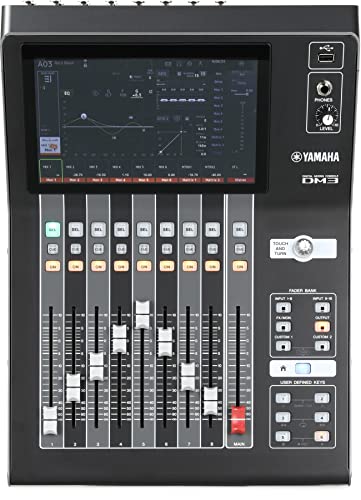
Yamaha DM3
Bands, small venues and project studios that want a compact 96 kHz digital console that doubles as an 18x18 USB recording interface.
Read the Yamaha DM3 review →Questions Buyers Ask
Yamaha DM3-D 22
See the current listing, price and included accessories.
About This Review
Mandrillis Team
The Mandrillis editorial team researches and compares audio and music gear using manufacturer documentation, verified specs and real buyer feedback, so you can make a confident purchase without wading through marketing claims.
Read our full research methodology.