Instruments Review
Roland A-49-BK 49-Key MIDI Review: Slim Keys-First Controller
The Roland A-49-BK 49-Key MIDI controller offers 49 full-size velocity-sensitive keys with a professional-grade synth action, a slim-line black case, two knobs, two switches and a D-BEAM sensor, all running on USB bus power. This research review looks at what the listing publishes, what it skips, and where the keys-first approach wins or loses.
Our Verdict
Research Score 73/100The Roland A-49-BK 49-Key MIDI controller is built for players who judge a controller by its keybed. The listing commits to 49 full-size velocity-sensitive keys with a professional-grade synth action, a slim-line black chassis, two knobs, two switches, the D-BEAM infrared controller and USB bus power. It stops there: no pads, no faders, no published DAW integration or bundled software, and no stated weight, dimensions or secondary ports. For a lower mid-range controller from a brand with a long keyboard history, that earns 73 out of 100. Choose it for feel and footprint, and look at a pad and fader controller if production control matters more than the keys.
Editorial research score based on published specifications and documented features, not a customer rating or lab test.

Roland
Roland A-49-BK 49-Key MIDI
Best for: Keyboard players who want a slim, serious 49-key keybed with a few real-time controls and a single USB cable, not a pad and fader workstation.
Skip it if: You rely on pads, faders or a documented DAW map, or you need confirmed weight, pedal inputs and software before you order.
Check Price on AmazonWe may earn a commission at no extra cost to you.
Listing verified: October 2026
Who Should Buy It
Buy it if
- Pianists and synth players who care about key feel first
- Producers with a small desk who need a shallow controller
- Gigging players who want a bus-powered keyboard in black
- Learners who want a straightforward controller with no menus to fight
Skip it if
- You program drums on pads
- You want a hardware fader bank for mixing
- You expect a DAW or sound library in the box
Key Specifications
| Keys | 49 full-size keys |
| Key type | Velocity-sensitive synth action, described as professional-grade |
| Pads | None listed |
| Knobs and faders | Two knobs, two switches and a D-BEAM controller; no faders listed |
| DAW integration | Not published in listing |
| Bundled software | Not published in listing |
| Connectivity | USB (bus powered); other ports not published in listing |
| Power | USB bus power, no AC adapter required |
| Weight | Not published in listing, described as lightweight and slim-line |
| Included accessories | Not published in listing |
Overview
The Roland A-49-BK 49-Key MIDI controller is the black version of Roland's slim four-octave controller, and the listing leads with a professional-grade keyboard action in a space-saving case. It belongs to the lower mid-range tier and draws all its power from the USB cable. The pitch is portable control with pro action.
Where most controllers in this price band compete on pad counts and encoder banks, the A-49-BK offers only two knobs, two switches and the D-BEAM infrared controller. That restraint is the point. Roland is selling a keybed with a thin layer of control, not a desktop production hub.
Everything in this review comes from the published listing. Weight, dimensions, secondary ports, bundled software and any DAW script are not published, and each of those gaps is noted where it matters instead of being filled from memory of other Roland products.
Keys, Pads and Feel
Forty-nine full-size keys with velocity sensitivity form the heart of the A-49-BK. The listing goes further than its white sibling in describing the action, calling it professional-grade and promising superior playing feel and response for enhanced musical expression. In plain terms, this is a synth action aimed at players who notice key return and consistency.
A synth action is light and springy, which favors organ glides, fast synth lines and repeated notes over the weighted resistance a pianist expects. Full-size keys keep octave stretches and chord voicings natural, something a mini-key controller cannot offer. The listing does not mention aftertouch, so expressive pressure control should not be assumed.
There are no pads, which means drum parts are played on keys or programmed with a mouse. For a player who already thinks in keyboard terms, that is no loss. For someone who finger drums, a controller like the Novation Launchkey Mini or the Akai MPK Mini MK3 is a better match despite its smaller keys.
Knobs, Faders and DAW Integration
Two knobs and two switches are the only conventional controls, and the listing describes them, together with the D-BEAM, as providing control over music software parameters. Think of them as filter and resonance plus a pair of toggles for sustain, arpeggiator on and off, or a patch change. There are no faders at all.
The D-BEAM is what separates this controller from a generic 49-key board. It is an infrared sensor that reads the height of your hand and converts it into a continuous controller message, so a wave becomes a pitch bend, a filter sweep or a volume swell. It is theatrical on stage and useful in the studio for a one-handed gesture while the other hand plays.
DAW integration is not published. The A-49-BK sends standard MIDI, so any DAW that accepts a USB MIDI device can use it, but there is no stated transport section or mixer map. Controllers such as the Native Instruments Komplete Kontrol M32 or the Nektar Impact LX publish deep DAW scripts, and this Roland does not compete on that front.
Software, Sounds and Features
No bundled software appears in the listing. That means no DAW, no virtual instrument and no plug-in pack, which is a notable absence when most rivals include at least a lite DAW. If you already own a production suite, the omission costs nothing; if you are starting from scratch, factor in a software purchase.
The listing describes a user-friendly interface with straightforward controls for quick integration into a music workflow. On a board with two knobs, two switches and a sensor, that is an accurate description of a panel with very little to learn. There is no internal sound engine, so the A-49-BK makes no sound on its own.
Deeper control assignment through a software editor is not mentioned in the listing, so this review treats it as unconfirmed. Check the manual if you want to remap the switches or change the D-BEAM behavior beyond whatever the panel allows.
- Professional-grade velocity-sensitive synth action
- D-BEAM infrared controller for gestural expression
- Two knobs and two switches for parameter control
- Slim-line, space-saving chassis
- No bundled DAW or sounds published
Build, Design and Portability
Slim-line is the listing's word, and it describes a controller that fits on a desk in front of a monitor without pushing the keyboard tray out of reach. Lightweight and compact construction is also published, which fits a controller meant to move between home, lesson and rehearsal. Exact dimensions and weight are not published.
The black finish is the practical choice for a controller that travels. Scuffs and fingerprints are less visible than on the white version, and black blends into most studio setups. Shell material is not described in the listing, so durability claims beyond Roland's general reputation cannot be confirmed here.
A 49-key controller with full-size keys is still a long object. It will not fit in a laptop bag, so a padded keyboard case is the realistic way to carry it. Light weight also means it may slide on a smooth desk, and a rubber mat solves that cheaply.
Connectivity and Power
USB bus power is confirmed, and the listing presents it as a way to eliminate the AC adapter and reduce cable clutter. One cable carries both power and MIDI to a laptop or desktop, which is as simple as a controller setup gets. Whether the connection is class compliant is not stated, though a bus-powered Roland controller is expected to work without a special driver on current systems.
Secondary ports are not published. Players who want to connect a sustain pedal, an expression pedal or a hardware synth over five-pin MIDI should confirm those jacks in the manual, because the listing does not describe them. This review does not assume they exist.
Power draw is also unstated. On a laptop that is rarely an issue, but tablet users who connect through an adapter should verify the controller falls within the device's power budget. Keyboards with motorized or lit components draw more, and the A-49-BK has neither, which works in its favor.
Setup and Daily Use
Setup is as short as the port list. Plug in the USB cable, open your DAW, select the A-49-BK as a MIDI input and begin playing. There is no companion software to install and no script to load, which keeps first use fast and avoids version headaches.
In regular use the controller rewards players who keep both hands at the keys. The two knobs are best mapped once to the parameters you reach for most, and the D-BEAM becomes a performance tool for sweeps and swells during a take. Switching octaves and channels through the panel is straightforward, although the listing does not detail the button layout.
Limits appear when production tasks pile up. Mixer moves, clip launching and drum programming stay on the computer, and producers who want to move those onto hardware will add a second controller or trade up. For a player who records parts and leaves mixing to the mouse, the A-49-BK is enough.
Who Should Buy It
Keyboard players first. Anyone who has played a full-size keyboard and finds mini keys cramped will appreciate 49 proper keys with a professional-grade action, and the slim case makes room for it on a desk that already holds a monitor and an audio interface.
Gigging musicians running software instruments from a laptop are the second group. A bus-powered controller in black with no wall adapter cuts setup time, and the D-BEAM adds a visual performance element that audiences notice. The lower mid-range price tier is fair for a Roland keybed with this little else attached.
Beat producers and mix engineers should look elsewhere. Without pads, faders or a published DAW map, the A-49-BK does not accelerate the tasks they care about, and the M-Audio Oxygen Pro or the Nektar Impact LX will serve them better at a similar key count.
Alternatives Worth Considering
The M-Audio Oxygen Pro adds pads, faders and DAW presets to a comparable 49-key format, and the Nektar Impact LX does the same with a strong focus on DAW transport and mixer control. Both are deeper controllers, and both are bulkier than the slim-line Roland.
The Native Instruments Komplete Kontrol M32 offers tighter software integration in a shorter, mini-key format, which suits producers who live inside one plug-in ecosystem. The Arturia MiniLab 3, Akai MPK Mini MK3 and Novation Launchkey Mini are the backpack options, each with pads and encoders but with keys that pianists tend to find small.
The closest alternative is the Roland A-49-WH, the identical controller in white. The published hardware is the same, so the decision between them comes down to finish and whichever is cheaper when you buy.
Verdict
The Roland A-49-BK 49-Key MIDI controller is a focused tool. The listing confirms 49 full-size velocity-sensitive keys with a professional-grade synth action, a slim-line black case, two knobs, two switches, the D-BEAM and USB bus power, and that is the complete offer.
It is honest about what it is not. There are no pads or faders, no bundled software, no published DAW map, and the weight, dimensions and secondary ports are unstated. Those omissions hold the score to 73 out of 100 in the lower mid-range tier.
If your priority is a keybed you will enjoy playing every day in a case that leaves desk space free, the A-49-BK is a sound buy. If your priority is hardware control over a DAW, spend the same money on a controller that publishes pads, faders and scripts.
Strengths and Limitations
Strengths
- 49 full-size velocity-sensitive keys with a pro-grade synth action
- Slim-line chassis that fits a crowded desk
- USB bus powered, so no adapter to carry
- D-BEAM infrared controller plus two knobs and two switches
- Black finish hides wear on a gigging controller
Limitations
- No pads and no faders
- Bundled software and DAW scripts are not published
- Weight, dimensions and secondary ports are unstated
- No aftertouch mentioned
How We Scored It
Scores reflect published specifications, documented features and value against the alternatives below. They are editorial research scores, not laboratory measurements.
Alternatives to Consider

Behringer X-TOUCH Universal Surface
Home and project studios that want nine motorized faders and protocol-based control across DAWs, with Ethernet connectivity as a bonus.
Read the Behringer X-TOUCH Universal Surface review →
Behringer X-TOUCH
Producers and mix engineers who want motorized faders and a bank of rotaries under their hands for DAW mixing, instrument control and live automation without a large console footprint.
Read the Behringer X-TOUCH review →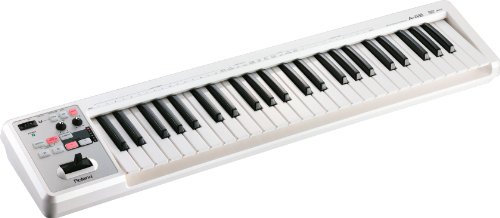
Roland A-49-WH 49-Key MIDI
Players who want a slim, bus-powered 49-key controller with proper full-size keys for playing parts rather than a pad and fader surface for mixing.
Read the Roland A-49-WH 49-Key MIDI review →Questions Buyers Ask
Roland A-49-BK 49-Key MIDI
See the current listing, price and included accessories.
About This Review
Mandrillis Team
The Mandrillis editorial team researches and compares audio and music gear using manufacturer documentation, verified specs and real buyer feedback, so you can make a confident purchase without wading through marketing claims.
Read our full research methodology.