Speakers Review
Edifier R2750DB MKII 3-Way Review: Powered Clarity in a Versatile Box
The Edifier R2750DB MKII 3-Way is a lower mid-range powered bookshelf speaker with a 3-way driver layout, 144 watts RMS, Bluetooth 6.0 with LDAC, HDMI eARC, and a subwoofer output. The listing omits frequency response, dimensions, and weight, but the feature set looks strong for TV, desktop, and music.
Our Verdict
Research Score 79/100The Edifier R2750DB MKII 3-Way is a lower mid-range powered bookshelf speaker with a three-way driver layout, 144 watts RMS, Bluetooth 6.0 with LDAC, HDMI eARC, optical, coaxial, line input, and a subwoofer output. It offers a strong feature set for TV, desktop, and music listening, plus app based EQ and a remote. The main caveat is missing published frequency response, sensitivity, dimensions, and weight, which makes real world planning harder. Buyers who need USB or Wi-Fi streaming should look elsewhere. For those who can work within those limits and do not mind a likely larger cabinet, this speaker is a strong value.
Editorial research score based on published specifications and documented features, not a customer rating or lab test.

Edifier
Edifier R2750DB MKII 3-Way
Best for: Listeners who want a powered 3-way bookshelf speaker with broad wired connectivity, Bluetooth LDAC, and a subwoofer output at a lower mid-range price.
Skip it if: People who need published frequency response specs, compact dimensions, or built-in Wi-Fi streaming and phono preamp.
Check Price on AmazonWe may earn a commission at no extra cost to you.
Listing verified: October 2026
Who Should Buy It
Buy it if
- Desktop and PC listeners who want a powered 3-way speaker
- TV and home theater users who need HDMI eARC and optical inputs
- Bluetooth listeners who want LDAC quality and multipoint
- Buyers planning to add a subwoofer via the dedicated sub out
Skip it if
- You need a speaker with published frequency response and size specs
- You want built-in Wi-Fi streaming or USB audio input
- You plan to connect a turntable without a separate phono preamp
Key Specifications
| Type | Powered 3-way bookshelf speaker / active studio monitor |
| Drivers | 7-inch woofer, 4.5-inch mid-range, 1-inch silk-dome tweeter, quad Class-D amplifiers |
| Power or sensitivity | 144W RMS total system power; sensitivity not published in listing |
| Frequency response | Not published in listing |
| Inputs and connectivity | HDMI eARC, optical, coaxial, line-in, subwoofer output |
| Bluetooth and streaming | Bluetooth 6.0 with LDAC, Hi-Res Audio Wireless, multi-point connection |
| Dimensions | Not published in listing |
| Weight | Not published in listing |
| Finish | Black |
| Included accessories | Remote control; other accessories not published in listing |
Overview
The Edifier R2750DB MKII 3-Way is a powered bookshelf speaker that the product listing positions as an active studio monitor for music, desktop use, TV, and home audio. The published specification includes a 7-inch woofer, a 4.5-inch mid-range driver, and a 1-inch silk-dome tweeter. Four Class-D amplifiers deliver a combined 144 watts RMS. This lower mid-range speaker also includes Bluetooth 6.0 with LDAC and Hi-Res Audio Wireless.
On paper, the R2750DB MKII 3-Way tries to cover a wide range of wired and wireless roles. It offers HDMI eARC, optical, coaxial, and line inputs, plus a subwoofer output. The listing describes a customizable sound experience through the EDIFIER ConneX app and a physical remote. However, the listing does not publish frequency response, sensitivity, dimensions, or weight, so some real world planning requires extra care.
Sound Quality
The three-way driver layout is the main sound quality story. A dedicated 4.5-inch mid-range driver sits between the 7-inch woofer and the 1-inch silk-dome tweeter. This arrangement, in principle, reduces the burden on each driver and can improve clarity in voices and instruments compared with a typical two-way bookshelf design. The listing claims balanced sound, accurate sound staging, and a smooth frequency response, although no frequency response numbers are published.
Hi-Res Audio certification and 24-bit/96kHz DSP processing are also part of the listing. LDAC Bluetooth support provides higher quality wireless playback than standard Bluetooth codecs. The quad Class-D amplifiers and active crossover should help keep distortion low and let each driver operate within a defined range. These are plausible engineering choices, but without in-person measurements, buyers should treat the listing claims as intended performance rather than verified results.
One practical advantage is the ability to shape the sound. The EDIFIER ConneX app includes four presets called Classic, Monitor, Dynamic, and Vocal, plus a 9-band EQ for custom settings. A physical remote also allows playback and sound effect control. This flexibility gives users a way to adjust the speaker to different rooms or content, even if the baseline tonal character remains unknown from the listing alone.
Drivers, Power and Room Fit
The published driver set includes a 7-inch woofer, a 4.5-inch mid-range driver, and a 1-inch silk-dome tweeter. The four built-in Class-D amplifiers provide a total of 144 watts RMS. This is a substantial power figure for a powered bookshelf speaker, and it suggests the R2750DB MKII 3-Way can fill small to medium rooms without an external amplifier. The listing does not publish sensitivity or maximum sound pressure level.
Room fit is harder to judge because the listing does not state dimensions or weight. A 7-inch woofer typically requires a cabinet large enough to support decent low frequency output, so buyers should plan for a speaker that may occupy meaningful desk or stand space. The subwoofer output is a useful room fit feature. Adding a subwoofer can reduce the need for the built-in woofer to play very deep bass, which can help in small rooms.
For nearfield desktop use, the three-way design may need extra distance between the listener and the drivers to integrate properly. A seated listening position a few feet away is usually better for a 7-inch woofer and separate midrange. The listing describes use in music production and entertainment, which suggests the speaker is meant to work at moderate listening distances. Without published dispersion or frequency response, placement will require some experimentation.
Features and Connectivity
The strongest feature set in the listing is wired connectivity. The R2750DB MKII 3-Way includes HDMI eARC, optical, coaxial, and line inputs. This makes it a candidate for a TV, projector, turntable with a phono preamp, laptop, or home stereo. None of these wired inputs require a separate amplifier because the speaker is active. The subwoofer output is another practical addition for bass expansion.
Wireless connectivity is centered on Bluetooth 6.0 with LDAC and multipoint support. LDAC is a higher bandwidth Bluetooth codec that can preserve more detail than older codecs. Multipoint allows two source devices to be paired at once, which is handy for switching between a phone and a laptop. The listing also mentions Hi-Res Audio Wireless certification. There is no USB audio input or Wi-Fi streaming, so users who want direct PC USB or network streaming will need a separate source.
- HDMI eARC for TV audio return
- Optical and coaxial digital inputs
- Line input for analog sources
- Bluetooth 6.0 with LDAC and multipoint
- Subwoofer output for external bass
- EDIFIER ConneX app and physical remote
Build, Design and Finish
The listing only states a black finish for the Edifier R2750DB MKII 3-Way. Cabinet material, grille type, and exact construction are not published. The silk-dome tweeter is a common driver material known for smooth high frequency reproduction, but nothing else about the enclosure or internal bracing is described. Buyers who value specific cabinet materials or finish options will need to look beyond the listing.
Because dimensions and weight are not published, the physical footprint remains unclear. The presence of a 7-inch woofer and a 4.5-inch mid-range generally points to a larger bookshelf cabinet, but the listing does not confirm exact size. The included remote control suggests a traditional home audio layout, while the app support adds a modern control layer. Overall, the design appears functional rather than showy, with black as the only noted color.
Setup and Placement
Setup should be straightforward for a powered speaker. Since amplification is built in, users only need to connect a source, such as an HDMI eARC TV, optical output, coaxial digital, or analog line signal, and then apply power. The HDMI eARC connection can allow TV volume control over the speaker in many setups. For Bluetooth, pairing requires selecting the speaker in the source device settings; multipoint allows two devices to stay connected.
Placement is an open question because the listing does not publish dimensions or weight. In general, a 7-inch woofer benefits from a stable surface and some distance from walls to avoid exaggerated bass. If using the subwoofer output, the main speakers can be placed for best stereo imaging while the subwoofer handles low frequencies. The active crossover and DSP may help with room integration, but the listing does not describe any room correction features.
Daily Use
Daily use should be convenient with the included remote and app. The remote can handle playback and sound effect control, while the EDIFIER ConneX app provides four presets and a 9-band EQ. Multipoint Bluetooth means two paired devices can take turns playing audio without repeated pairing rituals. For TV use, HDMI eARC can simplify volume and power sync, although the listing does not state whether the speaker supports automatic standby.
The lack of published frequency response and sensitivity does not affect everyday operation, but it makes system matching less certain. The subwoofer output gives an easy upgrade path for more bass. The active design removes the need for a receiver or integrated amplifier, which keeps daily use simple. Buyers should note that no USB input means a PC connection should use optical, coaxial, line, or Bluetooth rather than a direct USB cable.
Who Should Buy It
The Edifier R2750DB MKII 3-Way suits buyers who want a powered three-way bookshelf speaker with extensive wired inputs and LDAC Bluetooth without spending a huge amount. Desktop and PC listeners, TV viewers who want HDMI eARC, and music fans who plan to add a subwoofer are strong candidates. The lower mid-range price makes the feature set attractive, even though some specifications are missing.
It also fits people who prefer an active speaker with app based EQ and a physical remote. The three-way driver layout is a meaningful step up from many two-way powered bookshelf speakers at this price. If you do not need built-in Wi-Fi or USB audio, the R2750DB MKII 3-Way covers most modern sources through Bluetooth, HDMI, optical, coaxial, and line input.
Alternatives Worth Considering
If you need a smaller and simpler powered bookshelf speaker, a model like the Edifier R1280DB is often mentioned as a lower cost option, though it does not offer the same three-way driver layout, HDMI eARC, or LDAC. For a more conventional passive setup, the Klipsch R-51M or ELAC Debut 2.0 B5.2 are popular bookshelf choices, but they require a separate amplifier and do not include the same built-in connectivity.
Portable Bluetooth speakers such as the JBL Flip 6 or Bose SoundLink Flex are not direct alternatives because they prioritize battery power and compact size over wired inputs and a three-way design. Floorstanding speakers like the Polk Audio T50 serve a different room and bass style. If the main goal is deep bass for movies, a powered subwoofer such as the SVS SB-1000 Pro could pair with smaller speakers, but the R2750DB MKII 3-Way already includes a sub output for that path.
Verdict
The Edifier R2750DB MKII 3-Way is a feature rich powered bookshelf speaker on paper. Its three-way driver layout, 144 watts RMS, Bluetooth 6.0 with LDAC, HDMI eARC, and subwoofer output make it a versatile hub for TV, desktop, and music. The lower mid-range price adds value, but the listing leaves out frequency response, sensitivity, dimensions, and weight, which requires some trust.
For buyers who can accommodate a larger bookshelf cabinet and do not need USB or Wi-Fi, this speaker offers a strong combination of wired and wireless flexibility. The app EQ and remote add daily usability. Overall, it is a compelling option for those who prioritize input variety and active three-way design over fully published specifications.
Strengths and Limitations
Strengths
- 3-way design with dedicated midrange driver
- 144W RMS quad-amplified output
- Bluetooth 6.0 with LDAC and Hi-Res Audio Wireless
- HDMI eARC, optical, coaxial, and line-in inputs
- Subwoofer output for expandable bass
- App-based EQ and included remote
Limitations
- Listing does not publish frequency response
- Listing does not publish dimensions or weight
- No USB or Wi-Fi streaming input
- No built-in phono preamp for turntable use
- App EQ may require additional setup for custom tuning
How We Scored It
Scores reflect published specifications, documented features and value against the alternatives below. They are editorial research scores, not laboratory measurements.
Alternatives to Consider

Klipsch Reference Premiere RP-504C II
Home theater listeners who want a dedicated passive center channel with emphasis on clear dialogue.
Read the Klipsch Reference Premiere RP-504C II review →
Yamaha HS8
A powered studio subwoofer for mixing and monitoring setups that need low frequency extension down to 22 Hz with XLR connectivity and manual crossover control.
Read the Yamaha HS8 review →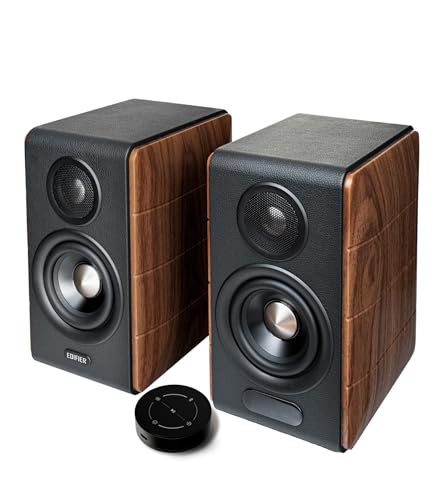
Edifier S880DB MKII
A compact desktop or small-room hi-fi setup that benefits from wireless LDAC Bluetooth and wired digital inputs.
Read the Edifier S880DB MKII review →Questions Buyers Ask
Edifier R2750DB MKII 3-Way
See the current listing, price and included accessories.
About This Review
Mandrillis Team
The Mandrillis editorial team researches and compares audio and music gear using manufacturer documentation, verified specs and real buyer feedback, so you can make a confident purchase without wading through marketing claims.
Read our full research methodology.