Speakers Review
JBL 1 104-BT Review: Compact Desktop Coaxial Monitor
The JBL 1 104-BT packs a coaxial 4.5-inch woofer and 0.75-inch tweeter into a compact desktop monitor with Bluetooth 5.0, balanced TRS, RCA, and aux inputs. Published specs suggest a smooth nearfield presentation, though low-end depth is limited and physical dimensions are not stated in the listing.
Our Verdict
Research Score 74/100The JBL 1 104-BT is a practical powered monitor for small desks and casual production work. Its coaxial design promises a wide sweet spot, and the front input selector plus headphone mute make it easy to switch between sources. The 60-watt Class D amp and ported ABS cabinet are appropriate for nearfield listening, but the 4.5-inch woofer cannot deliver deep bass, and the listing does not include dimensions or weight. For buyers who need Bluetooth, balanced inputs, and a compact footprint without spending in a higher tier, this pair is a sensible budget option. Those who prioritize bass extension or premium cabinets should look elsewhere. On paper, it is a focused desktop monitor rather than a room-filling speaker.
Editorial research score based on published specifications and documented features, not a customer rating or lab test.
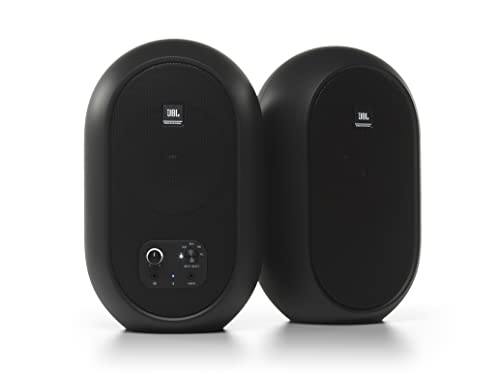
JBL
JBL 1 104-BT
Best for: Desktop producers, podcasters, and casual listeners who want compact powered monitors with Bluetooth and multiple wired inputs.
Skip it if: You need deep sub-bass, high continuous output, or detailed physical measurements before buying.
Check Price on AmazonWe may earn a commission at no extra cost to you.
Listing verified: October 2026
Who Should Buy It
Buy it if
- Desktop music producers needing nearfield reference monitors in a small footprint
- Listeners who want Bluetooth convenience with balanced and unbalanced wired options
- Podcasters or video editors wanting a front headphone jack with speaker mute
- Anyone who prefers a sold-as-pair powered monitor system with included cables
Skip it if
- You need sub-bass below 60 Hz for bass-heavy genres
- You require published dimensions and weight for precise desk planning
- You want a cabinet with wood or premium metal construction rather than molded ABS
Key Specifications
| Type | Powered compact desktop reference monitors, sold as a pair |
| Drivers | Coaxial 4.5-inch (118 mm) woofer and 0.75-inch (19 mm) soft-dome tweeter |
| Power or sensitivity | 60-watt Class D amplifier total, 30 watts per speaker; sensitivity 87 dB SPL @ 1 m with -10 dBV aux in at max volume |
| Frequency response | 88 Hz to 20 kHz (-3 dB), 60 Hz to 20 kHz (-10 dB) |
| Inputs and connectivity | Bluetooth 5.0, 1/8-inch aux, RCA, 1/4-inch TRS balanced; front input selector with combine all; headphone out with auto speaker mute |
| Bluetooth and streaming | Bluetooth 5.0 streaming |
| Dimensions | Not published in listing |
| Weight | Not published in listing |
| Finish | Black molded ABS cabinet |
| Included accessories | Extension monitor speaker wire (2 meters), 3.5 mm to RCA audio cable, regional power cable, quick setup guide |
Overview
The JBL 1 104-BT is a compact powered desktop monitor sold as a pair, positioned in the budget tier for nearfield listening and light production work. JBL describes a proprietary coaxial driver that combines a 4.5-inch woofer and a 0.75-inch soft-dome tweeter in a molded ABS cabinet. The listing positions the system for desktop placement, with Bluetooth 5.0 and multiple wired inputs. A 60-watt Class D amplifier provides 30 watts to each speaker.
Published specifications cover frequency response, sensitivity, and SPL figures, but the listing omits physical dimensions and weight. That absence makes precise desk planning harder, though the speaker is clearly intended for compact desks. The front panel includes input selection, volume, and a headphone jack that mutes the speakers. On paper, this is a flexible desktop monitor for small rooms and mixed-use setups.
Sound Quality
On paper, the JBL 1 104-BT emphasizes midrange and treble clarity through its coaxial arrangement. The published frequency range is 88 Hz to 20 kHz at -3 dB and 60 Hz to 20 kHz at -10 dB, which means the speaker will not reproduce deep sub-bass with authority. The 0.75-inch soft-dome tweeter is designed for a wide sweet spot, and the stated 120 by 60 degree coverage suggests a broad horizontal listening window. For nearfield use, that should translate to consistent tonal balance when the listener moves slightly off axis.
The system sensitivity is listed at 87 dB SPL at 1 meter with a -10 dBV aux input at maximum volume, which is adequate for close-range playback. Maximum continuous SPL is 89 dB, with a system peak of 102 dB and a momentary peak of 104 dB. Those figures are modest and confirm the speaker is meant for desktop monitoring rather than filling a large room. The ported cabinet tunes at 72 Hz, reinforcing upper bass but not extending low-end response dramatically.
Distortion criteria are published as less than 0.2 percent THD at 1 kHz with 2.83 Vrms output, which is a useful reference for clean midrange performance. The first-order crossover at 1725 Hz places the handoff between woofer and tweeter in a critical region, but JBL's coaxial design should reduce lobing compared to separate drivers. Buyers should treat these figures as design targets, not as a guarantee of measured performance in every room.
Drivers, Power and Room Fit
The driver complement is a single coaxial unit per cabinet, pairing a 4.5-inch woofer with a 0.75-inch soft-dome tweeter. The woofer's 118 mm diameter is small for low-frequency output, so the speaker will rely on the port and desktop boundary to reinforce bass. The tweeter's soft dome material typically offers smoother high-frequency behavior than rigid metal domes, which can help reduce listening fatigue during long sessions.
Power comes from an integrated 60-watt Class D amplifier, split as 30 watts per speaker. That is sufficient for nearfield monitoring at moderate levels, but the 89 dB maximum continuous SPL indicates limited headroom for louder playback. The ported enclosure has a tuning frequency of 72 Hz, which suggests a mild bump in the upper bass around that region. In a small room or on a desk, that tuning can provide a sense of body without excessive boom.
Room fit is best described as desktop or small studio use. The listing does not include physical dimensions or weight, so buyers cannot calculate exact footprint or shelf clearance from the published data. The compact design and front port location, if the contoured port is front-facing, would make placement against a wall less problematic. However, the listing does not explicitly specify port orientation, so that detail remains unconfirmed.
Features and Connectivity
Connectivity is a strong point for this compact monitor. The system includes Bluetooth 5.0 streaming, a 3.5 mm aux input, stereo RCA inputs, and a pair of 1/4-inch TRS balanced inputs. The front panel input selector can choose Bluetooth, Aux, RCA, TRS, or combine all inputs, which is unusual for budget monitors and useful for users who want to keep multiple sources connected.
A front-panel volume control and headphone jack with automatic speaker mute add daily convenience. The headphone output is 1/8-inch stereo, making it compatible with common wired headphones. The master monitor houses the electronics for the extension monitor, reducing cable clutter because only a two-conductor speaker wire runs to the passive second speaker. Included cables cover the basic setup needs.
- Bluetooth 5.0 streaming with input selector
- 3.5 mm aux, stereo RCA, and balanced 1/4-inch TRS inputs
- Front headphone jack with auto speaker mute
- Master monitor houses electronics for a cleaner desk
- Included 2-meter extension speaker wire and 3.5 mm to RCA cable
Build, Design and Finish
The cabinets are molded from ABS plastic, a common choice for budget powered monitors because it keeps weight and cost down. The black finish described in the listing is neutral and should fit most desktop setups. JBL calls the design compact and desktop-oriented, but the listing does not provide exact dimensions or weight, so the physical footprint remains unverified.
The coaxial driver is mounted in a single opening, which reduces the front baffle size compared to separate woofer and tweeter layouts. The contoured low-frequency port is mentioned as part of the cabinet design, but the listing does not specify whether it is front or rear facing. Build quality on paper appears straightforward, with no premium materials like wood veneer or metal baffles. Given the budget tier, the ABS cabinet is expected and acceptable for the price.
The included accessories extend the value: a two-meter extension speaker wire connects the master to the passive monitor, a 3.5 mm to RCA cable covers common consumer sources, and a regional power cable is provided. A quick setup guide rounds out the package. Buyers who want a heavier, furniture-grade cabinet should look at higher-priced monitors, because the ABS construction is functional rather than luxurious.
Setup and Placement
Setup is straightforward for a powered monitor pair. The master speaker contains the amplifier and inputs, so the user connects sources to one cabinet and runs the included speaker wire to the extension monitor. The front-panel input selector and volume control keep adjustments within easy reach, which is convenient for a desk.
The listing states the speaker is acoustically optimized for desktop placement, which suggests the designer accounted for boundary gain from a desk surface. Since the dimensions are not published, users should measure their intended space before buying. The ported design benefits from a little breathing room behind or below the cabinet, depending on port location, but the listing does not specify the port orientation.
Placing the monitors at ear height and forming an equilateral triangle with the listening position is standard practice for nearfield use. The stated horizontal coverage of 120 degrees supports a reasonably wide listening position, so the sweet spot should not collapse with small head movements. No isolation pads or angle adjustment features are mentioned, so users may need aftermarket foam wedges to aim the drivers upward.
Daily Use
In daily use, the JBL 1 104-BT should behave like a flexible desktop hub. The ability to combine all inputs means a computer, a phone, and a Bluetooth stream can stay connected without swapping cables. The front headphone jack with speaker mute is a practical feature for late-night listening or quick checks without disturbing others.
The 60-watt amplifier will deliver enough level for nearfield monitoring, but the modest 89 dB continuous SPL means the speaker is not suited to loud party playback or filling a living room. The coaxial driver's wide coverage should make the sound consistent across a desk, and the soft-dome tweeter is likely to be forgiving of less-than-ideal positioning. The ported cabinet may add some upper bass warmth, but deep bass notes will be subdued.
The front-panel controls reduce the need to reach behind the cabinet, which is a real convenience on a crowded desk. The included 3.5 mm to RCA cable covers many sources, and Bluetooth 5.0 provides wireless streaming with stable connectivity. Users who prioritize instant source switching and headphone monitoring will find the layout efficient. The lack of published dimensions is a minor inconvenience, but the pair appears small enough for most desks.
Who Should Buy It
The JBL 1 104-BT suits desktop producers, podcasters, and video editors who need a compact powered monitor with balanced inputs and a front headphone output. The coaxial driver promises a wide sweet spot, which is beneficial when the listener moves around a desk. Bluetooth 5.0 adds convenience for casual listening without turning on a computer.
It is also a sensible choice for buyers who want a complete pair with cables included, rather than assembling a system from separate components. The input selector that can combine all sources is rare in the budget tier and useful for multi-device setups. Students or home office workers who want better sound than built-in laptop speakers will appreciate the compact footprint. Those who need accurate low-end monitoring will need to add a subwoofer, but this monitor is not designed for that task.
Alternatives Worth Considering
For buyers who want a comparison, the Edifier R1280DB is a popular powered bookshelf pair in a similar budget tier, with a wood-look cabinet and remote control. It tends to appeal to casual listeners, while the JBL focuses more on desktop monitoring with balanced TRS inputs. The Klipsch R-51M is a passive bookshelf speaker that would require a separate amplifier, so it is less convenient for a simple desktop setup.
The ELAC Debut 2.0 B5.2 is a well-regarded passive bookshelf speaker with a larger woofer and more extended bass on paper, but it also needs an external amp and lacks Bluetooth built in. For portable use, the JBL Flip 6 and Bose SoundLink Flex are not direct competitors because they are battery-powered and mono, but they offer rugged Bluetooth convenience. The JBL 104-BT sits between those worlds: a desktop monitor with Bluetooth, not a portable speaker.
Buyers who want deeper bass from a powered monitor could consider stepping up to a larger woofer or adding a compact subwoofer, though that increases cost and complexity. The Polk Audio T50 is a floorstanding passive speaker, so it occupies a different category entirely and is not a nearfield monitor. The SVS SB-1000 Pro is a powered subwoofer that could complement the JBL pair in a small studio, but it is a premium addition. None of these alternatives offer the exact same combination of coaxial driver, Bluetooth, and balanced inputs in a single compact pair.
Verdict
The JBL 1 104-BT is a focused budget monitor that prioritizes desktop ergonomics and input flexibility. Its coaxial driver and front controls differentiate it from many generic powered speakers in the same price band. The published specifications show a speaker that is honest about its limits: modest bass and limited maximum output, but clean midrange and useful connectivity.
The absence of dimensions and weight in the listing is a notable omission for a product sold online, and the ABS cabinet will not appeal to buyers seeking a premium feel. Still, the included cables and extension speaker wire make the pair ready to use out of the box. The ability to mix Bluetooth with aux, RCA, and balanced TRS inputs is practical for a modern desk.
Overall, this is a sensible choice for nearfield monitoring, podcasting, and casual listening where space is limited. Buyers who need deep bass or high output should look at larger monitors or add a subwoofer. As a compact desktop solution with a coaxial design, the JBL 1 104-BT delivers a well-rounded feature set for the budget tier.
Strengths and Limitations
Strengths
- Coaxial driver with 4.5-inch woofer and soft-dome tweeter
- Bluetooth 5.0 plus aux, RCA, and balanced TRS inputs
- Front-panel input select and headphone output with speaker mute
- Compact ABS cabinet with contoured port for desktop use
- Includes speaker wire and 3.5 mm to RCA cable
Limitations
- Dimensions and weight not published in listing
- Modest low-frequency extension for a 4.5-inch woofer
- No published tone controls or room correction
- Limited maximum continuous SPL of 89 dB
- Plastic cabinet may not satisfy buyers wanting heavier build
How We Scored It
Scores reflect published specifications, documented features and value against the alternatives below. They are editorial research scores, not laboratory measurements.
Alternatives to Consider

Audioengine S6 Mini
Small to medium rooms and desktop setups that need compact powered bass reinforcement without taking up much floor space.
Read the Audioengine S6 Mini review →
Audioengine A2 AIO
Listeners who want a simple white Bluetooth speaker pair for a desk or small room and do not need detailed published specifications.
Read the Audioengine A2 AIO review →
JBL 6
Buyers who want a rugged portable Bluetooth speaker with long battery life, USB-C lossless audio and multi-speaker support.
Read the JBL 6 review →Questions Buyers Ask
JBL 1 104-BT
See the current listing, price and included accessories.
About This Review
Mandrillis Team
The Mandrillis editorial team researches and compares audio and music gear using manufacturer documentation, verified specs and real buyer feedback, so you can make a confident purchase without wading through marketing claims.
Read our full research methodology.