Studio Gear Review
ADAM Audio A4V Review: DSP Room Tuning in a Compact Monitor
The ADAM Audio A4V pairs an HPS waveguide and a mineral stone fiber woofer with hybrid Class D and Class AB amplification and a four band DSP room adaptation system. This research review explains what the listing publishes, what it leaves out, and who the compact white monitor really suits.
Our Verdict
Research Score 82/100The ADAM Audio A4V is a mid-range compact nearfield that competes on refinement rather than price. Its four band DSP room adaptation, with Bass, Desk, Presence and Treble bands and more than 100 combinations, is the most useful tuning system in its class and directly targets the problems of small home studios. The HPS waveguide and hybrid amplification promise smooth, fatigue free treble and a wide, stable sweet spot. The listing does not publish woofer size, power, frequency response, inputs, dimensions or weight, so buyers should confirm those details with the manufacturer. For a producer who has outgrown entry monitors and works in an imperfect room, it is a strong choice. First time buyers on a budget should look at the alternatives.
Editorial research score based on published specifications and documented features, not a customer rating or lab test.
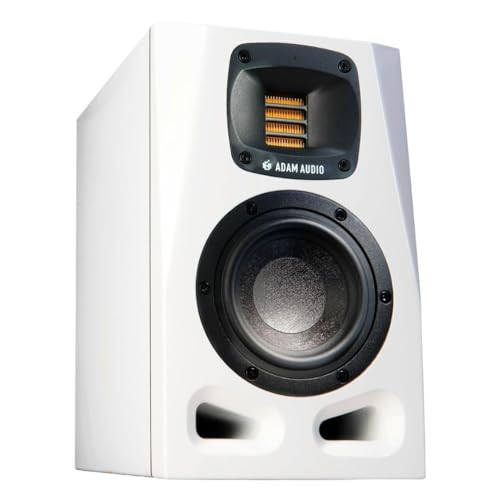
ADAM Audio
ADAM Audio A4V
Best for: Producers in small or untreated rooms who want ADAM Audio detail with genuine room tuning in a compact white cabinet.
Skip it if: You need full published specifications before buying or you are shopping at an entry tier budget.
Check Price on AmazonWe may earn a commission at no extra cost to you.
Listing verified: October 2026
Who Should Buy It
Buy it if
- Home studio owners fighting desk and wall reflections
- Engineers stepping up from a budget pair
- Content creators who want a white monitor that fits a visible setup
- Anyone who values a smooth tweeter for long sessions
Skip it if
- You are buying your first monitors on a tight budget
- You produce bass heavy music in a mid sized room without a subwoofer
- You want every spec confirmed on the listing page
Key Specifications
| Type | Active nearfield studio monitor from the A Series, white finish, DSP-based electronics |
| Woofer | Mineral stone fiber composite cone, diameter not published in listing |
| Tweeter | Waveguide-loaded tweeter with HPS high-frequency propagation system, Class AB driven, size and type not published in listing |
| Power | Class D amplification for the woofer and Class AB for the tweeter, wattage not published in listing |
| Frequency response | Not published in listing |
| Inputs | Not published in listing |
| Room controls | Four bands of room adaptation EQ (Bass, Desk, Presence, Treble) in predefined steps, more than 100 tuning combinations |
| Dimensions | Not published in listing |
| Weight | Not published in listing |
| Included accessories | Not published in listing |
Overview
The ADAM Audio A4V is the compact member of the company's A Series, sold here in a white finish and positioned as a nearfield monitor for small control rooms and desktop production spaces. It sits in the mid-range tier, above entry monitors from Yamaha, KRK and PreSonus, and below the larger A Series cabinets. The listing leans on technology rather than raw numbers, which shapes how this review has to be read.
Three ideas define the A4V on paper. The HPS waveguide controls how the tweeter disperses sound, the woofer uses a baked mineral stone fiber cone, and a DSP engine replaces the analog tone switches found on most monitors in this class. Each of those is a meaningful design choice, and each is explained in more detail in the sections that follow.
What the listing does not do is publish a woofer diameter, an amplifier wattage, a frequency response range or an input list. Those gaps do not mean the product lacks them, only that a buyer cannot confirm them from this page. Where a specification is missing it is marked as not published, and the score reflects that uncertainty alongside the brand's strong reputation.
Accuracy and Sound Signature
ADAM Audio built its name on ribbon style tweeters that resolve fine detail without harshness, and the A Series continues that approach with a tweeter driven by a Class AB amplifier. The listing describes that pairing as delivering a smooth, natural reproduction of high frequencies. In practical terms that usually means long sessions with less ear fatigue, which is one of the main reasons engineers step up from budget monitors.
The HPS waveguide is the other half of the treble story. According to the published description, it disperses sound broadly on the horizontal axis while keeping the vertical plane tightly focused. The intended result is a wide sweet spot side to side, so two people at a desk hear a similar balance, with less energy bouncing off the desk surface and the ceiling to blur the image.
Low frequency accuracy comes from the stone fiber woofer, which the listing credits with high output and low distortion for a clean low end. No frequency response figure is provided, so the depth of that low end cannot be stated here. What can be said is that a monitor in this size class is a nearfield tool, and buyers producing bass heavy genres usually plan for a subwoofer regardless of brand.
Drivers, Amplification and Power
The woofer cone is made from mineral stone fibers that are baked together into a material described as lightweight but highly stable. A stiff, light cone is the classic recipe for fast transient response and low distortion at higher volume, since the cone flexes less under load. The listing does not give the woofer's diameter, and the model name is the only hint of its size class.
Amplification is a hybrid design. Class D amplifiers drive the woofers for linear performance with reduced distortion and efficient power delivery, while Class AB amplifiers handle the tweeters, and in the larger A Series models the midrange drivers as well. This is a common high end approach because Class D excels at moving a woofer efficiently and Class AB is prized for smooth high frequency behavior.
Wattage, peak SPL and the crossover frequency are not published in this listing. That is a real omission for a monitor in the mid-range tier, where buyers generally expect those numbers up front. Anyone comparing the A4V against a Kali Audio LP-6 or an Adam Audio T5V on output capability will need to find the figures in the manufacturer's documentation rather than on this page.
Room Fit, Placement and Controls
The headline feature of the A4V is its DSP-based room adaptation. Instead of two or three switches, the listing describes four bands of equalization named Bass, Desk, Presence and Treble, each adjustable in predefined steps. Combined, those bands offer more than 100 tuning options to compensate for the acoustic problems that come from speaker placement.
That matters most in the rooms where a compact nearfield actually lives. A desk placement adds a reflection that thickens the lower midrange, a position near a rear wall boosts bass, and a bright room with hard surfaces can make treble feel forward. Having a dedicated band for each of those problems is more useful than a single generic shelf.
The listing does not say whether the adjustments are made on the rear panel, through software, or both, and it does not mention automatic room measurement. Buyers who want a fully automated calibration should confirm what is included before purchase. Even as a manual system, 100 plus combinations is far more flexibility than the switch based controls on a Yamaha HS5 or a JBL 305P MkII.
- Bass band for placement near walls and corners
- Desk band to tame the reflection from a work surface
- Presence band to adjust upper midrange forwardness
- Treble band for bright or dead rooms
- Predefined steps rather than continuous knobs
- More than 100 combinations in total
Build, Design and Finish
This version of the A4V comes in white, which is a less common choice among studio monitors and suits modern desks, content creation spaces and home studios that double as living areas. Cabinet material, port design and dimensions are not described on the page. Weight is also unpublished, so stand and shelf planning requires a check with the manufacturer.
What is described is the engineering inside the box: the waveguide, the stone fiber cone and the hybrid amplifier pack. ADAM Audio's A Series is the company's professional line rather than its entry T Series, and the construction choices reflect that positioning. A buyer in this tier is paying for driver technology and DSP rather than for cosmetic extras.
The absence of published build details is the main reason this review cannot rate the cabinet more highly. A compact monitor that is tuned by DSP depends on a rigid, well braced enclosure to make that tuning meaningful, and that is almost certainly the intent here. It simply is not documented on the page a buyer will see.
Connectivity and Inputs
No input list is published for the A4V. Balanced XLR and TRS inputs are standard on monitors in this price tier, and professional lines like this one typically include at least one balanced connection, but that cannot be confirmed from the data provided. Treat the inputs as not published until verified.
The DSP architecture raises a second question the page leaves open: whether there is a digital input or a network control connection. Some DSP monitors accept a digital feed or allow remote adjustment from a computer, and some do not. For a buyer with an interface that outputs balanced analog only, this will not change the decision, but owners of digital monitor controllers should check.
Compared with an entry monitor such as the PreSonus Eris 3.5, which advertises its full input set up front, the A4V listing asks the buyer to do more homework. The connectivity score is held back for that reason rather than for any known shortfall.
Setup and Daily Use
Day to day, a DSP tuned nearfield like the A4V rewards a careful first hour. The sensible order is to place the monitors in an equilateral triangle with the listening position, tweeters at ear height, then work through the Bass, Desk, Presence and Treble bands one at a time with familiar reference tracks. Changing one band at a time makes it clear what each step is doing.
Because the adjustments are in predefined steps rather than continuous sweeps, settings are repeatable, and that is helpful when the monitors move between rooms or when a second user wants to restore a known state. Nothing on the page mentions a power saving mode, a standby function or front panel controls, so those remain open questions.
For long mixing or editing days, the Class AB driven tweeter and the controlled dispersion of the waveguide are the two features most likely to be noticed. A monitor that keeps treble smooth and the stereo image stable as the listener shifts in the chair is simply easier to live with than one that demands a fixed head position.
Who Should Buy It
The A4V fits producers and engineers who work in a small or untreated room and want tuning tools that go beyond a bass cut switch. It also suits anyone who has outgrown a budget pair and wants the detail of an ADAM Audio tweeter in a compact cabinet. The white finish adds appeal for shared spaces and camera facing setups.
It is a less obvious choice for a first time buyer on a tight budget, where a Yamaha HS5 or a Kali Audio LP-6 provides a well documented path for less money. It is also not the right pick for someone who needs full published specifications before committing, since this listing leaves several blanks.
Buyers producing bass heavy music in a mid sized room should plan on a larger A Series model or a subwoofer. A compact monitor can be accurate without being full range, and the A4V is clearly built for close listening at a desk rather than for filling a room.
Alternatives Worth Considering
Within the same brand, the Adam Audio T5V is the obvious comparison. It offers the company's ribbon style tweeter and waveguide at a lower tier price, but it uses conventional shelf switches instead of the four band DSP system described for the A4V. Buyers who do not need fine room tuning may find the T Series enough.
The Kali Audio LP-6 is a strong value alternative with a larger woofer and well regarded boundary compensation switches, aimed at similar small room problems. The JBL 305P MkII is another waveguide focused design at an entry price. Neither offers a DSP engine with 100 plus tuning combinations.
For a buyer who simply wants a proven, flat reference without extra features, the Yamaha HS5 remains the safe default and is widely understood by mix engineers. The A4V competes with it on refinement and flexibility rather than on price, and the choice comes down to whether room adaptation is worth the step up in tier.
Verdict
The ADAM Audio A4V is a thoughtfully engineered compact monitor whose most distinctive feature, four band DSP room adaptation, addresses the exact problems small studio owners face. The waveguide, stone fiber woofer and hybrid amplification are all credible, well explained design choices in the listing.
The weakness is documentation. Woofer size, wattage, frequency response, inputs, dimensions and weight are all unpublished here, and the score reflects that gap rather than any known flaw. Buyers should verify those figures from the manufacturer before ordering.
For a mid-range nearfield with professional lineage and real room tuning, the A4V is an easy recommendation for the right room. For a budget first pair, the alternatives above remain the better starting point.
Strengths and Limitations
Strengths
- Four band DSP room adaptation with more than 100 combinations
- HPS waveguide for controlled horizontal dispersion and a wide sweet spot
- Mineral stone fiber woofer designed for high output with low distortion
- Hybrid Class D and Class AB amplification
- White finish suits modern desks and camera facing spaces
Limitations
- Woofer size, wattage and frequency response are not published in the listing
- No input list or connector details on the page
- Dimensions and weight are unpublished
- Mid-range tier price against well documented entry rivals
How We Scored It
Scores reflect published specifications, documented features and value against the alternatives below. They are editorial research scores, not laboratory measurements.
Alternatives to Consider

JBL EON715 1300-watt 15-inch
Mobile DJs, bands and event hosts who want a single 15 inch powered speaker with a built in mixer, Bluetooth streaming and app control.
Read the JBL EON715 1300-watt 15-inch review →
Focal Alpha 80
Producers and engineers in a medium room who want a high output 8 inch monitor with a deep floor, three inputs and room shelving, bought one cabinet at a time.
Read the Focal Alpha 80 review →
ADAM Audio T7V 7-Inch
Home studio producers and mix engineers who want a ribbon tweeter pair with real low end reach and cables in the box, ready to wire to an interface.
Read the ADAM Audio T7V 7-Inch review →Questions Buyers Ask
ADAM Audio A4V
See the current listing, price and included accessories.
About This Review
Mandrillis Team
The Mandrillis editorial team researches and compares audio and music gear using manufacturer documentation, verified specs and real buyer feedback, so you can make a confident purchase without wading through marketing claims.
Read our full research methodology.