Studio Gear Review
Behringer NEKKST K8 Active Studio Monitor Review: Budget Bi Amped 8 Inch Speaker
The Behringer NEKKST K8 Active Studio Monitor offers an 8 inch woofer, bi amped amplification, and waveguide technology at a budget price. The listing leaves out key specifications like power, frequency response, inputs, and room controls, so buyers must rely on brand reputation and feature claims rather than measured performance.
Our Verdict
Research Score 58/100The Behringer NEKKST K8 Active Studio Monitor presents an interesting budget option for those seeking a large driver and bi amped design. The listing highlights an 8 inch woofer, advanced waveguide, and durable build, but omits critical data such as power output, frequency response, tweeter type, input connectors, and room controls. On paper, the bi amping and waveguide could improve clarity and dispersion, but without measurements or in-person testing, it is impossible to confirm how accurate or flat this monitor really is. For casual listening, multimedia, or a first studio setup where exact specifications are not essential, the K8 may be acceptable. However, for mixing and mastering where a known response curve and adjustability are vital, the missing information makes this a risky choice. Overall, we assign a score of 58 out of 100, reflecting the budget price and large driver but acknowledging significant specification gaps.
Editorial research score based on published specifications and documented features, not a customer rating or lab test.

Behringer
Behringer NEKKST K8 Active Studio Monitor
Best for: Budget conscious home studio users who want a larger 8 inch powered monitor for casual mixing and playback and can accept missing technical data.
Skip it if: You need published frequency response, room controls, or clear input and power specifications before buying a studio monitor.
Check Price on AmazonWe may earn a commission at no extra cost to you.
Listing verified: October 2026
Who Should Buy It
Buy it if
- Beginner home studio owners wanting an 8 inch driver on a budget
- Multimedia producers and video editors needing general monitoring
- Buyers who trust Behringer entry level products
- Users who already have external EQ or room correction
Skip it if
- Critical mix engineers requiring flat response data
- Users needing specific input types like XLR or TRS
- Buyers who want room correction switches for placement
Key Specifications
| Type | Active studio monitor speaker |
| Woofer | 8 inch (from listing) |
| Tweeter | Not published in listing |
| Power | Bi amped, wattage not published in listing |
| Frequency response | Not published in listing |
| Inputs | Not published in listing |
| Room controls | Not published in listing |
| Dimensions | Not published in listing |
| Weight | Not published in listing |
| Included accessories | Not published in listing |
Overview
The Behringer NEKKST K8 Active Studio Monitor is a powered speaker aimed at home studio owners, multimedia producers, and budget conscious buyers. The listing describes an 8 inch woofer, a bi amped amplifier, and advanced waveguide technology in a black enclosure. Behringer positions this model as a professional speaker system for clear and accurate sound during studio monitoring, mixing, and other audio tasks.
The product listing provides a handful of marketing bullets but lacks many technical details that serious buyers often need. There is no published frequency response, no tweeter specification, no power output, and no information about inputs or room controls. This makes it difficult to evaluate the monitor's true performance on paper, especially against competitors that document these values.
As a budget tier product, the NEKKST K8 aims to deliver a larger driver and bi amping at an accessible price. However, the missing data means potential buyers must decide whether to trust Behringer's reputation and the feature claims, or look for alternatives with more transparent specifications.
Accuracy and Sound Signature
The listing does not publish a frequency response curve or any acoustic measurement, so we cannot comment on the monitor's actual accuracy or tonal balance. The marketing text claims clear and accurate sound with low distortion, attributing this to the bi amped amplifier and advanced waveguide. On paper, bi amping separates the high and low frequency signals before amplification, which can reduce intermodulation distortion and improve clarity compared to a single full range amplifier.
The advanced waveguide technology is mentioned in the title but not explained in detail. In general, a waveguide around the tweeter helps control high frequency dispersion, potentially creating a wider sweet spot and more consistent off axis response. Without knowing the tweeter size, material, or crossover frequency, it is impossible to predict how the speaker will sound in a real room.
Buyers who have used entry level Behringer monitors often report a moderately balanced sound with a slight emphasis on lows due to the larger woofer, but this is anecdotal and not based on the listing. For critical mixing, the absence of a published response curve leaves too much uncertainty. The monitor may work fine for casual listening or basic playback where a flat response is not mandatory.
Drivers, Amplification and Power
The listing confirms an 8 inch woofer, which is larger than the 5 inch drivers found on many budget monitors like the Yamaha HS5 or JBL 305P MkII. An 8 inch driver can move more air and typically produces more low frequency output, making it appealing for those who want stronger bass without adding a subwoofer. However, the listing does not specify the woofer material, voice coil diameter, or magnet type, so we cannot assess its quality or power handling.
The tweeter is not described at all. The title includes the phrase advanced waveguide technology, which implies a tweeter mounted inside a waveguide, but no size, type, or material is given. Common budget monitors use a 1 inch silk dome tweeter, but we cannot assume that here. The lack of tweeter details is a significant gap because the high frequency driver greatly affects overall clarity and detail.
The amplifier is described as bi amped, meaning there are separate amplifier channels for the woofer and tweeter. This design can improve headroom and reduce distortion, but the listing does not publish the wattage for either channel. Without power ratings, buyers cannot calculate maximum SPL or determine if the monitor will be loud enough for their room size. The marketing bullet mentions high quality transducers and built in amplifier, but without numbers this is just a claim.
Build, Design and Finish
The listing emphasizes a durable design and rugged enclosure, suggesting that the cabinet can withstand daily studio use and long listening sessions. However, the specific materials are not published. Budget monitors often use vinyl wrapped medium density fiberboard, but we cannot confirm whether the NEKKST K8 follows that approach. The black finish is mentioned in the title, and the speaker appears to have a straightforward box design with the woofer and tweeter on the front baffle.
No dimensions or weight are provided, so we cannot evaluate how large or heavy the monitor is. An 8 inch studio monitor typically weighs between 15 and 25 pounds, but that is an estimate and not based on this listing. The rugged enclosure claim is encouraging for buyers who may move the speakers between rooms or use them frequently, but without actual specs, build quality is hard to verify.
The overall design appears functional rather than stylish. The front facing drivers and waveguide suggest a typical nearfield monitor layout. There is no mention of front or rear ports, so bass reflex tuning and port placement are unknown. For a budget speaker, the finish will likely be simple black vinyl or paint, which is acceptable for a studio environment.
Connectivity and Inputs
The listing does not specify any input connectors on the Behringer NEKKST K8. Most active studio monitors offer at least one balanced input, often XLR or TRS, and sometimes an unbalanced RCA. Without this information, buyers cannot know if they need adapter cables or if the monitor will connect directly to their audio interface, mixer, or computer.
The absence of connectivity details is a major drawback. A buyer with a professional audio interface that outputs balanced TRS may find that the monitor only has RCA inputs, which could introduce noise or require a separate conversion box. Conversely, if the monitor has only XLR inputs, a consumer device with a headphone jack would need an adapter.
Potential buyers should contact the seller or manufacturer to confirm the input types before purchasing. The listing's marketing language focuses on the speaker's performance and durability, but omits the practical connection information that is essential for daily use.
Setup and Daily Use
Setting up the Behringer NEKKST K8 would involve placing the monitors on stands or a desk, connecting audio cables, and adjusting the volume. However, the listing does not mention a volume control on the rear panel, though most active monitors have one. Without that confirmation, users may need to control volume entirely from their audio interface or source device.
For daily use, the 8 inch driver may provide satisfying low end for casual listening, video editing, or gaming. The rugged enclosure suggests durability, but the lack of power rating means users cannot know how loud the speaker can play without distortion. In a small room, even a modestly powered 8 inch monitor can be sufficient, but in a larger space it may struggle.
The advanced waveguide could make the sweet spot wider, reducing the need for precise toe in. However, without room control switches, users cannot compensate for placement near walls or corners, which often causes bass buildup. Those with external EQ or room correction software may be able to mitigate this, but it is an added step.
Who Should Buy It
The Behringer NEKKST K8 Active Studio Monitor is best suited for budget conscious home studio owners who want an 8 inch driver for more low end without spending a lot. It may also work for multimedia producers, video editors, and casual listeners who need a powered speaker for general playback rather than critical mixing.
Buyers who already own a measurement microphone and use room correction software might be able to compensate for the lack of built in controls and unknown frequency response. Those who trust Behringer's entry level reputation and are willing to accept missing specifications may find this monitor a reasonable gamble.
This monitor is not a good choice for mix engineers who need to make precise EQ decisions based on a known flat response. It also may not suit buyers who require specific input types or room correction switches. For those users, spending a bit more on a monitor with published specs and controls is likely a better long term investment.
Alternatives Worth Considering
For buyers who need published specifications and room controls, several well known entry level monitors offer more transparency. The Yamaha HS5 is a 5 inch monitor known for its flat response and clear midrange, though it costs more and has less bass. The JBL 305P MkII includes a waveguide and published frequency response, and the KRK Rokit 5 G5 adds built in EQ and an app for room correction, but both are smaller drivers.
Those who want an 8 inch monitor with documented performance might look at the Kali Audio LP 6 or LP 8, which provide detailed measurements and have a reputation for accuracy. The Adam Audio T5V is a 5 inch ribbon tweeter monitor with published data and a slightly higher price. These alternatives are not as cheap as the NEKKST K8, but they give buyers confidence in what they are getting.
The NEKKST K8's main appeal is the combination of an 8 inch woofer and bi amping at a budget price. However, the complete lack of technical data makes it hard to compare directly with these alternatives. If budget is the top priority and the buyer is willing to accept unknowns, this Behringer model might be worth a look, but more informed buyers will likely choose a monitor with full specifications.
Verdict
The Behringer NEKKST K8 Active Studio Monitor presents an attractive package on paper: an 8 inch woofer, bi amped amplifier, and waveguide technology at a budget price. However, the listing leaves out critical specifications that would normally guide a purchase decision, including power output, frequency response, tweeter details, input types, and room controls.
Without those numbers, we cannot recommend this monitor for critical mixing or mastering. It may serve well as a casual listening speaker or a first monitor for a hobbyist who simply wants a larger driver and more bass than typical 5 inch budget monitors. The durable build claim offers some reassurance for daily use, but it is not a substitute for measurable performance.
Our score of 58 out of 100 reflects the budget price and the 8 inch driver, but heavily penalizes the missing data. Buyers who need a reliable tool for audio work should consider spending more on a monitor with published specifications and room adjustment options. The NEKKST K8 is a gamble, and the odds are not clearly in its favor.
Strengths and Limitations
Strengths
- 8 inch woofer for extended low end
- Bi amped design for separate driver amplification
- Advanced waveguide technology for dispersion
- Durable enclosure for daily studio use
- Budget price tier
- Versatile for home studio and multimedia
Limitations
- No published frequency response
- Tweeter specifications unknown
- No room correction controls
- Input types not listed
- Amplifier power rating missing
How We Scored It
Scores reflect published specifications, documented features and value against the alternatives below. They are editorial research scores, not laboratory measurements.
Alternatives to Consider

Mackie CR5BT 525 Powered Studio Monitors
Budget minded desktop producers, content creators and casual listeners who want a simple powered monitor pair with Bluetooth and wired TRS connectivity.
Read the Mackie CR5BT 525 Powered Studio Monitors review →
Hercules DJMonitor 42 Active DJ Monitors
Budget-minded desktop DJs and casual listeners who want simple powered monitors with front controls.
Read the Hercules DJMonitor 42 Active DJ Monitors review →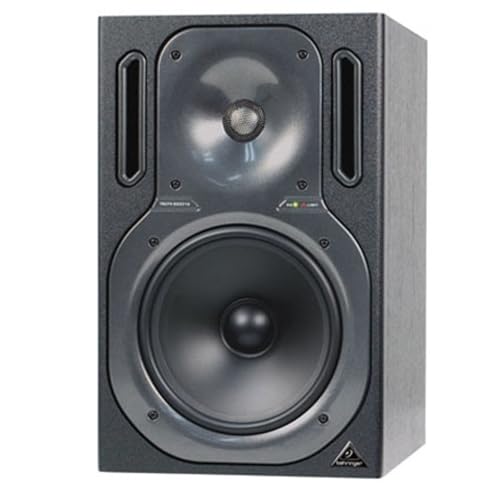
Behringer B2031A Truth Active Studio Monitor
Home studio owners who want a lower mid range active two way monitor with room compensation EQ and do not need full published specifications.
Read the Behringer B2031A Truth Active Studio Monitor review →Questions Buyers Ask
Behringer NEKKST K8 Active Studio Monitor
See the current listing, price and included accessories.
About This Review
Mandrillis Team
The Mandrillis editorial team researches and compares audio and music gear using manufacturer documentation, verified specs and real buyer feedback, so you can make a confident purchase without wading through marketing claims.
Read our full research methodology.