Studio Gear Review
Behringer Xenyx X1622USB 16-Input 2/2-Bus Review: Sweepable Mid EQ
The Behringer Xenyx X1622USB 16-Input 2/2-Bus brings four phantom-powered XENYX preamps, four one-knob compressors, a British 3-band EQ with a semi-parametric mid band, sixteen editable effects presets and a subgroup pair to a lower mid-range frame. This research review explains what the sweepable mid adds and which specs the listing leaves out.
Our Verdict
Research Score 72/100The Behringer Xenyx X1622USB 16-Input 2/2-Bus is the sound-shaping choice among Behringer's sixteen-input analog mixers. Its listing documents four phantom-powered XENYX mic preamps, four one-knob compressors with control LEDs, a neo-classic British 3-band EQ with a semi-parametric mid band, a sixteen-preset effects processor with tap and storable settings, a 2/2-bus subgroup path and a USB connection indicated by the model name. Phantom voltage, fader type, output connectors, aux sends, monitoring, USB resolution, software, dimensions and weight are not published. For small bands, worship teams and solo performers who need to carve vocals precisely in a live room, it is a well-judged lower mid-range buy. Multitrack recording users should look to a dedicated interface.
Editorial research score based on published specifications and documented features, not a customer rating or lab test.

Behringer
Behringer Xenyx X1622USB 16-Input 2/2-Bus
Best for: Small bands, worship teams and solo performers who want to shape vocals precisely with a sweepable mid EQ, simple compression and recallable effects in a lower mid-range analog mixer.
Skip it if: You need multitrack recording, more than four microphone preamps or a fully documented specification before buying.
Check Price on AmazonWe may earn a commission at no extra cost to you.
Listing verified: October 2026
Who Should Buy It
Buy it if
- Vocal-focused acts that need a sweepable mid to tame harsh frequencies
- Worship teams with two to four microphones and several line sources
- Solo performers who run their own sound and store effects settings
- Rehearsal rooms that want a subgroup pair
Skip it if
- You record each channel to its own DAW track
- You run five or more microphones
- You want documented faders, monitoring and dimensions first
Key Specifications
| Type | 16-input 2/2-bus analog mixer with built-in effects processor and USB connection |
| Inputs | 16 inputs in total, including 4 XENYX mic preamp channels (line and stereo channel breakdown not published in listing) |
| Outputs | 2/2-bus main and subgroup architecture (connector types not published in listing) |
| Preamps | 4 phantom-powered XENYX mic preamps (gain range and noise figures not published in listing) |
| Resolution | Not published in listing |
| Phantom power | Yes, phantom-powered preamps (voltage not published in listing) |
| Connection | USB per the model designation (resolution, channel count and connector type not published in listing) |
| Monitoring | Not published in listing |
| Bundled software | Not published in listing |
| Included accessories | Not published in listing |
Overview
The Behringer Xenyx X1622USB 16-Input 2/2-Bus sits between the smaller twelve-input and the larger twenty-two input models in Behringer's analog Xenyx range. Its listing describes four phantom-powered XENYX mic preamps, four one-knob compressors, a British-style 3-band EQ with a semi-parametric mid band, a sixteen-preset effects processor and a USB connection at a lower mid-range price.
The semi-parametric mid is the detail that separates this listing from its siblings. A sweepable mid-frequency control is the most valuable EQ tool on a live mixer, because problem frequencies in vocals, guitars and drums rarely land on a fixed center point. Having that documented here gives this model a specific reason to exist alongside the X1222USB.
What follows is a research review assembled from the listing. Channel count, preamp count, compressor count, EQ design and the effects engine are documented. Phantom voltage, fader type, output connectors, monitoring, USB resolution, bundled software, dimensions and weight are not, and each omission is noted where a purchase decision would depend on it.
Preamps and Sound Quality
Four XENYX mic preamps with phantom power handle the microphone channels. The listing's comparison to stand-alone boutique preamps is advertising language, since no gain range, noise floor or distortion figures are supplied to back it, but the broader reputation of XENYX preamps for clean, serviceable performance in live settings is well established among buyers.
Where this mixer earns extra credit is in what happens after the preamp. The neo-classic British 3-band EQ with a semi-parametric mid lets an operator sweep the mid frequency to find a nasal vocal resonance or a boxy guitar tone and cut it precisely, instead of accepting whatever fixed center the designer chose. That capability is usually reserved for larger consoles.
Without published noise figures, a numerical comparison with the D-PRE preamps in a Yamaha MG10XU is impossible from the listing. In practical terms, for stage vocals through dynamic microphones at normal levels, buyers report the XENYX preamps as more than adequate, and the sweepable mid will do more for the final sound than a slightly quieter preamp would.
Inputs, Outputs and Routing
Sixteen is the total input count, spread across the four mic channels, mono line inputs and stereo line pairs. The listing does not publish that breakdown, so a group with five or six microphones cannot confirm from the published text alone whether the extra mics can be accommodated. The manual is the only reliable source for the channel map.
The 2/2-bus architecture adds a subgroup pair to the main stereo output. Routing a drum submix or a set of backing vocals through the subgroup allows one fader pair to control the whole set, a method borrowed from larger consoles that simplifies live mixing for a single operator. Aux send count, control room outputs and connector types are not stated.
Each of the four mic channels carries a one-knob compressor with a control LED. The LED matters more than it sounds, because it shows at a glance whether the compressor is actually working or simply sitting idle, which is the most common point of confusion for volunteer operators. Insert points are not mentioned in the listing.
Features, Monitoring and Software
The effects processor provides sixteen editable presets covering reverb, chorus, flanger, delay, pitch shifter and multi-effects, with a tap function for setting delay times by tapping the tempo and storable user parameter settings. Being able to edit and save a preset means the preferred vocal reverb survives power cycles and operator changes.
The combination of a sweepable mid EQ and editable effects gives this mixer more sound-shaping depth than its input count suggests. A solo singer with a backing track can carve the vocal, add a tempo-matched delay and store the whole arrangement for the next show. Effects return routing and the number of user memories are not published.
Monitoring and metering are not described. Headphone output, control room feed, solo or PFL functions and main meters would be expected on a mixer of this size, but the listing confirms none of them. No bundled DAW, driver or download code is mentioned, so recording users should plan to supply their own software.
- Semi-parametric mid band on the British 3-band EQ
- Sixteen editable effects presets with tap function
- Storable user effect parameters
- Four one-knob compressors with control LEDs
- 2/2-bus routing with subgroup pair
Build, Design and Controls
No build figures appear in the listing for this model: fader length, chassis material, dimensions and weight are all absent. Its larger sibling, the X2222USB, documents 60 mm log-taper faders and sealed rotary controls, and buyers report similar construction across the family, but that is not stated for this unit and should be confirmed.
The channel strip adds one knob compared with a fixed-mid design, because the semi-parametric mid needs both a frequency control and a gain control. That extra control slightly increases the learning curve for newcomers, but once understood it becomes the most used knob on the strip. The rest of the layout follows the conventional gain, EQ, aux, pan and fader order.
A sixteen-input frame needs a dedicated surface or a case, and without published dimensions the footprint should be measured from the manual before a desk is chosen. There are no screen-based controls, so operation is fully analog apart from the effects section's preset selection.
Connectivity, Drivers and Latency
USB appears only in the model designation; the listing text does not describe a computer connection, its resolution or its channel count. Behringer mixers with the USB suffix generally present a stereo send and return to the computer, suitable for streaming and rehearsal capture but not for recording each channel separately. That is family context rather than a documented spec.
No driver or latency information is given. Mixers in this category are typically class compliant on Mac and Windows with optional ASIO drivers for lower latency on Windows, but none of that is confirmed. Since most live operators monitor from the mixer, computer latency is rarely an issue in practice.
Bluetooth, digital inputs and the wireless receiver slot found on the QX variants are not part of this listing. Phone or tablet playback will need a cable into a stereo line channel, which is a small practical note for anyone planning a sing-along or DJ setup.
Setup and Daily Use
Setup follows the familiar pattern: microphones into the four XENYX channels, keyboards and playback into the line and stereo inputs, main outputs to powered speakers or an amplifier, and the USB cable to a laptop when a stereo capture is wanted. Phantom power goes on only after condenser microphones are connected and the speakers are turned down.
During a show the semi-parametric mid earns its keep. If a vocal turns harsh as the singer pushes, the operator sweeps the mid until the harshness is loudest and cuts a few decibels there, a thirty-second fix that a fixed-mid EQ cannot deliver. The stored effects and one-knob compressors handle the rest with minimal attention.
The daily limit is the four-preamp ceiling, which a miked drum kit alone would consume. The mixer suits groups with a few vocal microphones and several line-level instruments, and anyone expecting to grow their microphone count should consider that now rather than after purchase.
Who Should Buy It
Small bands, worship teams and venue operators who care about getting vocals right will appreciate the sweepable mid and the compressors. The mixer is a good match for rooms with two to four microphones, keyboards, tracks and a need for consistent, recallable effects.
Solo performers and duos who run their own sound from the stage get a lot from the combination of editable effects with tap tempo and precise mid-band control. Rehearsal spaces and community theaters benefit from the input count and the subgroup pair.
Buyers who need multitrack recording, more than four microphones, or documented fader, monitoring and dimension figures before purchase should look elsewhere. The USB connection is undocumented in the listing text, so recording-focused users in particular should not assume more than a stereo feed.
Alternatives Worth Considering
The X1222USB from the same range matches the input count, preamps, compressors and effects presets, and its listing specifies +48 V phantom power and a 24-bit effects processor, but it does not document a semi-parametric mid. The X2222USB adds six more inputs and documented 60 mm faders for buyers who need the room.
The Yamaha MG10XU is the smaller, better documented alternative with D-PRE preamps and published noise figures, one-knob compressors, SPX effects and USB. It has fewer inputs and no subgroup pair, but buyers who prize a complete specification sheet will find it reassuring.
For recording rather than live mixing, the Behringer UMC202HD, Focusrite Scarlett 2i2 or PreSonus AudioBox put each input on its own DAW track and include software. Those devices are the right tool when the goal is a multitrack session rather than a stereo mix.
Verdict
The Behringer Xenyx X1622USB 16-Input 2/2-Bus is the version of Behringer's sixteen-input mixer that a sound-conscious operator should pick. The documented semi-parametric mid band, four phantom-powered XENYX preamps, four one-knob compressors, sixteen editable effects presets with tap and memory and a subgroup pair form a capable live package.
The listing's omissions are the familiar ones for this family. Phantom voltage, fader type, output connectors, aux sends, monitoring, metering, USB resolution, software, dimensions and weight are all unstated. Live users in small rooms can work around those gaps; recording users should treat the USB connection as a stereo convenience at most.
Scored at 72, it earns a place in the mid-range band on the strength of its EQ design and documented features, with points withheld for the thin specification. For small bands, worship teams and solo performers who want to shape vocals properly without a larger console, it is a well-judged lower mid-range buy.
Strengths and Limitations
Strengths
- Semi-parametric mid band on the British 3-band EQ
- Four phantom-powered XENYX mic preamps
- Four one-knob compressors with control LEDs
- Sixteen editable effects presets with tap and memory
- 2/2-bus subgroup routing
Limitations
- Only four mic preamps on sixteen inputs
- USB connection is indicated by the model name only, with no resolution stated
- Fader type, monitoring and output connectors are unpublished
- No bundled software is mentioned
How We Scored It
Scores reflect published specifications, documented features and value against the alternatives below. They are editorial research scores, not laboratory measurements.
Alternatives to Consider

PreSonus AudioBox iTwo Studio Recording
First-time home recordists, singer-songwriters and podcasters who want one lower mid-range purchase that covers interface, microphone, headphones and a full DAW.
Read the PreSonus AudioBox iTwo Studio Recording review →
Roland AeroCaster
Solo creators, small churches, schools and clubs that want multi-camera livestreams using phones as cameras, a physical switcher and two microphone inputs without a production crew.
Read the Roland AeroCaster review →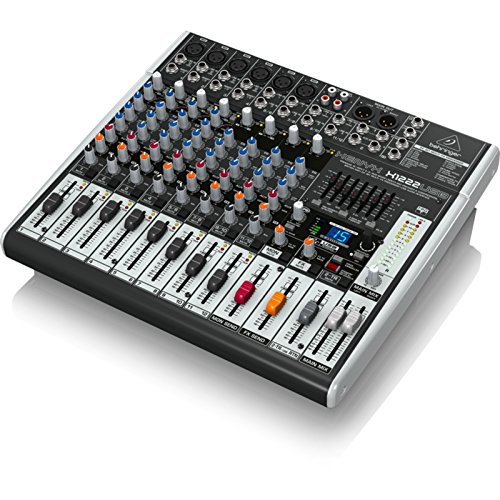
Behringer XENYX X1222USB 16-Input 2/2-Bus
Worship teams, small venues and rehearsal rooms that run a few vocal microphones and several line sources and want stored effects and simple compression in a lower mid-range analog.
Read the Behringer XENYX X1222USB 16-Input 2/2-Bus review →Questions Buyers Ask
Behringer Xenyx X1622USB 16-Input 2/2-Bus
See the current listing, price and included accessories.
About This Review
Mandrillis Team
The Mandrillis editorial team researches and compares audio and music gear using manufacturer documentation, verified specs and real buyer feedback, so you can make a confident purchase without wading through marketing claims.
Read our full research methodology.