Studio Gear Review
KRK Rokit 7 G4 Review: Kevlar Drivers and On-Screen Room EQ
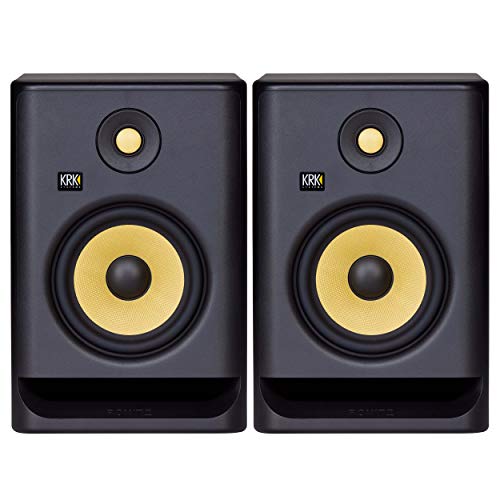
The KRK Rokit 7 G4 is a matched pair of 7 inch bi-amplified studio monitors with Kevlar drivers, Class D power and an on-screen DSP room EQ. This review covers what the listing publishes, what it leaves out, and which studios the pair suits best.
Our Verdict
Research Score 78/100The KRK Rokit 7 G4 pair brings Kevlar drivers built in-house, Class D bi-amplification and an on-screen DSP room EQ to the lower mid-range tier, and the 7 inch woofer gives it low-end reach that 5 inch rivals cannot match without a subwoofer. The visual EQ readout is a genuine convenience for setting up in an untreated room. Against that, the listing publishes no wattage, frequency response, input list, dimensions or weight, and the bundle contents beyond the two monitors are not itemized. Producers with a medium room who know the KRK sound will be satisfied. Buyers who need every specification confirmed before purchase should compare a more fully documented rival first.
Editorial research score based on published specifications and documented features, not a customer rating or lab test.
KRK
KRK Rokit 7 G4
Best for: Producers in a medium-sized room who want 7 inch bass reach and on-screen room correction from a matched pair at a lower mid-range tier.
Skip it if: You work on a small desk against a wall or need wattage, frequency response and inputs confirmed in the listing before buying.
Check Price on AmazonWe may earn a commission at no extra cost to you.
Listing verified: October 2026
Who Should Buy It
Buy it if
- Electronic, hip-hop and pop producers who want more low end than a 5 inch monitor
- Anyone upgrading from entry monitors who wants visual room EQ
- Buyers who prefer a matched pair in one purchase
- Owners of older Rokits who want the G4 DSP correction
Skip it if
- Your desk is small and sits against a wall
- You need every specification published before purchase
- You want Bluetooth or a headphone output for casual listening
Key Specifications
| Type | Active bi-amplified 2-way nearfield studio monitor, sold as a pair bundle |
| Woofer | 7 inch Kevlar woofer, built in-house by KRK |
| Tweeter | 1 inch Kevlar tweeter, matched to the woofer |
| Power | Built-in Class D bi-amplification; wattage not published in listing |
| Frequency response | Not published in listing |
| Inputs | Not published in listing |
| Room controls | Onboard DSP-driven EQ with LCD visual display |
| Dimensions | Not published in listing |
| Weight | Not published in listing |
| Included accessories | Two monitors in the bundle; other bundle contents not itemized in listing |
Overview
The KRK Rokit 7 G4 is a bi-amplified 7 inch nearfield studio monitor sold here as a matched pair in black. The listing describes a 7 inch woofer and a 1 inch tweeter, both made with Kevlar, driven by a built-in Class D amplifier and tuned through an onboard DSP EQ with an LCD screen. It sits in the lower mid-range price tier, which is where most project studios shop for their first serious pair.
KRK's Rokit range has been a fixture of home and project studios for years, and the fourth generation is the version that added digital room correction with a visual readout. Rather than hunting through dip switches on the rear panel, the user scrolls through EQ settings on a small screen and sees what each one does. That single change is the main reason to look at the G4 over older generations.
What the listing does not publish is just as important for a buyer. Amplifier wattage, frequency response, input types, dimensions and weight are all absent, and the word bundle is used without a list of what else ships in the box beyond the two speakers. This review works from the published facts and flags every gap clearly.
Accuracy and Sound Signature
On paper the combination of a 7 inch woofer and a 1 inch tweeter promises more low-end reach than the 5 inch monitors that dominate this price tier, such as the Yamaha HS5 or the KRK Rokit 5 G5. A larger cone moves more air at the same excursion, so bass-heavy genres get a fuller picture of the sub region without a separate subwoofer. The trade is that a 7 inch driver needs more distance and a bigger room to sound balanced.
Kevlar is a stiff, light aramid fiber that resists cone flex at higher output, and KRK uses it for both drivers here so the two share similar breakup behavior. In practice that means a more consistent character across the crossover region, where many budget monitors shift in tone. Buyers report the Rokit voicing as slightly forward in the low end, which the onboard EQ exists to tame.
Because no frequency response figure is published, there is no stated low-frequency limit to compare against competitors. The honest position is that a 7 inch ported design in this class usually reaches comfortably into the upper bass, but the exact number is not given and should be confirmed from the manufacturer before relying on it for sub-bass decisions.
Drivers, Amplification and Power
Both drivers are described as proprietary and built in-house from the ground up, which is a meaningful point in a market where many brands buy generic cones and domes from a shared supplier. Designing the woofer and tweeter together lets the engineers match their output and dispersion before the amplifier is tuned. KRK states the monitors are designed and engineered in the USA.
The amplifier is a bi-amp Class D design, meaning a separate amplifier channel feeds the woofer and the tweeter after an active crossover. Class D runs cool and light compared to the Class A/B amplifiers found in older Rokit generations and in rivals like the Mackie MR series. That matters for a pair that may sit on a desk for hours each day.
Wattage is the missing figure. The amplifier is described only as efficient, so total power, per-driver split and maximum SPL are all unknown from the published data. Larger Rokit models have historically offered generous headroom for nearfield use, but a buyer who needs a specific loudness number should treat it as unconfirmed.
Room Fit, Placement and Controls
The headline control feature is the onboard DSP-driven EQ with an LCD visual display. Instead of guessing at rear-panel switches, the user picks from a set of correction curves on screen and can see the resulting response shape. For a bedroom studio with a desk against a wall, that visual feedback shortens the setup process considerably.
A 7 inch monitor asks for more space than a 5 inch one. The pair performs best on stands or isolation pads at ear height, toed in to form an equal-sided triangle with the listener, and placed with some distance from the back wall to avoid bass build-up. The DSP EQ can reduce boundary boost when that distance is not available, but it cannot replace it.
The listing does not state the number of EQ presets, whether there is a high-frequency trim or whether the port is front or rear facing. Those details shape how forgiving the monitor is in a tight room, so they are worth confirming on the manufacturer's page before committing to a small desk setup.
- On-screen DSP EQ replaces rear-panel dip switches
- Visual readout shows the correction curve being applied
- Best on stands or pads at ear height with the pair toed in
- Needs more distance from walls than a 5 inch monitor
- Port orientation and preset count not published
Build, Design and Finish
The pair ships in black, the only finish named in the listing. KRK monitors are recognized by their yellow-tinted woofer cones, and the Kevlar drivers in the G4 continue that look, which some buyers love and others find loud on a desk. Cabinet material is not stated.
Dimensions and weight are not published, which is a real gap for a 7 inch monitor since cabinet depth decides whether it fits a typical desk or needs stands. As a rough guide, 7 inch two-way monitors from major brands are noticeably taller and deeper than 5 inch models, so measure the intended space before ordering.
Build quality on KRK's recent generations is generally described by owners as solid for the tier, with a rigid enclosure and a clean baffle. Without published materials or construction details, the safest conclusion is that the pair is built to the brand's usual standard rather than to any stated specification.
Connectivity and Inputs
The listing does not name any input connectors, which is unusual for a studio monitor page and is the biggest documentation gap here. Studio monitors in this class typically carry balanced XLR and TRS inputs and sometimes an unbalanced RCA, but none of those are stated for this bundle.
The practical consequence is that a buyer with a specific interface output, such as a pair of balanced TRS jacks or a consumer RCA source, cannot confirm compatibility from the listing alone. Most interfaces will work with any of the common formats through an inexpensive adapter cable, but it is better to know in advance.
Nothing in the data mentions Bluetooth, a headphone output or a subwoofer output, so the G4 should be approached as a straightforward wired monitor. That is normal for a pair aimed at mixing rather than casual listening, and it keeps the signal path simple.
Setup and Daily Use
Unboxing a matched pair means both speakers are ready to position without the mismatch risk that comes from buying two singles at different times. Each monitor is powered, so each needs its own mains outlet and a signal cable from the interface. The onboard screen then guides the room EQ step.
Day to day, the Class D amplifier should stay cool and quiet, and the lack of exposed dip switches means settings are less likely to be knocked out of place by accident. The LCD readout is also useful when two people share a room, since the current EQ state is visible at a glance.
The main daily question is level matching between the two monitors, which depends on an input sensitivity or volume control that the published data does not describe. Assume a rear-panel level control is present, as it is on nearly every active monitor, but confirm before building a setup that relies on precise gain staging.
Who Should Buy It
The KRK Rokit 7 G4 pair suits a producer or mix engineer working in a medium-sized room who wants more low-end extension than a 5 inch monitor provides without adding a subwoofer. Electronic, hip-hop and pop producers in particular benefit from the 7 inch woofer's reach.
It also fits anyone upgrading from a first pair of entry monitors who wants room correction they can see rather than guess at. The on-screen EQ is a genuine quality-of-life feature compared with rival monitors at the same tier that still use switches.
It is a weaker match for a very small desk against a wall, where the larger cabinet and bass output can overwhelm the space, and for buyers who need every spec documented before purchase. Those shoppers may prefer a listing that states wattage, response and connections outright.
Alternatives Worth Considering
The KRK Rokit 5 G5 is the newer and smaller sibling, with the brand's latest driver generation in a cabinet that fits a smaller desk. It gives up low-end reach to the 7 inch G4 but is easier to place and is the more current product.
The Yamaha HS5 remains the reference for a flat, revealing midrange at this price and is often paired with a subwoofer for larger rooms. The JBL 305P MkII offers a wide sweet spot from its waveguide and is a popular alternative for buyers who move around the room while working.
The Kali Audio LP-6 and Adam Audio T5V both publish detailed specifications and boundary EQ options, which makes them easier to evaluate on paper than this bundle. For a buyer who values documentation, either is a strong counterpoint.
Verdict
The KRK Rokit 7 G4 pair offers Kevlar drivers built in-house, Class D bi-amplification and an on-screen DSP room EQ, a combination that is still unusual at the lower mid-range tier. The 7 inch woofer brings bass reach that smaller rivals cannot match without a subwoofer.
The published data is thin on numbers, with no wattage, frequency response, input list, dimensions or weight, and the bundle contents are not itemized. Those gaps keep the score below what the design otherwise earns.
For a producer with room to place them and a willingness to confirm the missing specs elsewhere, this is a well-regarded pair at a fair tier. For a buyer who needs certainty from the listing alone, a better documented rival is the safer choice.
Strengths and Limitations
Strengths
- Kevlar woofer and tweeter from a single in-house driver program
- DSP room EQ with an onboard LCD screen
- Class D amplification keeps heat and weight down
- Sold as a matched pair, ready for stereo work
- Designed and engineered in the USA by a long-established monitor brand
Limitations
- Amplifier wattage not published
- Frequency response not published
- Input types not stated in the listing
- Bundle contents beyond the pair are not itemized
How We Scored It
Scores reflect published specifications, documented features and value against the alternatives below. They are editorial research scores, not laboratory measurements.
Alternatives to Consider

Kali Audio LP-UNF Ultra Nearfield
Desk based producers and editors who want Kali tuning at arm's length with Bluetooth and boundary correction.
Read the Kali Audio LP-UNF Ultra Nearfield review →Questions Buyers Ask
KRK Rokit 7 G4
See the current listing, price and included accessories.
About This Review
Mandrillis Team
The Mandrillis editorial team researches and compares audio and music gear using manufacturer documentation, verified specs and real buyer feedback, so you can make a confident purchase without wading through marketing claims.
Read our full research methodology.