Studio Gear Review
PreSonus Eris Pro 8 Review: Coaxial Imaging for Stereo and Atmos
The PreSonus Eris Pro 8 is an 8 inch coaxial studio monitor with a 1.25 inch silk dome, 140 W of Class AB bi-amplification, a published 35 Hz to 20 kHz response and a full Acoustic Tuning section. This review covers its imaging, controls, mounting options and the two figures the listing omits.
Our Verdict
Research Score 86/100The PreSonus Eris Pro 8 is one of the most capable monitors in its tier. The coaxial layout places a 1.25 inch silk dome at the center of an 8 inch woven-composite woofer for single-point-source imaging, 140 W of Class AB bi-amplification delivers a published 106 dB SPL peak, and the 35 Hz to 20 kHz response reaches deeper than almost any two-way rival at this price. The Acoustic Tuning section, three inputs, protection features and wall and ceiling mounting make it ready for both stereo and immersive work. Dimensions and weight are unpublished and the single-unit sale means an array adds up. For stereo mixers who want deep bass and precise imaging, and for anyone building an Atmos room on a sensible budget, it is a confident recommendation.
Editorial research score based on published specifications and documented features, not a customer rating or lab test.

PreSonus
PreSonus Eris Pro 8
Best for: Stereo mixers and anyone building an immersive room who want a coaxial monitor with deep published bass, full tuning controls and ceiling mounting at a lower mid-range tier.
Skip it if: Your room is very small or you need published dimensions and weight before planning a mounting layout.
Check Price on AmazonWe may earn a commission at no extra cost to you.
Listing verified: October 2026
Who Should Buy It
Buy it if
- Mix engineers who want single-point-source imaging
- Post-production and music mixers moving into Atmos
- Producers who want 35 Hz reach without a subwoofer
- Anyone who values published SPL, response and protection specs
Skip it if
- You work in a bedroom-sized space
- You need the lightest possible cabinet for ceiling mounts
- You want lifestyle features like Bluetooth
Key Specifications
| Type | Active 2-way bi-amplified coaxial studio monitor for stereo and immersive setups |
| Woofer | 8 inch woven-composite low-frequency driver with front-firing acoustic port |
| Tweeter | 1.25 inch (31.75 mm) ultra-low-mass silk dome, coaxially mounted |
| Power | 140 W Class AB bi-amplification, up to 106 dB SPL peak at 1 m |
| Frequency response | 35 Hz to 20 kHz |
| Inputs | Balanced XLR, balanced 1/4 inch TRS, unbalanced RCA |
| Room controls | HF and Midrange controls, highpass filter, Acoustic Space control with flat, minus 2 dB and minus 4 dB settings |
| Dimensions | Not published in listing |
| Weight | Not published in listing |
| Included accessories | Not published in listing; wall and ceiling mountable |
Overview
The PreSonus Eris Pro 8 is an 8 inch coaxial studio monitor with a 1.25 inch silk dome tweeter mounted at the center of a woven-composite woofer, driven by 140 W of Class AB bi-amplification. The listing publishes a 35 Hz to 20 kHz frequency response, 106 dB SPL peak at 1 meter, a full Acoustic Tuning section and XLR, TRS and RCA inputs. It sits in the lower mid-range tier.
PreSonus positions the Eris Pro line above its standard Eris range, and the coaxial models are aimed explicitly at both stereo and immersive work such as Dolby Atmos. A coaxial driver places the tweeter and woofer on the same axis, so sound from both arrives at the listener at the same time from the same point, which simplifies speaker placement in multichannel arrays.
This is one of the most thoroughly documented listings in its category. Power, SPL, response, controls, protection features and mounting are all stated. Dimensions and weight are the only significant omissions, and this review notes them where they affect planning.
Accuracy and Sound Signature
The published 35 Hz low-frequency limit is deep for a two-way monitor and places the Eris Pro 8 among the fullest-range cabinets in the tier, well beyond the reach of 5 inch designs like the Yamaha HS5 or the Adam Audio T5V. The front-firing acoustic port supports that extension while allowing closer wall placement than a rear port.
The single-point-source coaxial design is the accuracy argument. Because the tweeter sits at the acoustic center of the woofer, the two drivers share a common origin and the listing credits the layout with better phase alignment, superior imaging and symmetrical dispersion. In practice that means a stereo image that holds together when the listener moves and a consistent tonal balance off axis.
The 1.25 inch silk dome is larger than the 1 inch tweeters common at this tier, and the listing describes it as ultra-low-mass for a natural high end. Combined with the dedicated midrange control, the published design targets a neutral presentation that the user can adjust rather than one fixed voicing.
Drivers, Amplification and Power
The woofer is an 8 inch woven-composite cone, a construction that balances stiffness with damping to keep the cone behaving as a piston at high excursion. The listing credits it and the front port with powerful, accurate and smooth bass with extended low end, which the 35 Hz figure supports on paper.
Amplification is 140 W of Class AB bi-amplification, with separate channels for the woofer and the tweeter after an active crossover. Class AB is heavier and warmer-running than Class D but is often preferred for its dynamic behavior, and 140 W is a generous allocation for an 8 inch nearfield or midfield monitor.
The published 106 dB SPL peak at 1 meter confirms real headroom for loud playback checks and for the larger listening distances that immersive layouts can involve. A protection suite covering RF interference, output current, over-temperature, transients and subsonic content guards the drivers, and a soft-start feature prevents the pop on power-up that cheaper amplifiers produce.
Room Fit, Placement and Controls
The Acoustic Tuning section is unusually complete. An HF control and a Midrange control shape the top and middle of the response, a highpass filter removes low frequencies when a subwoofer takes over, and the Acoustic Space control offers flat, minus 2 dB and minus 4 dB settings to compensate for placement near a wall or in a corner.
That control set, together with the front port, makes the Eris Pro 8 more forgiving of placement than most 8 inch monitors. In a small room the Acoustic Space control pulls back the boundary boost, and the highpass filter lets the monitor hand off sub-bass to a dedicated subwoofer cleanly.
The cabinet is wall and ceiling mountable, which is the feature that makes an Atmos array practical with this speaker. Height channels can be mounted overhead and matched tonally with the desk-level monitors because every unit shares the same coaxial design and controls. Dimensions and weight are not published, so mounting hardware ratings should be checked against the manufacturer's figures.
- HF and Midrange controls for tonal correction
- Highpass filter for clean subwoofer integration
- Acoustic Space control with flat, minus 2 dB and minus 4 dB settings
- Front-firing port tolerates closer wall placement
- Wall and ceiling mountable for immersive arrays
- Dimensions and weight not published
Build, Design and Finish
The listing does not name the cabinet material or finish, nor dimensions or weight. An 8 inch monitor with 140 W of Class AB amplification and a protection suite is a substantial object, and a buyer planning ceiling mounts in particular needs the weight figure from the manufacturer.
The coaxial driver gives the front baffle a distinctive look, with the tweeter visible at the center of the woofer and the port below or beside it. PreSonus's Eris Pro cabinets are generally reported by buyers as well finished and solid, with a professional rather than consumer appearance.
The protection features are part of the build story. Over-temperature and current limiting mean the amplifier can be driven hard without risk, and the Power Saver mode that engages after 40 minutes of inactivity reduces energy use and heat when the monitor is left on between sessions.
Connectivity and Inputs
Inputs are balanced XLR, balanced 1/4 inch TRS and unbalanced RCA, which the listing summarizes as all the connections you need. An interface or monitor controller connects over XLR or TRS, while a consumer source uses RCA. Whether all three are active simultaneously is not stated.
Balanced connections are the ones to use for a monitor that may be mounted some distance from the interface, since they reject the hum and interference that longer unbalanced runs pick up. For a ceiling-mounted height channel in an Atmos setup that distance is a given.
There is no digital input, no network audio and no Bluetooth, which is appropriate for a monitor built for accurate reproduction. Subwoofer integration is handled by the onboard highpass filter rather than a dedicated sub output, so the sub receives its feed from the interface or controller.
Setup and Daily Use
Setup for a stereo pair follows the usual nearfield pattern, with the monitors at ear height forming an equal-sided triangle with the listener. The Acoustic Space control is set first according to the distance to the nearest wall, then the HF and Midrange controls are adjusted by ear against reference tracks.
For an immersive array the coaxial design pays off, because each speaker can be aimed directly at the listening position and will deliver the same tonal balance regardless of mounting angle. The soft-start feature and Power Saver mode make a multi-speaker system less fussy to power up and leave idle.
Daily use benefits from the 35 Hz reach, which reduces reliance on a subwoofer for bass decisions in stereo work. The Class AB amplifier will run warm, and a sensitivity control is not described in the published data, so confirm one exists for level matching across a multichannel array.
Who Should Buy It
The PreSonus Eris Pro 8 suits a mix engineer or producer building a stereo or immersive system who wants a single-point-source monitor with deep published bass extension, full tuning controls and mounting options, at a lower mid-range tier that undercuts most coaxial rivals.
It also fits post-production and music mixers moving into Atmos who need a consistent speaker for front, surround and height channels. The wall and ceiling mounting and the matching controls across units make that expansion straightforward.
It is a weaker match for a very small room, where an 8 inch monitor with 140 W is more than the space needs, and for a buyer who requires published dimensions and weight before committing to a mounting plan.
Alternatives Worth Considering
Within PreSonus's own range, the smaller Eris Pro coaxial models offer the same single-point-source design in lighter cabinets, better suited to tight rooms and to height channels where weight matters. They are the first comparison for anyone drawn to the coaxial approach.
The Kali Audio LP-6 and the JBL 305P MkII are conventional two-way designs with strong published specifications and wide dispersion, though neither is coaxial nor rated for ceiling mounting. The Adam Audio T5V brings a different tweeter technology at a similar tier.
The Yamaha HS5 and the KRK Rokit 5 G5 are the mainstream references for stereo work and cost less, but neither publishes a bass figure close to 35 Hz nor offers immersive mounting. For a buyer who wants both, the Eris Pro 8 stands apart.
Verdict
The PreSonus Eris Pro 8 combines a coaxial 8 inch driver with a 1.25 inch silk dome, 140 W of Class AB bi-amplification, a published 35 Hz to 20 kHz response, 106 dB SPL peak, a full Acoustic Tuning section, three inputs, comprehensive protection and wall and ceiling mounting. On paper it is one of the most capable monitors in its tier.
Dimensions and weight are unpublished, and the single-unit sale means a pair or an array adds up quickly. Those are the only meaningful caveats in an otherwise complete listing.
For stereo mixers who want deep bass and precise imaging, and for anyone building an Atmos room on a sensible budget, it is a confident recommendation.
Strengths and Limitations
Strengths
- Single-point-source coaxial design for imaging and phase alignment
- Published 35 Hz to 20 kHz response
- 140 W Class AB with 106 dB SPL peak
- Full Acoustic Tuning section with Acoustic Space control
- Wall and ceiling mountable for immersive arrays
- Comprehensive amplifier protection and soft start
Limitations
- Dimensions and weight not published
- Sold individually, so arrays add up quickly
- Class AB runs warmer and heavier than Class D
- More monitor than a very small room needs
How We Scored It
Scores reflect published specifications, documented features and value against the alternatives below. They are editorial research scores, not laboratory measurements.
Alternatives to Consider

Mackie CR8BT
Producers, streamers and gamers who want one 8 inch pair for production, entertainment and casual listening with every input type covered.
Read the Mackie CR8BT review →
Mackie MR824
Producers and mix engineers in a medium or larger room who want an 8 inch monitor with a wide listening sweet spot and Class A/B amplification at a lower mid-range tier.
Read the Mackie MR824 review →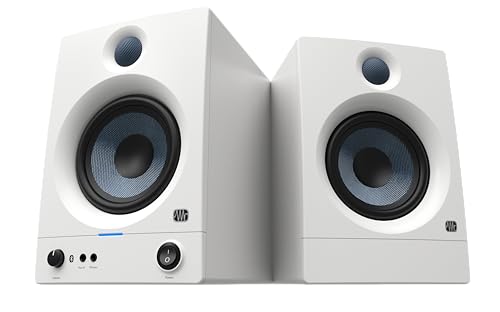
PreSonus Eris 5BT 5.25-inch
Producers and creators who want one white pair of near-field monitors to handle production, video work and Bluetooth listening on the same desk at a lower mid-range tier.
Read the PreSonus Eris 5BT 5.25-inch review →Questions Buyers Ask
PreSonus Eris Pro 8
See the current listing, price and included accessories.
About This Review
Mandrillis Team
The Mandrillis editorial team researches and compares audio and music gear using manufacturer documentation, verified specs and real buyer feedback, so you can make a confident purchase without wading through marketing claims.
Read our full research methodology.