Studio Gear Review
Yamaha HS8 8-Inch Review: 120 W Bi-Amped Pair That Reaches 38 Hz
The Yamaha HS8 8-Inch pair combines an 8 inch cone woofer and a 1 inch dome tweeter with a 75 W plus 45 W bi-amp system and a published 38 Hz to 30 kHz response. This review examines the published specification, the Advanced Magnetic Circuit design, the room requirements and the details the listing leaves out.
Our Verdict
Research Score 84/100The Yamaha HS8 8-Inch is the full size member of the HS family, and the published figures explain why it is so often chosen when a subwoofer is not wanted. A 38 Hz to 30 kHz response, an 8 inch cone woofer with a 1 inch dome tweeter and 120 W of bi-amp power per cabinet give it extension and headroom that the smaller HS models cannot match, and the pair bundle means both monitors arrive together. The listing does not publish inputs, room controls, dimensions or weight, which are gaps a buyer should close with the manufacturer's documentation. In a medium or large room, at a mid-range price tier, it remains one of the most sensible full range monitor choices for serious mixing.
Editorial research score based on published specifications and documented features, not a customer rating or lab test.

Yamaha
Yamaha HS8 8-Inch
Best for: Producers and mix engineers with a medium sized room who want a full range 8 inch bi-amped pair that reaches 38 Hz without a subwoofer.
Skip it if: You work at a small desk in a small room where an 8 inch woofer will overload the space.
Check Price on AmazonWe may earn a commission at no extra cost to you.
Listing verified: October 2026
Who Should Buy It
Buy it if
- Mix engineers who want bass extension without adding a subwoofer
- Producers in bass heavy genres with a medium or large room
- Studios that value the plain, revealing HS series balance
- Buyers who want a matched pair in one purchase
Skip it if
- Your room is small or untreated
- You need the input types confirmed in the listing before buying
- You prefer a warm, forgiving monitor for casual listening
Key Specifications
| Type | Active bi-amped 2-way powered studio monitor, sold as a pair, black |
| Woofer | 8 inch cone woofer |
| Tweeter | 1 inch dome tweeter |
| Power | 75 W LF plus 45 W HF bi-amp system, 120 W total per monitor |
| Frequency response | 38 Hz to 30 kHz |
| Inputs | Not published in listing |
| Room controls | Not published in listing |
| Dimensions | Not published in listing |
| Weight | Not published in listing |
| Included accessories | Not published in listing; bundle is a pair of two monitors |
Overview
The Yamaha HS8 8-Inch is the largest nearfield in the Yamaha HS series, sold here as a pair of two black monitors. The HS line has become a fixture in project studios for its plain, revealing balance, and the HS8 is the version chosen by people who want that character with real low end and without a separate subwoofer.
The product listing publishes the core specification: a 38 Hz to 30 kHz frequency response, an 8 inch cone woofer, a 1 inch dome tweeter, and a bi-amp system of 75 W for the low frequencies and 45 W for the highs, which the listing totals at 120 W. It also mentions large magnets in an Advanced Magnetic Circuit design.
The listing is silent on inputs, room controls, dimensions and weight. Those are familiar features on the HS series, but this review does not assume them, and each is marked as unpublished where it would otherwise be discussed.
Accuracy and Sound Signature
The HS series sound is best described as honest. Buyers report that it does not flatter a mix, that the upper midrange is forward enough to expose harsh vocals and cluttered guitars, and that a mix which sounds good on these tends to translate well elsewhere. The published 38 Hz to 30 kHz response for the Yamaha HS8 8-Inch extends that honesty into the bottom octave, where the smaller HS models roll off earlier.
A 38 Hz low limit from a two-way monitor means the fundamental of a four string bass, most kick drums and much of the sub bass in modern productions can be heard directly rather than inferred from harmonics. The 30 kHz upper limit from a 1 inch dome tweeter indicates generous headroom above the audible band, which tends to keep the top end from sounding strained.
The bi-amp design separates the low and high frequency amplifiers so that each driver is fed by an amplifier suited to its range. The listing pairs this with large magnets in an Advanced Magnetic Circuit design, which is Yamaha's term for a motor structure intended to keep the magnetic field stable as the cone moves, reducing distortion at high excursion. On paper, both features serve accuracy rather than loudness.
Drivers, Amplification and Power
The woofer is an 8 inch cone, and the listing does not state the cone material. An 8 inch driver moves considerably more air than the 6.5 inch and 5 inch woofers in the smaller HS models, which is what delivers the 38 Hz extension and the headroom for loud monitoring. The tweeter is a 1 inch dome, the standard size for a nearfield two-way, and again the material is not published.
Power is split 75 W to the woofer and 45 W to the tweeter, a total of 120 W per monitor. That split follows the energy distribution of music, where the low frequencies demand far more amplifier power than the highs, and the 45 W on the tweeter is generous enough to keep transients clean at high level.
Large magnets in an Advanced Magnetic Circuit design are the one driver construction detail the listing shares. A larger magnet with a well controlled field gives the amplifier more authority over the cone, which translates into tighter bass and lower distortion. The listing does not describe the port design, though the HS series is known among buyers for rear porting, so placement planning should allow for that possibility.
Room Fit, Placement and Controls
An 8 inch monitor with a 38 Hz floor asks more of the room than a 5 inch design. The low end that makes the Yamaha HS8 8-Inch appealing also excites room modes more strongly, and in a small untreated space that can turn a flat monitor into a boomy one. Medium and large rooms with some bass treatment get the most from this pair.
The product listing does not publish any room controls. The HS series is known for Room Control and High Trim switches, but since the listing does not list them for this bundle, this review cannot confirm their presence. Buyers who need boundary compensation should verify the rear panel before relying on it.
Dimensions and weight are not published either. An 8 inch two-way is a substantial cabinet, so stands rather than a desk are the usual choice, and the exact footprint should be checked against the manufacturer's data sheet before ordering stands or shelving.
- Best suited to medium and large rooms with some bass treatment
- Room control switches not published in the listing, verify before relying on them
- Stands usually preferable to a desk for an 8 inch monitor
- Dimensions and weight not published
- Sold as a pair, so both cabinets arrive together
Build, Design and Finish
The listing specifies a black finish and a pair of two monitors but does not describe the cabinet material, port or front baffle. The HS series has a reputation among buyers for durable, utilitarian cabinets that survive years of studio use, and nothing in the listing contradicts that. The large magnets mentioned in the Advanced Magnetic Circuit design imply a heavy driver assembly, which is consistent with a solid build.
A bi-amp monitor with 120 W of amplification carries a meaningful power supply and heat sink. The emphasis on high performance power amplification in the feature list suggests Yamaha treats the electronics as a central part of the design rather than an afterthought.
Weight is not published, which is the main practical unknown for a monitor of this size. Anyone planning wall brackets or lightweight stands should confirm the figure first.
Connectivity and Inputs
Yamaha's listing does not publish the inputs on the Yamaha HS8 8-Inch. The HS series is widely known for offering balanced XLR and TRS inputs, but since the product listing for this pair does not say so, this review records the inputs as unpublished. Buyers with a specific connector requirement should confirm it from the manufacturer documentation.
No digital inputs, wireless connectivity or network control are mentioned, and none would be expected on a monitor of this type. In a studio fed by an audio interface or a monitor controller, balanced analog inputs are the standard requirement.
Because this is an active monitor, each cabinet needs its own power connection in addition to the signal cable. The listing does not say whether power cords are included.
Setup and Daily Use
Setting up the pair follows the usual nearfield routine: place the monitors at ear height forming a triangle with the listening position, keep them away from corners, and connect balanced lines from the interface. Because the 38 Hz extension will reveal room problems, it is worth spending time on placement before judging the sound.
In daily use the HS8 is a monitor for working, not for background listening. Buyers report that the forward midrange and extended bass make fatigue possible over long sessions if levels creep up, and that the reward is mixes that translate. Keeping the monitoring level moderate is the practical answer.
The product page does not mention auto standby, a front panel power indicator or included accessories. These are minor matters for a monitor that is switched on with the rest of the studio.
Who Should Buy It
The Yamaha HS8 8-Inch suits mix engineers and producers who want one pair of monitors to cover the full range without a subwoofer. The 38 Hz floor is low enough for most genres, and the 120 W bi-amp power gives the headroom to monitor at realistic levels in a medium sized control room.
Producers in bass heavy styles who do not want the complexity of integrating a sub will find the 8 inch woofer a practical compromise. Buyers who already know and like the HS series balance from the HS5 or HS7 and simply want more low end are the most natural customers.
People working at a small desk in a bedroom should look at the HS5 or HS7 instead. The larger cabinet and deeper extension of the HS8 become liabilities when there is no room for them to breathe.
Alternatives Worth Considering
The closest alternatives are inside the family. The Yamaha HS5 offers the same character in a compact cabinet for small rooms, and the HS7 splits the difference with a 6.5 inch woofer. Pairing either with the HS8 subwoofer achieves similar extension with more placement flexibility, at the cost of a more complex setup.
Across brands, the Kali Audio LP-6 and the JBL 305P MkII are popular lower tier choices with waveguides and boundary EQ, while the Adam Audio T5V brings a ribbon tweeter. All three are smaller than an 8 inch design, so none reaches as low on its own.
Buyers who want an 8 inch monitor with more adjustability may prefer a competitor that publishes multiple room EQ bands in its listing. The appeal of the Yamaha HS8 8-Inch is a straightforward, well known sound rather than a long feature list.
Verdict
On the published specification, the Yamaha HS8 8-Inch pair is a strong full range monitoring choice. The 38 Hz to 30 kHz response, 8 inch cone woofer, 1 inch dome tweeter, 120 W bi-amp power and Advanced Magnetic Circuit design describe a monitor built for honest, extended reproduction in a medium or large room, and buying a pair in one bundle keeps things simple.
Silence on inputs, room controls, dimensions and weight costs it some points, because those are things a buyer should not have to look up elsewhere. For anyone with the space to use it, the mid-range price tier for a matched pair of 8 inch bi-amped monitors is sensible value, and the HS8 continues to earn its place as a reference for mixes that need to translate.
Strengths and Limitations
Strengths
- Published 38 Hz to 30 kHz response from an 8 inch two-way
- 120 W bi-amp power per monitor, 75 W low and 45 W high
- 8 inch cone woofer and 1 inch dome tweeter
- Large magnets in an Advanced Magnetic Circuit design
- Sold as a matched pair
Limitations
- Inputs are not published in the listing
- Room controls are not described in the listing
- Dimensions and weight are not published
- An 8 inch monitor needs a larger room than a 5 inch or 6.5 inch design
How We Scored It
Scores reflect published specifications, documented features and value against the alternatives below. They are editorial research scores, not laboratory measurements.
Alternatives to Consider

KRK S12.4 S12 4 12"
Producers with a medium or large studio who want a 12 inch Kevlar subwoofer that reaches 26 Hz and can be bypassed with a footswitch for mix checks.
Read the KRK S12.4 S12 4 12" review →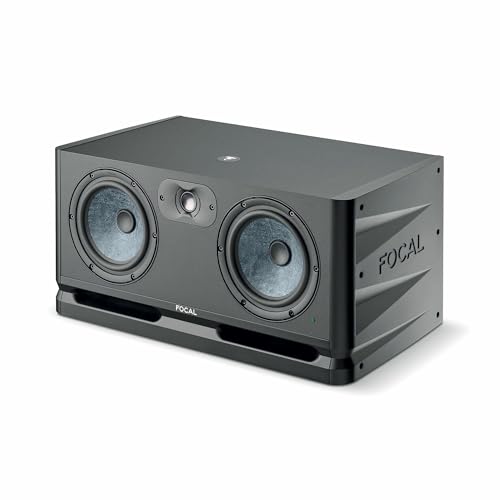
Focal Alpha-Twin-EVO 2.5-Channel Studio
Mix engineers who want a French built 2.5-channel active monitor with wide dispersion and multiple source inputs, and who will confirm the specification separately.
Read the Focal Alpha-Twin-EVO 2.5-Channel Studio review →
Yamaha HS7 100-Watt 6.5"
Producers who want the well known Yamaha HS7 monitor sound extended by a matched 8 inch subwoofer with phase and cutoff controls.
Read the Yamaha HS7 100-Watt 6.5" review →Questions Buyers Ask
Yamaha HS8 8-Inch
See the current listing, price and included accessories.
About This Review
Mandrillis Team
The Mandrillis editorial team researches and compares audio and music gear using manufacturer documentation, verified specs and real buyer feedback, so you can make a confident purchase without wading through marketing claims.
Read our full research methodology.