Instruments Review
Arturia KeyStep Pro 37-Key Review: Keyboard Meets Sequencer
The Arturia KeyStep Pro 37-Key combines a velocity-sensitive slimkey keyboard with a 4-track polyphonic sequencer, arpeggiator and extensive CV, Gate and MIDI connectivity. The listing emphasizes Chord Mode, pattern chaining and a dedicated drum sequencer, making it a hub for hybrid analog and software setups.
Our Verdict
Research Score 79/100The Arturia KeyStep Pro 37-Key earns its reputation as an all-in-one performance and sequencing hub rather than a simple keyboard controller. The published feature set, including a 4-track polyphonic sequencer, pattern chaining, Scenes mode, Chord Mode and a dedicated drum sequencer with individual Gate outputs, points to a device built for players who want to control an entire rig from one surface. Connectivity is a genuine strength, with CV, Gate, Mod and MIDI outputs covering both analog and digital gear. The velocity-sensitive slimkeys with aftertouch are capable, though the slim profile and absence of pads mean this is not a finger drumming instrument. For anyone assembling a hybrid hardware and software studio, it is a strong lower mid-range choice that rewards the time spent learning its workflow.
Editorial research score based on published specifications and documented features, not a customer rating or lab test.

Arturia
Arturia KeyStep Pro 37-Key
Best for: Hybrid studio and live performers who want one unit that plays, sequences and drives analog synths or drum machines through CV and Gate outputs.
Skip it if: You want a simple plug and play keyboard with pads and no sequencing to learn, or you need full size, non-slim keys for comfortable long sessions.
Check Price on AmazonWe may earn a commission at no extra cost to you.
Listing verified: November 2026
Who Should Buy It
Buy it if
- Hardware synth owners who want a central hub for CV, Gate and MIDI sequencing
- Producers who compose using step sequencing, chord modes and pattern chaining
- Performers who want a drum sequencer with individual Gate outputs for analog percussion
- Players who value aftertouch and velocity sensitivity in a compact slimkey design
Skip it if
- You need finger drumming pads rather than a keyboard and sequencer
- You want full size keys for comfortable extended playing
- You need a simple controller with no sequencing workflow to learn
Key Specifications
| Keys | 37 keys |
| Key type | Velocity-sensitive slimkeys with aftertouch support |
| Pads | Not published in listing |
| Knobs and faders | Direct physical controls for sequencing and performance, including a Touch Strip Looper; exact knob and encoder count not published in listing |
| DAW integration | USB connection for DAW and software synth control; specific plugin remote mode not published in listing |
| Bundled software | Not published in listing |
| Connectivity | 4 CV, Gate and Mod outputs, 8 dedicated drum Gate outputs, Clock output, MIDI in, 2 MIDI outputs, solo metronome output, sustain pedal input, USB |
| Power | Not published in listing; USB connection is described for power and control |
| Weight | Not published in listing |
| Included accessories | Not published in listing |
Overview
The Arturia KeyStep Pro 37-Key positions itself as more than a keyboard controller. The listing describes it as an all-in-one performance controller that combines a MIDI keyboard, a sequencer and an arpeggiator, aimed at players who want to run an entire set with multiple hardware and software devices from a single surface.
What separates it from a typical MIDI keyboard is the depth of its sequencing tools. Chord Mode, Quick Edit, Time Shift and a Touch Strip Looper are all named in the listing as ways to build and manipulate musical ideas directly on the hardware, without necessarily opening a DAW first.
Connectivity reinforces that sequencer-first identity. CV, Gate and Mod outputs, a dedicated drum sequencer with its own Gate outputs, and multiple MIDI ports mean the KeyStep Pro is built to sit at the center of a mixed analog and digital rig rather than simply feed one software instrument.
Keys, Pads and Feel
The keybed is a 37-key velocity-sensitive slimkey design with aftertouch support. Slimkeys are narrower and shorter than standard piano keys, a tradeoff Arturia makes across this product line to keep the overall unit compact enough to travel with a hybrid rig of synths and drum machines.
Velocity sensitivity means dynamics respond to how hard a key is struck, and aftertouch adds a second layer of expression once a note is held. Together these let the keybed do more than simple triggering, even within its compact slim profile, which matters for a device positioned as a performance instrument rather than just a sequencer remote.
The listing does not mention any pads on this model. Finger drumming and sample triggering are not part of the feature set, so the drum sequencing here happens entirely through the dedicated Track 1 sequencer and its Gate outputs rather than through pad hits.
Knobs, Faders and DAW Integration
Exact knob and encoder counts are not published in the listing, but the described control set centers on sequencing and performance tools rather than generic mixer-style knobs. The Touch Strip Looper stands out as a named control, letting a player loop and manipulate phrases directly from the panel.
Quick Edit and Time Shift are described as ways to reshape sequences on the fly, which suggests dedicated physical controls or menu shortcuts tied to those functions rather than a single multi-purpose encoder. Chord Mode adds another performance layer, letting one key trigger a full harmonic structure across the sequencer.
DAW integration is addressed only at the level of USB connectivity for power and software synth control. The listing does not describe a specific DAW remote mode, transport control mapping or plugin editor, so buyers who want deep native DAW integration should treat the KeyStep Pro primarily as a standalone sequencing instrument that also happens to connect over USB.
Software, Sounds and Features
The KeyStep Pro's feature list is built around composition and performance rather than bundled instrument plugins, and the listing does not mention any included software. Its real strength is the sequencing engine itself, which supports polyphonic sequencing, 16-pattern chaining and a Scenes mode for storing and recalling full arrangements.
Chord Mode allows complex harmony to be triggered simply, while the built-in arpeggiator and automation tools let a single pattern evolve over a performance. The combination of Quick Edit and Time Shift is described as making intricate sequencing feel responsive rather than tedious, which is a meaningful claim for a hardware step sequencer where editing can otherwise be slow.
Track 1's dedicated polyrhythmic drum sequencer, paired with its own set of Gate outputs, effectively gives the KeyStep Pro a second identity as a drum machine brain for analog percussion modules. That is a feature set well beyond what most MIDI keyboards in this price range attempt.
- 4-track polyphonic sequencer with 16-pattern chaining
- Scenes mode for storing full arrangements
- Chord Mode, Quick Edit and Time Shift performance tools
- Touch Strip Looper for live phrase manipulation
- Dedicated polyrhythmic drum sequencer on Track 1
Build, Design and Portability
The listing does not publish weight, dimensions or chassis material for the KeyStep Pro 37-Key, so this review cannot describe its physical build in specific terms. The slimkey design itself is a deliberate portability choice, trading some playing comfort for a smaller footprint compared to a full size 37-key controller.
Given the density of connectivity described, including multiple CV, Gate and MIDI ports, the rear panel is likely to be busy, which is typical of hardware sequencers built for studio or live rack integration rather than a minimalist travel controller.
Without published weight or case dimensions, buyers planning to travel with the KeyStep Pro alongside a modular or analog rig should confirm those figures directly with Arturia before finalizing a case or bag choice.
Connectivity and Power
Connectivity is where the KeyStep Pro distinguishes itself clearly from typical MIDI controllers. The listing lists 4 CV, Gate and Mod outputs alongside 8 dedicated drum Gate outputs, a Clock output, MIDI in, 2 MIDI outputs, a solo metronome output and a sustain pedal input, which is an unusually complete set of analog and digital connections for a keyboard-format device.
That connectivity is aimed squarely at hybrid setups, letting a single KeyStep Pro drive Eurorack modules, analog synths and drum machines in sync while simultaneously talking to a DAW or soft synth over USB. Few controllers at this price offer that level of simultaneous analog and digital control.
Power details are not published in the listing beyond the statement that USB handles both power and DAW or software synth control, which implies the unit can run from a computer's USB port without a separate power supply, though this should be confirmed directly if running the unit standalone from a battery or hub is important.
Setup and Daily Use
Daily use of the KeyStep Pro centers on building and chaining patterns rather than simply playing notes into a DAW. A typical session might involve sketching a bassline on Track 1's drum sequencer, layering polyphonic chords through Chord Mode, and then using Scenes to recall different arrangement sections during a live set.
For hybrid studios, the practical workflow benefit is running everything from one clock source. Since the KeyStep Pro can output Clock signals alongside CV and Gate, synced analog gear and a DAW can share timing without needing a separate master clock device.
New users should expect a learning curve given how many functions are packed into the hardware, since Quick Edit, Time Shift and pattern chaining all add capability but also add menu depth compared with a basic step sequencer. Working through a guided walkthrough before a live session is a sensible precaution, since discovering a menu structure for the first time on stage is a risk with any device this dense. Once the workflow is familiar, the payoff is a sequencer that can hold an entire set's worth of material, and Scenes mode in particular rewards preparation by letting a performer step between pre-built arrangement sections live rather than improvising transitions on the fly.
Who Should Buy It
This suits players already running or planning a hybrid setup of analog synths, drum machines and software instruments who want one central brain to sequence all of it. The combination of CV, Gate and MIDI outputs makes the KeyStep Pro unusually well suited to that specific use case.
Composers who think in terms of chords, patterns and arrangement sections rather than note-by-note entry will also benefit from Chord Mode, pattern chaining and Scenes. Performers who want to run a live set without a laptop, using the built-in sequencer and arpeggiator as the core instrument, are another strong fit.
Buyers who simply want a straightforward keyboard to play virtual instruments, without learning a sequencing workflow, will likely find the feature depth here more than they need.
Alternatives Worth Considering
Players who want sequencing features but a simpler footprint might look at Arturia's own smaller KeyStep models, which trade some of the Pro's connectivity and drum sequencing for a more compact, keyboard-focused design.
Those who want a standard velocity-sensitive controller without any sequencing layer, closer to what a Novation Launchkey or Arturia KeyLab style controller offers, should consider that the KeyStep Pro's value is tied directly to its sequencer, and that value disappears if sequencing is never used.
Buyers focused purely on analog synth integration without a keyboard at all might compare the KeyStep Pro against dedicated standalone sequencer modules, since the keybed here, while useful, is only one part of a larger instrument.
Verdict
The KeyStep Pro 37-Key succeeds as a hub rather than as a simple keyboard, and that framing matters for anyone deciding whether it fits their setup. Its value is concentrated in the sequencer, arpeggiator and connectivity, not in the keybed alone.
For hybrid studios running analog gear alongside software, the combination of CV, Gate, Clock and MIDI outputs is difficult to match at this price, and the drum sequencer with individual Gate outputs adds a genuinely distinct capability.
Players who will not use the sequencing side are paying for features they will not touch, but for the intended hybrid performer or composer, this is one of the more capable lower mid-range devices in its class.
Strengths and Limitations
Strengths
- Combines a MIDI keyboard, a 4-track sequencer and an arpeggiator in one unit
- Extensive connectivity with 4 CV, Gate and Mod outputs plus 8 dedicated drum Gate outputs for analog gear
- Polyphonic sequencing with 16-pattern chaining and Scenes mode for building full arrangements
- Chord Mode, Quick Edit, Time Shift and a Touch Strip Looper add creative depth beyond basic step entry
- A dedicated polyrhythmic drum sequencer on Track 1 with individual Gate outputs
- Velocity-sensitive slimkeys with aftertouch support for expressive playing in a compact frame
Limitations
- No pads are mentioned, so finger drumming relies entirely on the keys and sequencer
- Slimkeys trade some playing comfort for a smaller footprint
- Exact knob, encoder and weight figures are not published in the listing
- Deep DAW remote control features are not described beyond general USB connectivity
- The feature set is dense enough that newer users may need time to learn the full workflow
How We Scored It
Scores reflect published specifications, documented features and value against the alternatives below. They are editorial research scores, not laboratory measurements.
Alternatives to Consider

Yamaha Montage M6 61-Key
Professional synth players and producers who want a flagship 61-key instrument with massive polyphony, analog style synthesis and a matching software plugin.
Read the Yamaha Montage M6 61-Key review →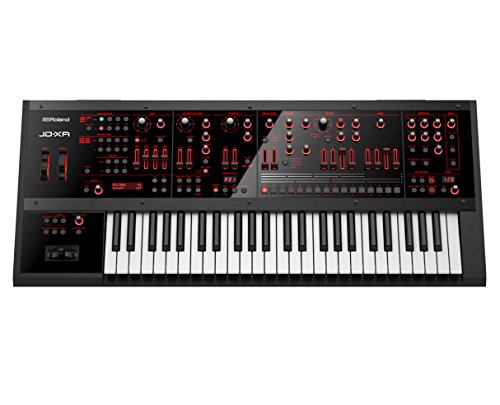
Roland JD-XA 49-Key
Synthesists who want genuine discrete analog voices and a digital engine in one 49-key crossover instrument with deep real time filter control.
Read the Roland JD-XA 49-Key review →
Pioneer DJ DDJ-FLX10 4-Channel
Mobile and open-format DJs who want a 4-channel club style controller with live stem separation and lighting control from one unit.
Read the Pioneer DJ DDJ-FLX10 4-Channel review →Questions Buyers Ask
Arturia KeyStep Pro 37-Key
See the current listing, price and included accessories.
About This Review
Mandrillis Team
The Mandrillis editorial team researches and compares audio and music gear using manufacturer documentation, verified specs and real buyer feedback, so you can make a confident purchase without wading through marketing claims.
Read our full research methodology.