Instruments Review
KORG Keystage 49 Review: Aftertouch Meets MPE Control
The KORG Keystage 49 pairs a semi-weighted 49-key bed with Polyphonic and Channel Aftertouch, MPE compatibility and a built-in audio interface with direct stereo output. The listing highlights MIDI 2.0 Property Exchange, wood side panels and a generous Ableton Live software bundle, though several physical specifications remain unpublished.
Our Verdict
Research Score 79/100The KORG Keystage 49 earns its place by combining two features that rarely appear together at a mid-range price: Polyphonic Aftertouch and full MPE compatibility. That pairing matters most to players who lean on expressive synth, string and pad sounds, since pressure after the strike becomes a real performance tool rather than a gimmick. The built-in audio interface with direct stereo output is a genuine convenience for a compact rig, and the Ableton Live bundle adds value for producers already inside that ecosystem. The listing leaves knob counts, power and weight unstated, which keeps a few practical questions open. For an Ableton-centered player who wants expressive control in a 49-key semi-weighted frame, this is a strong mid-range pick worth closer inspection before purchase.
Editorial research score based on published specifications and documented features, not a customer rating or lab test.

KORG
KORG Keystage 49
Best for: Live performers and Ableton Live producers who want expressive Polyphonic Aftertouch and MPE control on a 49-key semi-weighted controller with a built-in audio interface.
Skip it if: You need a fully weighted 88-key piano action or you want exact knob, fader and weight figures published before you buy.
Check Price on AmazonWe may earn a commission at no extra cost to you.
Listing verified: November 2026
Who Should Buy It
Buy it if
- Live performers who want a built-in audio interface inside their controller
- Producers working inside Ableton Live who want deep, automatic parameter integration
- Players who value Polyphonic Aftertouch for expressive pad, string and synth sounds
- Buyers who want a generous software bundle without paying extra for a DAW
Skip it if
- You need a fully weighted hammer-action keybed for classical piano practice
- You require exact knob, fader, power and weight figures before buying
- You never touch Ableton Live and have no use for MPE
Key Specifications
| Keys | 49 keys |
| Key type | Semi-weighted keybed with Polyphonic and Channel Aftertouch, MPE compatible |
| Pads | Not published in listing |
| Knobs and faders | Not published in listing; the listing describes parameter-dedicated OLED screens for visual feedback |
| DAW integration | Official Ableton Live integration with MIDI 2.0 Property Exchange for automatic parameter mapping |
| Bundled software | Korg Gadget Producer Bundle, wavestate native LE, Ableton Live 11 Lite |
| Connectivity | Built-in audio interface with direct stereo output; other ports not published in listing |
| Power | Not published in listing |
| Weight | Not published in listing |
| Included accessories | Not published in listing |
Overview
The KORG Keystage 49 is a 49-key MIDI controller built around a single idea: expressive touch should not be reserved for flagship synthesizers. It uses a semi-weighted keybed fitted with both Polyphonic and Channel Aftertouch, a combination that lets pressure applied after a key is struck shape a sound on a per-note basis rather than across the whole keyboard. That alone separates it from the mass of budget and mid-range controllers that skip aftertouch entirely.
Korg builds the case for live use throughout the feature set. Wood side panels give the chassis a more considered look than the molded plastic typical of this price range, and parameter-dedicated OLED screens are described as giving instant visual feedback during both production and performance. A built-in arpeggiator and chord modes round out a streamlined workflow aimed at players who want to sketch ideas quickly.
Korg also leans into software integration, pairing the hardware with official Ableton Live support and MIDI 2.0 Property Exchange, a newer protocol feature meant to make controller to software mapping more automatic. Buyers get a software bundle on top of that, which matters for anyone assembling a first production setup around this keyboard.
Keys, Pads and Feel
The 49-key bed is semi-weighted, a touch profile that sits between the light springs of entry level controllers and the hammer weighted feel of a digital piano. That makes it suited to synth, organ and pad playing, where fast repeated notes matter more than simulating an acoustic piano's resistance. Pianists who want a weighted feel for two-handed repertoire should look elsewhere, since the listing does not describe any weighted option for this model.
What raises this keybed above most controllers in its class is the aftertouch implementation. Polyphonic Aftertouch tracks pressure independently on every held note, while Channel Aftertouch applies a single pressure value across the whole keyboard; having both available lets a player choose the behavior that suits a given patch. Combined with MPE compatibility, this keybed can drive a modern synth with the kind of per-note expression normally associated with specialized expressive controllers rather than general purpose keyboards.
The listing does not mention any pads on the Keystage 49, so finger drumming, sample triggering and clip launching are not part of its feature set. Buyers who want that functionality alongside expressive keys will need to add a separate pad controller to the setup.
Knobs, Faders and DAW Integration
Exact knob, fader and button counts are not published in the listing, so this review cannot describe the panel layout in numbers. What is confirmed is the presence of parameter-dedicated OLED screens, which the listing says provide instant visual feedback during both production and live performance. That suggests a control surface built around clear labeling rather than a dense unlabeled grid of generic knobs.
An arpeggiator and chord modes are built into the workflow, letting a player generate rhythmic or harmonic material directly from the keybed without opening software. The listing frames this as part of a streamlined workflow, which is a reasonable description if the controls are indeed dedicated to specific parameters rather than requiring constant mode switching.
DAW integration centers on official Ableton Live support paired with MIDI 2.0 Property Exchange. Property Exchange is designed to let compatible hardware and software negotiate parameter names, ranges and current values automatically, which in practice should mean less manual mapping than on older MIDI 1.0 controllers. The listing does not describe a specific DAW remote mode beyond the Ableton Live integration, so users of other DAWs should expect standard MIDI mapping rather than deep native control.
Software, Sounds and Features
The Keystage 49 ships with a notably generous software bundle for its price tier. The Korg Gadget Producer Bundle brings a mobile and desktop friendly production environment with its own synths and effects, wavestate native LE offers a taste of Korg's wave sequencing synthesis engine in plugin form, and Ableton Live 11 Lite provides a full, if entry level, digital audio workstation. Together these give a new buyer a working production chain without any additional software purchase.
MIDI 2.0 Property Exchange is the more forward looking feature here. Where MIDI 1.0 required manual assignment of controller numbers to software parameters, Property Exchange is designed to let compatible gear share that information automatically, reducing setup friction. Its real world benefit depends on how many of a user's other devices and plugins also support the newer protocol, which is still spreading across the industry.
The arpeggiator and chord modes mentioned under creative features deserve a second look here, since they function as compositional tools as much as performance aids. Chord modes let a single key trigger a full chord, which is useful for players who think in terms of harmony first and keyboard technique second.
- Korg Gadget Producer Bundle for mobile and desktop production
- wavestate native LE wave sequencing synth plugin
- Ableton Live 11 Lite digital audio workstation
- Built-in arpeggiator and chord modes
- MIDI 2.0 Property Exchange for automatic parameter mapping
Build, Design and Portability
Wood side panels are the standout build detail in the listing, giving the Keystage 49 a visual and tactile character that most plastic-bodied controllers in this range lack. Korg frames this explicitly as a design choice for live performance, where a more durable and distinctive looking instrument matters on a stage next to other gear.
The listing does not publish weight, dimensions or chassis material beyond the wood panels, so this review cannot confirm how the Keystage 49 compares for portability against similarly sized 49-key controllers. Buyers who gig regularly and need to know exact case dimensions or travel weight should check Korg's own specification sheet before committing.
Parameter-dedicated OLED screens also factor into the build story, since a screen based interface typically means more robust, purpose-built hardware behind the panel rather than generic potentiometers with printed labels that can wear off over time.
Connectivity and Power
The most notable connectivity feature is a built-in audio interface with direct stereo output, which the listing ties directly to live performance use. That feature alone can simplify a touring rig, since a player can run a stereo signal from a laptop or synth engine straight out of the controller rather than carrying a separate interface.
Beyond the built-in interface, the listing does not publish a full connectivity list. Standard MIDI controllers in this class typically offer USB, MIDI in and out, and sustain or expression pedal inputs, but Korg's listing for the Keystage 49 does not confirm which of those are present, so this review will not assume any of them.
Power requirements and whether the unit can run on USB bus power alone are also not stated. Buyers planning a battery powered or minimal cable rig should confirm power draw directly with Korg before building a setup around this assumption.
Setup and Daily Use
For an Ableton Live user, the setup path described in the listing should be close to plug and play, since the official integration and MIDI 2.0 Property Exchange are both designed to reduce manual configuration. A player should expect to install the bundled software, connect the controller, and have transport and parameter mapping largely handled for them inside Live.
Daily use benefits from the parameter-dedicated OLED screens, assuming they behave as described and show live feedback rather than static labels. That kind of visual confirmation reduces the guesswork that comes with unlabeled knob based controllers, where a player has to remember which knob does what across different patches.
Players outside the Ableton Live ecosystem will rely on standard MIDI mapping in their DAW of choice, since the listing does not promise native integration elsewhere. The aftertouch and MPE features should still function in any MPE aware synth or plugin, which broadens the Keystage 49's usefulness beyond Ableton alone.
Who Should Buy It
The Keystage 49 is aimed squarely at players who want expressive control over a straightforward one way MIDI connection. Its combination of Polyphonic Aftertouch and MPE compatibility makes it a strong match for anyone performing with modern soft synths or MPE capable hardware that reward per-note pressure and movement.
Ableton Live users get an additional reason to consider it, since the official integration and bundled Ableton Live 11 Lite reduce both setup friction and software cost. Producers who want a semi-weighted 49-key bed with a built-in audio interface for a compact live or home setup will also find the feature set well matched to that use case.
Players who need a fully weighted piano action, exact published specifications on weight and power, or pad based finger drumming will be better served elsewhere, since none of those needs are addressed by what Korg has published about this model.
Alternatives Worth Considering
Players comparing the Keystage 49 against other 49-key semi-weighted controllers from Arturia or Novation should weigh how much aftertouch and MPE matter to their own playing style, since many competing controllers at a similar tier do not offer Polyphonic Aftertouch at all. That single feature is arguably the Keystage 49's clearest differentiator.
Buyers who want a more compact footprint with pads for finger drumming, closer to what a small Akai or Arturia MiniLab style controller offers, should look at keyboards built around that use case instead, since the Keystage 49 has no pads in its published feature set.
Those who prioritize fully weighted piano feel over expressive control will find more satisfaction in a hammer action controller or a dedicated digital piano, since the Keystage line is built around synth style playing rather than acoustic piano replication.
Verdict
Taken as a whole, the Keystage 49 reads as a controller built around touch sensitivity rather than raw control density. Polyphonic Aftertouch and MPE compatibility are the features that justify its mid-range position, since they bring a level of per-note expression that most controllers in this bracket skip entirely.
Korg backs that expressive core with practical extras: a built-in audio interface, an Ableton Live focused workflow and a software bundle generous enough to get a new producer working immediately. What is missing is transparency on the physical details, since knob counts, power draw and weight are never stated.
Buyers who care most about touch and expression over raw spec sheets, and who already work inside or are willing to adopt Ableton Live, will get the most from this keyboard.
Strengths and Limitations
Strengths
- Polyphonic and Channel Aftertouch on a semi-weighted 49-key bed, a rare combination at this tier
- MPE compatibility opens the door to per-note pitch, pressure and timbre control
- Built-in audio interface with direct stereo output simplifies a stage or desk setup
- Wood side panels add a more durable, premium look than most plastic controllers
- Generous bundled software includes the Gadget Producer Bundle, wavestate native LE and Ableton Live 11 Lite
- MIDI 2.0 Property Exchange points toward deeper, more automatic integration with supported software
Limitations
- Knob, fader and pad counts are not published in the listing
- Power, weight and included accessories are not stated
- No pads are mentioned, so finger drumming or clip launching needs a separate controller
- Semi-weighted action will not satisfy players who want a fully weighted hammer feel
How We Scored It
Scores reflect published specifications, documented features and value against the alternatives below. They are editorial research scores, not laboratory measurements.
Alternatives to Consider

Yamaha Montage M6 61-Key
Professional synth players and producers who want a flagship 61-key instrument with massive polyphony, analog style synthesis and a matching software plugin.
Read the Yamaha Montage M6 61-Key review →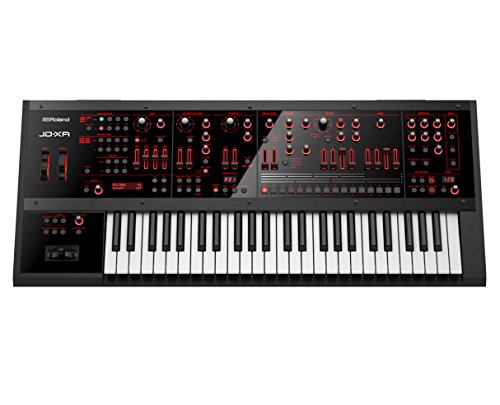
Roland JD-XA 49-Key
Synthesists who want genuine discrete analog voices and a digital engine in one 49-key crossover instrument with deep real time filter control.
Read the Roland JD-XA 49-Key review →
Pioneer DJ DDJ-FLX10 4-Channel
Mobile and open-format DJs who want a 4-channel club style controller with live stem separation and lighting control from one unit.
Read the Pioneer DJ DDJ-FLX10 4-Channel review →Questions Buyers Ask
KORG Keystage 49
See the current listing, price and included accessories.
About This Review
Mandrillis Team
The Mandrillis editorial team researches and compares audio and music gear using manufacturer documentation, verified specs and real buyer feedback, so you can make a confident purchase without wading through marketing claims.
Read our full research methodology.