Instruments Review
Novation Launchkey 88 MK3 Review: Full Size, Full Featured
The Novation Launchkey 88 MK3 pairs 88 premium semi-weighted keys with 16 velocity-sensitive pads, deep DAW integration, a powerful arpeggiator with Strum Mode and three chord modes. It is a full size controller built for players who want keys, pads and software control together in one unit.
Our Verdict
Research Score 79/100The Novation Launchkey 88 MK3 delivers on the promise of a full size controller that does not sacrifice pad based workflows for keyboard range. Eighty eight premium semi-weighted keys cover two-handed playing, while 16 velocity-sensitive pads bring finger drumming and clip launching into the same unit. Its strongest claim is deep, seamless integration across all leading DAWs, backed by a powerful arpeggiator with Strum Mode and three distinct chord modes for harmonic playing. Custom Modes and MIDI output extend its reach to external hardware synths as well. Knob, fader, power and weight details are not published, leaving some practical questions open. For a player who wants the full Launchkey workflow in an 88-key format, this is a strong lower mid-range pick.
Editorial research score based on published specifications and documented features, not a customer rating or lab test.

Novation
Novation Launchkey 88 MK3
Best for: Producers who want full size semi-weighted keys and pads together, with deep plug and play integration across major DAWs.
Skip it if: You need a compact, travel-friendly controller, since 88 keys makes this one of the larger options in the Launchkey range.
Check Price on AmazonWe may earn a commission at no extra cost to you.
Listing verified: November 2026
Who Should Buy It
Buy it if
- Pianists and keyboardists who want 88 keys without giving up pads and DAW controls
- Producers who want seamless integration with their DAW out of the box
- Players who use chord modes and arpeggiation as part of their writing process
- Anyone who wants to control external hardware synths via Custom Modes and MIDI output
Skip it if
- You need a compact controller for travel or a small desk
- You require a published, exact knob and fader count before buying
- You want bundled production software included in the purchase
Key Specifications
| Keys | 88 keys |
| Key type | Premium semi-weighted, full size keybed |
| Pads | 16 velocity-sensitive pads |
| Knobs and faders | Not published in listing; exact pot and fader count not stated |
| DAW integration | Described as seamless, deep integration across all leading DAWs with immediate access to controls |
| Bundled software | Not published in listing |
| Connectivity | MIDI output for controlling synths and hardware; other ports not published in listing |
| Power | Not published in listing |
| Weight | Not published in listing |
| Included accessories | Not published in listing |
Overview
The Novation Launchkey 88 MK3 sits at the top of the Launchkey range by key count, offering a full 88-key keybed alongside the pad and control layout that defines the rest of the series. The listing leads with that keybed, describing it as a premium full size keybed with 88 premium semi-weighted keys.
Alongside the keys, 16 velocity-sensitive pads are included, which means this controller does not force a choice between a full piano range and a pad based performance surface. Both are present in one unit, aimed at players who move between melodic playing and beat programming.
Novation's pitch for the Launchkey line has always centered on DAW integration, and this listing repeats that emphasis, describing seamless integration across all leading DAWs with immediate access to the controls a producer needs most during a session.
Keys, Pads and Feel
The 88-key bed is described as premium and semi-weighted, which should offer a heavier, more piano-like response than the lighter synth action found on many smaller MIDI controllers. For a keyboardist who regularly plays two-handed parts, 88 keys removes the range limitations that come with 49 or 61-key alternatives.
The 16 velocity-sensitive pads bring a second performance mode to the same unit. Velocity sensitivity means the pads respond differently to light and hard hits, which matters for finger drumming and for triggering clips or samples with some dynamic feel rather than a flat on-off response.
Having both a full size keybed and a dedicated pad bank in one controller is relatively uncommon at this size, since many manufacturers treat 88-key controllers as keyboard-only products. The Launchkey 88 MK3 keeps the pad workflow intact even at the largest key count in its range. That design choice matters most for producers who do not want to give up finger drumming just because they need the extra octaves a full size keybed provides.
Knobs, Faders and DAW Integration
The listing does not publish an exact knob, pot or fader count for this model, so this review cannot describe the control surface layout in specific numbers. What is described in detail is the behavior of that integration rather than the hardware count behind it.
DAW integration is presented as a core strength, with the listing promising immediate access to the controls a producer needs across every leading DAW. That kind of claim typically means transport, mixer and plugin parameter mapping are handled automatically once the controller is connected, reducing manual MIDI assignment.
Custom Modes extend that control surface beyond DAW use, letting a player remap the same knobs, pads and buttons to control external hardware synths or other MIDI gear. Combined with a dedicated MIDI output, this gives the Launchkey 88 MK3 a role outside the DAW as well as inside it. That dual role is a meaningful selling point for anyone who splits time between software production and a hardware synth collection, since one controller can serve both contexts without reconfiguration.
Software, Sounds and Features
No bundled software is named in the listing, which stands out given how many competing controllers lead with an included synth or sample library. The feature emphasis here is squarely on performance tools built into the hardware itself rather than software included in the box.
The powerful arpeggiator with Strum Mode is one of the more distinctive features described. Strum Mode typically lets a player trigger a held chord progressively, similar to strumming a guitar, which adds a performance technique not found on most basic arpeggiators.
Three chord modes, fixed, scale and user, give players different ways to access harmony without manual note-by-note chord voicing. Fixed mode locks in a chosen chord shape, scale mode keeps triggered chords within a selected scale, and user mode allows a custom chord definition, covering a range of harmonic working styles.
- 88 premium semi-weighted keys with 16 velocity-sensitive pads
- Seamless DAW integration across all leading software
- Powerful arpeggiator with Strum Mode
- Three chord modes: fixed, scale and user
- Custom Modes and MIDI output for external hardware control
Build, Design and Portability
The listing does not publish weight, dimensions or chassis material for the Launchkey 88 MK3, so this review cannot describe its physical build in specific terms. An 88-key controller with 16 pads and a full control section is inherently one of the larger devices in its category simply due to key count.
Portability is a real consideration here, since 88 keys typically means a longer, heavier chassis than the 25, 37 or 49-key Launchkey variants in the same family. Buyers who travel frequently should weigh that size against the benefit of having full keyboard range.
Without published weight or case dimensions, musicians planning to transport this controller regularly should confirm those figures directly with Novation before committing to a specific bag or case. Players who mainly intend to keep this controller on a permanent studio desk will find portability less of a concern than a gigging musician moving gear between venues.
Connectivity and Power
The clearest connectivity feature in the listing is MIDI output, described specifically for controlling synths and hardware, which supports the Custom Modes functionality covered earlier. That confirms at least one dedicated MIDI connection beyond the standard USB link to a computer.
Other connectivity details, including whether MIDI input is present, how many MIDI ports exist, and whether there is a sustain or expression pedal input, are not published in the listing. Buyers who need those specific connections for a hybrid analog and digital setup should verify them before purchase.
Power requirements are not stated either. Most controllers in this class run on USB bus power without a separate adapter, but that is not explicitly confirmed here, so it should not be assumed without checking. A buyer planning to run the controller from a USB hub alongside other bus powered devices should verify its current draw before relying on that setup for a show.
Setup and Daily Use
Given the emphasis on seamless DAW integration, setup should be straightforward for anyone using one of the major supported DAWs, with transport and mixer controls mapped automatically once the controller connects. That reduces the manual configuration typically required with a generic MIDI controller.
Daily use would likely move between the 88-key bed for melodic parts and the 16 pads for beat programming or clip launching, supported by the arpeggiator, Strum Mode and chord modes when a player wants to generate musical material quickly rather than entering every note by hand.
For hardware focused producers, Custom Modes and the dedicated MIDI output allow the same physical controller to double as a control surface for external synths, which can simplify a studio that mixes software and hardware instruments on the same desk. Switching between a software and a hardware focused session should, in principle, be a matter of selecting a different Custom Mode rather than physically swapping controllers.
Who Should Buy It
This suits keyboardists who want full 88-key range without giving up a pad based performance workflow, since both are present in one unit rather than requiring two separate controllers.
Producers who want DAW integration to work immediately after connecting, without extensive manual setup, are a strong match, as are players who lean on arpeggiators and chord modes to generate musical ideas during writing sessions.
Buyers who want a compact, travel-light controller, or who need a published exact knob and fader count before purchasing, will find this listing leaves some of that detail to be confirmed separately.
Alternatives Worth Considering
Players who do not need the full 88-key range should look at the smaller Launchkey models in the same family, which trade some keys for a more compact, travel-friendly footprint while keeping similar pad and DAW integration features.
Buyers who want bundled production software included in the box should compare this listing against controllers that specifically name an included synth or sample library, since the Launchkey 88 MK3 listing does not make that claim.
Those focused mainly on hardware synth control through CV or Gate outputs, rather than MIDI alone, should look at a dedicated sequencer-style controller instead, since this model's external control relies on MIDI output and Custom Modes rather than analog connections. Players weighing this decision should think about how much of their rig is already MIDI based, since that determines how much the Launchkey's connectivity choices actually matter in practice.
Verdict
The Launchkey 88 MK3 succeeds at combining two things that do not always coexist in one controller: a full 88-key playing range and a dedicated pad bank for beat programming and clip launching.
Its DAW integration claim is backed by real performance tools, including a Strum Mode arpeggiator and three chord modes, while Custom Modes and MIDI output extend its usefulness to external hardware as well.
Unpublished knob counts, power and weight leave a few details for buyers to confirm, but for anyone wanting full keys and pads together with strong DAW support, this is a well-rounded lower mid-range choice.
Strengths and Limitations
Strengths
- 88 premium semi-weighted keys give a full size, two-handed playing range
- 16 velocity-sensitive pads add finger drumming and clip launching to a full keybed
- Deep, seamless DAW integration across all leading software
- Powerful arpeggiator with a dedicated Strum Mode for melodic and chordal texture
- Three chord modes, fixed, scale and user, make harmonic playing more accessible
- Custom Modes and MIDI output let it control external synths and hardware directly
Limitations
- Knob, fader and pot counts are not published in the listing
- No bundled software is named
- Power, weight and included accessories are not stated
- 88 keys and a full control layout make this a larger, less portable controller than smaller Launchkey models
How We Scored It
Scores reflect published specifications, documented features and value against the alternatives below. They are editorial research scores, not laboratory measurements.
Alternatives to Consider

Yamaha Montage M6 61-Key
Professional synth players and producers who want a flagship 61-key instrument with massive polyphony, analog style synthesis and a matching software plugin.
Read the Yamaha Montage M6 61-Key review →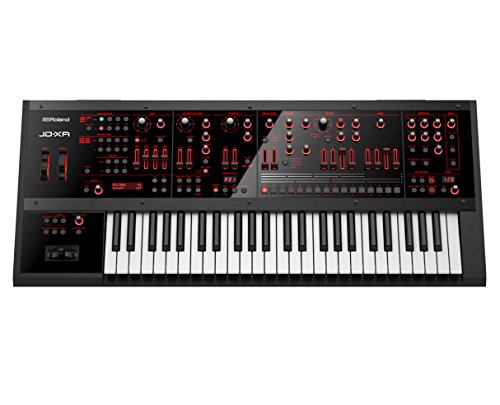
Roland JD-XA 49-Key
Synthesists who want genuine discrete analog voices and a digital engine in one 49-key crossover instrument with deep real time filter control.
Read the Roland JD-XA 49-Key review →
Pioneer DJ DDJ-FLX10 4-Channel
Mobile and open-format DJs who want a 4-channel club style controller with live stem separation and lighting control from one unit.
Read the Pioneer DJ DDJ-FLX10 4-Channel review →Questions Buyers Ask
Novation Launchkey 88 MK3
See the current listing, price and included accessories.
About This Review
Mandrillis Team
The Mandrillis editorial team researches and compares audio and music gear using manufacturer documentation, verified specs and real buyer feedback, so you can make a confident purchase without wading through marketing claims.
Read our full research methodology.