Studio Gear Review
ADAM Audio D3V Active Review: Ribbon Treble on a USB-C Desk
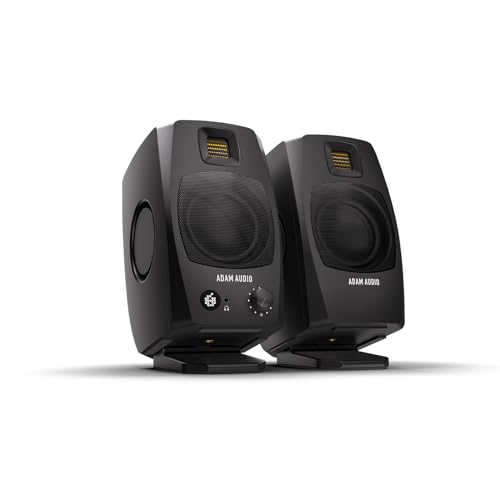
The ADAM Audio D3V Active is a desktop monitoring pair with a 1.5 inch D-ART ribbon tweeter, 3.5 inch aluminum woofers, dual passive radiators, USB-C and TRS inputs and DSP placement switches. This research review covers the published 45 Hz to 23 kHz response, the angled stands and who the system suits.
Our Verdict
Research Score 81/100The ADAM Audio D3V Active brings ribbon tweeter detail to a desktop system that connects straight to a laptop. The listing publishes a 1.5 inch D-ART tweeter, 3.5 inch aluminum woofers with ferrite magnets and dual-sided passive radiators, a 45 Hz to 23 kHz response, 97 dB SPL, USB-C and balanced TRS inputs on the left speaker, a front headphone socket, DSP placement switches, 15 degree angled stands and a firmware controlled sleep mode. It is a close listening tool with modest output, the power figures on the page are inconsistent, and dimensions and weight are unpublished. For producers and creators working at a desk at the lower mid-range tier, it is one of the most complete small systems available.
Editorial research score based on published specifications and documented features, not a customer rating or lab test.
ADAM Audio
ADAM Audio D3V Active
Best for: Laptop based songwriters, producers and creators who want ribbon tweeter accuracy and a headphone hub on a desk over USB-C.
Skip it if: You mix from more than arm's length away, need XLR inputs or high output, or must hear below 45 Hz directly.
Check Price on AmazonWe may earn a commission at no extra cost to you.
Listing verified: October 2026
Who Should Buy It
Buy it if
- Songwriters and producers working from a laptop without an interface
- Content creators and streamers who want accurate desktop sound
- Owners of larger ADAM Audio monitors wanting a matching writing desk pair
- Anyone who wants a front volume knob and headphone socket within reach
Skip it if
- You need a traditional midfield or large nearfield monitor
- You require XLR connections
- You produce sub bass heavy music without a subwoofer
Key Specifications
| Type | Fully active desktop studio monitor system, black, pair, with inputs and controls on the left speaker |
| Woofer | 3.5 inch aluminum woofer with ferrite magnet system, plus dual-sided 3.5 inch passive radiators |
| Tweeter | 1.5 inch D-ART (Desktop Accelerated Ribbon Tweeter) |
| Power | 240W stated in the listing title; bullets describe woofers driven by 80 W amplifiers; 97 dB SPL |
| Frequency response | 45 Hz to 23 kHz |
| Inputs | USB-C, balanced 1/4 inch TRS inputs on the left speaker backplate, front panel headphone output |
| Room controls | DSP-powered switches on the left speaker backplate for placement related acoustic issues |
| Dimensions | Not published in listing |
| Weight | Not published in listing |
| Included accessories | Detachable monitor stands angled 15 degrees toward the listener |
Overview
The ADAM Audio D3V Active is a desktop monitoring system that brings the company's ribbon tweeter technology down to a size that fits beside a laptop. Sold as a pair in black, it combines 3.5 inch aluminum woofers, a 1.5 inch D-ART tweeter per speaker, built in DSP and a USB-C connection so a computer or mobile device can feed it directly. It sits in the lower mid-range tier.
The listing describes the D3V as designed for songwriters, producers and music lovers, which is a wider audience than the typical studio monitor targets. The front panel volume knob, headphone socket and angled stands all point to a product meant to live on a desk and be used every day rather than tucked into a control room.
Documentation is good. The listing publishes driver sizes, the passive radiator arrangement, a 45 Hz to 23 kHz response, 97 dB SPL, the input types, the stand angle, the mounting thread and even a firmware controlled sleep setting. Dimensions and weight are missing, and the power figures need a closer look, which the drivers section covers.
Accuracy and Sound Signature
The D-ART, which the listing expands as Desktop Accelerated Ribbon Tweeter, is a 1.5 inch version of the folded ribbon design ADAM Audio uses across its studio lines. The listing promises the same precise and unfatiguing high frequency reproduction the brand's established monitors are known for, and that character is the main reason to choose the D3V over a conventional dome tweeter desktop speaker.
Low frequency reach is handled by a 3.5 inch aluminum woofer per speaker, supported by dual-sided 3.5 inch passive radiators that the listing credits with extending response down to 45 Hz. Passive radiators act like a tuned port without the air noise, and they are a common way to get deeper bass from a cabinet too small for a conventional port.
A 45 Hz floor from a 3.5 inch system is a strong published figure, and the 97 dB SPL rating indicates a speaker built for close listening rather than for volume. Against a PreSonus Eris 3.5, the natural size rival, the D3V competes on tweeter refinement and DSP rather than on loudness, and against a Yamaha HS5 it gives up woofer area but gains desktop convenience.
Drivers, Amplification and Power
Each speaker uses a 3.5 inch aluminum woofer with a ferrite magnet system, which the listing describes as driven by 80 W amplifiers. Aluminum cones are stiff and light, which suits a small driver that has to move quickly and resist breakup at the top of its range.
The listing title states 240W for the system, while the bullets describe 80 W amplification for the woofers. The two figures are not reconciled on the page, and the title number may represent a peak or total system rating while the bullet refers to woofer amplification. Buyers who care about the exact split should confirm with the manufacturer rather than assume.
The 1.5 inch D-ART tweeter is the smallest ribbon style unit ADAM Audio describes, scaled for desktop distances. The crossover frequency and the tweeter amplifier power are not published. For a desktop system the overall driver complement is unusually ambitious, and the published 45 Hz extension reflects that.
Room Fit, Placement and Controls
Desktop monitors face a specific acoustic problem: the desk itself. A speaker sitting directly on a work surface produces a strong early reflection that colors the lower midrange, and a position near a wall adds bass. The D3V answers both with DSP-powered switches on the left speaker's backplate, which the listing says address common acoustical issues arising from placement.
The detachable stands are the other half of the solution. They angle each speaker 15 degrees toward the listener's ears, which lifts the tweeter axis off the desk and reduces that first reflection. For a listener seated close to a monitor on a desk, the angle is as important as any EQ switch.
There is also a standard 3/8 inch threaded hole on the underside of both monitors for microphone stand mounting, which allows the speakers to come off the desk entirely. The listing does not publish dimensions or weight, so buyers planning stand mounting should check the load rating against the manufacturer's figures.
- DSP switches on the left speaker for desk and wall placement
- Detachable stands angled 15 degrees toward the listener
- 3/8 inch thread on both speakers for stand mounting
- Compact footprint for laptop desks
- Firmware controlled 20 minute auto sleep can be disabled
Build, Design and Finish
The D3V comes in black in this listing, with a compact cabinet designed to look at home on a desk rather than in a control room. The listing describes the monitors as stylish and the front panel carries a volume knob and a headphone socket, which gives the system the feel of a finished desktop product rather than a bare studio tool.
The passive radiators are mounted on both sides of each cabinet, which is why the listing calls them dual-sided. That arrangement balances the forces on the enclosure and keeps the front baffle free for the woofer and tweeter. Cabinet material and construction details are not published, and neither are dimensions or weight.
The included stands are detachable, so the speakers can be used flat, angled or on microphone stands as the desk demands. For a product in the lower mid-range tier that flexibility is a genuine value point, since many rivals require separate angled pads or stands.
Connectivity and Inputs
The D3V's standout connection is USB-C, which allows a computer, tablet or phone to feed the monitors directly without a separate audio interface. For songwriters and content creators working from a laptop, that removes a box and a set of cables from the desk and is a major reason the system exists.
For studio use, the left speaker's backplate carries balanced 1/4 inch TRS inputs, so an audio interface or monitor controller connects in the conventional way. The front panel adds a headphone socket, which lets the D3V act as a small monitoring hub for late night work without touching the interface.
No XLR, RCA or wireless connection is published. The system architecture means the right speaker connects to the left rather than to the source, so only the left unit needs a signal feed. Cable length between the two speakers is not stated and should be checked for wider desks.
Setup and Daily Use
Setup is as simple as a studio monitor gets: attach the angled stands, place the pair at the edges of the desk aimed at the listening position, connect USB-C or TRS to the left speaker, and set the DSP switches for desk and wall placement. The front volume knob then handles daily level changes.
The headphone socket on the front panel turns the D3V into a convenient desktop hub, and the firmware controlled sleep mode is a thoughtful detail. The listing notes that with the latest firmware the 20 minute auto sleep can be turned on or off, so users streaming, gaming or mixing long sessions can keep the monitors awake, while others can save energy.
Day to day the appeal is a ribbon tweeter at arm's length. ADAM Audio's treble is known for staying smooth over long sessions, and at desktop distances the placement of instruments in a mix is unusually clear. The modest 97 dB SPL rating is not a limitation at that range.
Who Should Buy It
The ADAM Audio D3V Active is built for songwriters, producers and content creators who work from a laptop at a desk and want a serious monitor that connects over USB-C without an interface. It also suits anyone who wants a headphone hub and volume knob within reach.
Owners of larger ADAM Audio monitors will find it a natural second system for a writing desk or an office, since the tweeter character is familiar. Gamers and streamers who want accurate sound with a disable option on auto sleep are explicitly addressed by the listing.
It is not the right choice for a mixing room where the engineer sits more than arm's length away, or for anyone who needs XLR inputs or high output. Producers of bass heavy music who need to hear below 45 Hz directly should look at a larger monitor or add a subwoofer.
Alternatives Worth Considering
The PreSonus Eris 3.5 is the obvious size rival, offering front controls and a headphone jack at a budget tier, but with a conventional dome tweeter and without USB-C or DSP placement switches. Buyers who want the cheapest competent desktop pair will consider it first.
The Adam Audio T5V is the step up within the brand, with a larger woofer and the same family of ribbon tweeters in a conventional studio monitor format that needs an interface. The Yamaha HS5 and the JBL 305P MkII are similar traditional alternatives that trade desktop convenience for more woofer area.
Few competitors combine a ribbon style tweeter, USB-C input, DSP placement correction and included angled stands in one desktop package. That combination is the D3V's case, and buyers who want all of those together have limited options at this tier.
Verdict
The ADAM Audio D3V Active is a well documented, cleverly designed desktop monitoring system. The listing publishes a 1.5 inch D-ART tweeter, 3.5 inch aluminum woofers with dual-sided passive radiators, a 45 Hz to 23 kHz response, 97 dB SPL, USB-C and balanced TRS inputs, a headphone output, DSP placement switches and angled stands.
Its limits are output and reach: this is a close listening system, not a room filling monitor. The power figures on the page are inconsistent between the title and the bullets, and dimensions and weight are unpublished.
For a laptop based producer or creator who wants ADAM Audio treble on the desk with minimal cabling, it is an easy recommendation at the lower mid-range tier. Engineers who need distance, XLR or volume should look at a conventional nearfield.
Strengths and Limitations
Strengths
- 1.5 inch D-ART ribbon tweeter at desktop scale
- Published 45 Hz to 23 kHz response from a 3.5 inch system
- USB-C input removes the need for an interface
- Balanced TRS inputs and front headphone output
- DSP placement switches plus 15 degree angled stands included
- Auto sleep can be disabled with the latest firmware
Limitations
- 97 dB SPL suits close listening only
- Power figures differ between the listing title and bullets
- No XLR or RCA input
- Dimensions and weight not published
How We Scored It
Scores reflect published specifications, documented features and value against the alternatives below. They are editorial research scores, not laboratory measurements.
Alternatives to Consider

Edifier MR5
Home producers and musicians who want one 3-way pair for production, everyday listening and wireless convenience.
Read the Edifier MR5 review →
Kali Audio LP-UNF Ultra Nearfield
Desk based producers and editors who want Kali tuning at arm's length with Bluetooth and boundary correction.
Read the Kali Audio LP-UNF Ultra Nearfield review →
ADAM Audio T8V
Bass heavy producers and film or game composers with a medium sized room who want full range monitoring without a subwoofer.
Read the ADAM Audio T8V review →Questions Buyers Ask
ADAM Audio D3V Active
See the current listing, price and included accessories.
About This Review
Mandrillis Team
The Mandrillis editorial team researches and compares audio and music gear using manufacturer documentation, verified specs and real buyer feedback, so you can make a confident purchase without wading through marketing claims.
Read our full research methodology.