Studio Gear Review
Edifier MR5 Review: Three-Way Drivers and Bluetooth for a Desk
The Edifier MR5 is a 3-way active 2.0 pair with a 5 inch long-throw woofer, 3.75 inch mid driver and silk dome tweeter, 110W RMS, Bluetooth 6.0 and four wired inputs. This research review covers the published 46 Hz to 40 kHz response, app room compensation and who the versatile black pair suits.
Our Verdict
Research Score 79/100The Edifier MR5 earns its place at the lower mid-range tier by doing something few rivals attempt: a 3-way active design with a dedicated midrange driver, wrapped in a complete feature set. The listing publishes a 5 inch long-throw woofer, 3.75 inch mid driver, 1 inch silk dome tweeter with dimpled waveguide, 46 Hz to 40 kHz response, 110W RMS Class D power, 101 dB peak SPL, MDF cabinets, XLR, TRS, RCA and AUX inputs, Bluetooth 6.0 with LDAC and multi-point, a front headphone output and app based room compensation. Dimensions, weight and crossover points are unpublished, and the finer tuning relies on the app. For a producer who wants one versatile pair for work and listening, it is a strong recommendation.
Editorial research score based on published specifications and documented features, not a customer rating or lab test.

Edifier
Edifier MR5
Best for: Home producers and musicians who want one 3-way pair for production, everyday listening and wireless convenience.
Skip it if: You want a minimalist reference monitor with no app dependence or you need published dimensions for a tight shelf.
Check Price on AmazonWe may earn a commission at no extra cost to you.
Listing verified: October 2026
Who Should Buy It
Buy it if
- Home studio owners who also use their monitors for music listening
- Creators who want a headphone output and front volume control
- Users with multiple sources including turntables and phones
- Buyers who value room compensation beyond simple switches
Skip it if
- You want a pure reference with no wireless or app features
- You need crossover points and dimensions confirmed
- You dislike app dependent settings
Key Specifications
| Type | 3-way active 2.0 studio monitor bookshelf speaker pair, black |
| Woofer | 5 inch long-throw woofer with 3.75 inch mid driver |
| Tweeter | 1 inch silk dome tweeter with dimpled waveguide |
| Power | 110W RMS Class D amplification, 101 dB peak SPL |
| Frequency response | 46 Hz to 40 kHz |
| Inputs | XLR, TRS, RCA and AUX inputs, Bluetooth 6.0 with LDAC and multi-point, front panel 3.5 mm headphone output |
| Room controls | Rear High and Low frequency knobs plus ConneX app room compensation with Low Cut-Off, Desktop Control and Acoustic Space presets |
| Dimensions | Not published in listing |
| Weight | Not published in listing |
| Included accessories | Not published in listing |
Overview
The Edifier MR5 is a 2.0 pair of active bookshelf monitors that takes an unusual route for the lower mid-range tier: a 3-way driver layout with a dedicated midrange unit, wrapped in a feature set that includes Bluetooth 6.0, an app for room compensation and a front panel headphone output. It is finished in black and aimed at home studios and music listening alike.
Most monitors at this tier are 2-way designs with a woofer and a tweeter. Adding a 3.75 inch mid driver between a 5 inch long-throw woofer and a 1 inch silk dome tweeter lets each driver cover a narrower band, which in principle improves midrange clarity and reduces the compromise at the crossover points. That is the MR5's central technical argument.
The listing is thorough. It publishes all three driver sizes, a 46 Hz to 40 kHz response, 110W RMS Class D power, a 101 dB peak SPL figure, the full input set, the Bluetooth version, the app features and the cabinet material. Dimensions and weight are the only significant omissions, and the review flags them where relevant.
Accuracy and Sound Signature
Edifier describes the MR5 as studio grade, with a 3-way active crossover system built for accurate, detailed reproduction across 46 Hz to 40 kHz. The upper figure is well beyond hearing and is tied to the Hi-Res Audio support the listing highlights, with 24-bit/96kHz handling for wired sources and LDAC for wireless. For monitoring, the 46 Hz floor is the more practical number.
A silk dome tweeter is generally associated with a smooth, slightly soft top end rather than the etched detail of a metal dome or a ribbon. Paired with a dimpled waveguide that the listing says keeps sound consistent across a wider listening area, the MR5's treble should be easy to live with and stable as the listener moves around a desk.
The dedicated midrange driver is where the MR5 differs from a Yamaha HS5 or a KRK Rokit 5 G5. Voices, guitars and snare drums sit in the band the 3.75 inch driver covers, and relieving the woofer of that duty can tighten both the midrange and the bass. Buyers report a fuller presentation than typical 2-way monitors, which suits listening as much as mixing.
Drivers, Amplification and Power
The driver complement is a 5 inch long-throw woofer, a 3.75 inch mid driver and a 1 inch silk dome tweeter per speaker. Long-throw describes a woofer designed for greater cone excursion, which helps a 5 inch unit produce usable bass, and the published 46 Hz extension is a respectable figure for that size.
Amplification is a 110W RMS Class D design, and the listing states a 101 dB peak SPL, which it describes as suitable for nearfield studio use or filling mid sized rooms. Class D is efficient and runs cool, which matters in a compact cabinet that also houses Bluetooth and DSP electronics. The power split between the three drivers is not published.
The 3-way active crossover means the signal is divided before amplification and each driver band is handled separately. Crossover frequencies are not stated in the listing. For a lower mid-range pair, three drivers per side with active filtering is an ambitious specification, and it is the main reason the drivers score well here.
Room Fit, Placement and Controls
The MR5 offers two layers of room tuning. Physical knobs on the rear adjust high and low frequencies in the traditional way, so a quick bass cut for near wall placement or a treble trim for a bright room does not require a phone. That alone matches what most monitors at this tier provide.
The second layer is the EDIFIER ConneX app, which the listing says adds room compensation with a Low Cut-Off setting, Desktop Control and Acoustic Space presets, plus EQ customization. Desktop Control targets the reflection that occurs when a monitor sits on a work surface, and Acoustic Space presets address wall and corner placement.
App based tuning is a double edged convenience: it gives finer control than switches, but it depends on the app being maintained and on the user keeping a phone or tablet handy. The rear knobs provide a fallback, which is the right design. Dimensions and weight are not published, so shelf and stand planning needs the manufacturer's figures.
- Rear High and Low knobs for quick adjustment
- App Low Cut-Off for subwoofer pairing or boom control
- Desktop Control for work surface reflections
- Acoustic Space presets for wall and corner placement
- App EQ for personal taste
Build, Design and Finish
The cabinets are MDF, which the listing credits with reducing distortion and resonance. MDF is the standard material for monitor enclosures at every tier because it is dense, consistent and easy to brace, and its presence is a reassuring detail on a feature heavy product that could have cut corners on the box.
The front panel carries a volume knob and a 3.5 mm headphone output, giving the MR5 the daily usability of a desktop speaker rather than a bare studio tool. The tweeter sits in a dimpled waveguide, a visible design feature that also serves the dispersion goal described in the listing.
The finish is black in this listing. Dimensions and weight are not published, which is a gap for a 3-way cabinet that is likely to be deeper than a typical 5 inch monitor. Buyers planning a narrow shelf should confirm the depth before ordering.
Connectivity and Inputs
Connectivity is the MR5's strongest card. The listing publishes XLR, TRS, RCA and AUX inputs, which cover professional interfaces, consumer sources, turntable preamps and portable players in one cabinet. Few monitors at any tier offer all four at once.
Wireless comes via Bluetooth 6.0 with multi-point connection, so two devices can stay paired, and LDAC support allows higher resolution wireless streaming from compatible phones. For a monitor that doubles as a listening speaker, that is a significant convenience, and it is cleanly separated from the wired studio inputs.
A front panel 3.5 mm headphone output rounds out the set, letting the user switch to headphones for late sessions without touching the interface. The listing does not state whether inputs can be mixed or must be selected, so buyers who want to combine sources should confirm the switching behavior.
Setup and Daily Use
Setup starts in the usual way: place the pair in an equilateral triangle with the listening position, tweeters at ear height, and set the rear Low knob to trim bass if the monitors sit near a wall. The app can then refine the result with Desktop Control and the Acoustic Space presets.
For daily use the MR5 behaves like a hybrid of studio monitor and desktop speaker. Wired sources handle production work at 24-bit/96kHz, Bluetooth takes over for casual listening or reference tracks from a phone, and the front volume knob and headphone jack keep the common controls within reach.
The one habit worth building is checking which room settings are active before mixing, since app EQ designed for enjoyable listening can mislead a mix. Keeping a flat profile saved for production work and a separate one for listening solves that cleanly.
Who Should Buy It
The Edifier MR5 suits home producers and musicians who want one pair of speakers for both production and everyday listening, with enough inputs to connect an interface, a turntable preamp and a phone at the same time. The 3-way layout and app tuning give it more technical depth than most multi purpose speakers.
It also fits content creators and streamers who want a headphone output and front volume control at the desk, and anyone who values wireless convenience without giving up balanced wired inputs. The MDF cabinets and the 101 dB peak SPL make it credible for mid sized rooms.
Engineers who want a strict, minimalist reference may prefer a Yamaha HS5 or a Kali Audio LP-6, which offer fewer features and a narrower focus. Buyers who need published dimensions, or who distrust app dependent tuning, should also weigh those alternatives.
Alternatives Worth Considering
The Yamaha HS5 is the purist alternative at a similar tier: a 2-way design with switch based room controls and no wireless, chosen for translation rather than features. The KRK Rokit 5 G5 adds DSP tuning in a 2-way format and has a warmer character.
The Kali Audio LP-6 is often recommended for buyers who want deeper bass and strong boundary compensation controls, while the JBL 305P MkII competes on waveguide imaging. None of these offers Bluetooth, an AUX input or a headphone jack built in.
For the smallest desks the PreSonus Eris 3.5 provides front controls and a headphone output at a budget tier, but with a 2-way layout and less power. The MR5's combination of three drivers per side, four wired inputs and Bluetooth 6.0 is distinctive in this group.
Verdict
The Edifier MR5 is a feature rich, well documented 2.0 pair that stands apart through its 3-way active driver layout. The listing publishes a 5 inch long-throw woofer, 3.75 inch mid driver, 1 inch silk dome tweeter, 46 Hz to 40 kHz response, 110W RMS Class D power, 101 dB peak SPL, MDF cabinets, four wired inputs, Bluetooth 6.0 with LDAC and app based room compensation.
Dimensions and weight are unpublished, crossover points are not stated, and the app dependence of the finer tuning will not suit everyone. Purist mix engineers may prefer a simpler reference.
For a home producer who wants one pair of speakers to cover production, listening and streaming at a lower mid-range price, it is a strong and unusually versatile choice. Few rivals at this tier offer three drivers per side and four wired inputs together.
Strengths and Limitations
Strengths
- 3-way active layout with a dedicated 3.75 inch mid driver
- Published 46 Hz to 40 kHz response and 101 dB peak SPL
- 110W RMS Class D amplification
- XLR, TRS, RCA and AUX inputs plus Bluetooth 6.0 with LDAC
- Rear knobs and app room compensation with Desktop Control
- MDF cabinets with front volume knob and headphone output
Limitations
- Dimensions and weight not published in the listing
- Crossover frequencies not stated
- Finer room tuning depends on the app
- Feature focus may distract from strict reference use
How We Scored It
Scores reflect published specifications, documented features and value against the alternatives below. They are editorial research scores, not laboratory measurements.
Alternatives to Consider
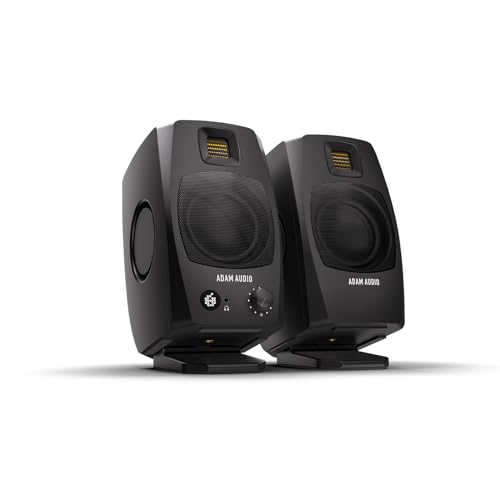
ADAM Audio D3V Active
Laptop based songwriters, producers and creators who want ribbon tweeter accuracy and a headphone hub on a desk over USB-C.
Read the ADAM Audio D3V Active review →
Kali Audio LP-UNF Ultra Nearfield
Desk based producers and editors who want Kali tuning at arm's length with Bluetooth and boundary correction.
Read the Kali Audio LP-UNF Ultra Nearfield review →Questions Buyers Ask
Edifier MR5
See the current listing, price and included accessories.
About This Review
Mandrillis Team
The Mandrillis editorial team researches and compares audio and music gear using manufacturer documentation, verified specs and real buyer feedback, so you can make a confident purchase without wading through marketing claims.
Read our full research methodology.