Studio Gear Review
ADAM Audio T7V Review: Ribbon Tweeter Detail With 7 Inch Reach
The ADAM Audio T7V is a 7 inch two-way studio monitor with the brand's U-ART ribbon tweeter in an HPS waveguide, 70 W of power, a published 39 Hz to 25 kHz response, XLR and RCA inputs and DSP shelf filters. This review covers its treble resolution, bass reach, room controls and the specifications the listing leaves out.
Our Verdict
Research Score 84/100The ADAM Audio T7V brings the brand's U-ART ribbon tweeter and HPS waveguide to a 7 inch cabinet at a lower mid-range tier, and the result is unusually fine treble resolution and a published 39 Hz to 25 kHz response that reaches deeper than most rivals its size. The 70 W of amplification and 110 dB SPL per pair are adequate for nearfield work, the DSP low and high shelf filters handle room correction, and the beveled rear-ported cabinet allows flexible placement. The listing omits woofer material, dimensions, weight and filter ranges, and the input set is XLR and RCA only with no TRS. For a project studio that wants professional-grade treble detail and real bass extension, it is one of the most compelling monitors in its class.
Editorial research score based on published specifications and documented features, not a customer rating or lab test.

ADAM Audio
ADAM Audio T7V
Best for: Project studios that want ribbon tweeter detail and a published 39 Hz bass reach from a 7 inch monitor at a lower mid-range tier.
Skip it if: You need a TRS input, published dimensions and weight, or high output for a large room.
Check Price on AmazonWe may earn a commission at no extra cost to you.
Listing verified: October 2026
Who Should Buy It
Buy it if
- Mixers who want the ADAM treble character on a project budget
- Producers working on bright, dense or vocal-heavy material
- Anyone who wants 7 inch bass reach without a subwoofer
- Buyers who have heard ADAM professional monitors and want the family sound
Skip it if
- Your interface only outputs on TRS and you want a direct cable
- You need every cabinet specification published
- Your room is large and needs higher SPL
Key Specifications
| Type | Active 2-way nearfield studio monitor with rear-firing bass reflex port |
| Woofer | 7 inch woofer; cone material not published in listing |
| Tweeter | U-ART ribbon tweeter with HPS waveguide |
| Power | 70 W; 110 dB SPL per pair |
| Frequency response | 39 Hz to 25 kHz |
| Inputs | XLR and RCA |
| Room controls | DSP-based low shelf and high shelf filters |
| Dimensions | Not published in listing |
| Weight | Not published in listing |
| Included accessories | Not published in listing |
Overview
The ADAM Audio T7V is a two-way nearfield studio monitor built around the brand's U-ART ribbon tweeter in an HPS waveguide and a 7 inch woofer, with 70 W of amplification and a published frequency response of 39 Hz to 25 kHz. The listing states 110 dB SPL per pair, XLR and RCA inputs and DSP-based low and high shelf filters. It sits in the lower mid-range tier.
ADAM Audio is a Berlin company best known for its ribbon tweeters, which appear across its professional ranges at several times the price of the T series. The T7V and its smaller sibling the T5V brought that tweeter technology to a project-studio budget, and the T7V is the larger of the two for rooms that need more bass reach.
The published data documents the essentials of response, power, SPL, inputs and controls. Woofer material, dimensions and weight are not published, and the exact adjustment range of the shelf filters is not stated, so those gaps are noted where they affect a buying decision.
Accuracy and Sound Signature
The U-ART tweeter is a folded ribbon design in which a pleated diaphragm squeezes air out rather than pushing it like a dome. The result that buyers consistently report is a fast, detailed and airy treble, and the published upper limit of 25 kHz reflects the extension that ribbon designs achieve. The HPS waveguide controls how that treble disperses across the room.
At the bottom end, a 39 Hz published limit from a 7 inch rear-ported cabinet is a solid figure, deeper than the typical 5 inch monitor and competitive with other 7 and 8 inch designs in the tier. The listing describes the monitor's acoustic characteristics as accurate and its feedback as reliable for mixing decisions.
The character that the design points toward is detailed and slightly forward in the treble, which exposes sibilance and harshness early. Compared with the warmer tilt buyers attribute to the KRK Rokit 5 G5 or the Mackie MR line, the T7V should read as more revealing on paper, closer in intent to the Yamaha HS5 but with a very different treble presentation.
Drivers, Amplification and Power
The tweeter is the headline driver, and its waveguide, which ADAM calls HPS, shapes the ribbon's output so that it blends evenly with the woofer and keeps the sweet spot wide. The crossover frequency between the two drivers is not published.
The woofer is 7 inches, and the listing does not name its cone material. ADAM's T series has used polypropylene cones, but that is not confirmed here, so it is treated as unpublished. A 7 inch driver is a sensible match for the ribbon tweeter's speed, since it can keep up in the upper midrange without strain.
Amplification totals 70 W, and the listing states 110 dB SPL per pair. The amplifier class and the split between woofer and tweeter are not given. For a nearfield monitor at desk distance, 70 W is adequate rather than generous, and the SPL figure suggests headroom for normal mixing levels rather than for a large room.
Room Fit, Placement and Controls
Room adaptation is handled by DSP-based high and low shelf filters, which the listing describes as allowing optimal adaptation in acoustically difficult listening environments. A low shelf cut tames the bass build-up from a desk or wall, while the high shelf adjusts treble to suit a bright or dead room. Their ranges are not published.
The cabinet is beveled and uses a rear-firing bass reflex port, and the listing states that this allows placement anywhere, even with limited space. In practice a rear port still benefits from some distance to the wall, and the low shelf filter is the tool for compensating when that distance is short.
ADAM pairs the T7V with its T10S subwoofer for buyers who want to extend the low end further, and the listing describes the match as tuned for the T5V and T7V. For most nearfield work the 39 Hz reach of the T7V alone is sufficient, and the sub is an option rather than a necessity.
- DSP-based low and high shelf filters for room correction
- Beveled cabinet with rear-firing bass reflex port
- HPS waveguide widens the treble sweet spot
- Matched T10S subwoofer available separately
- Filter ranges, dimensions and weight not published
Build, Design and Finish
The beveled cabinet is the only construction detail published, and it serves an acoustic purpose by reducing edge diffraction around the tweeter as well as giving the T series its angular look. Material, finish, dimensions and weight are not stated.
A 7 inch two-way monitor with onboard amplification is a mid-sized cabinet that fits many desks but is more at home on stands. Without a published weight, buyers planning isolation pads or stands should confirm the figure from the manufacturer.
Owners generally describe the T series as solidly built for the tier, with a clean matte finish and a front baffle that draws attention to the ribbon tweeter. The design is clearly derived from the brand's professional ranges, which is part of its appeal.
Connectivity and Inputs
Inputs are balanced XLR and unbalanced RCA, which the listing describes as multiple analog connections for soundcards and home audio devices. An audio interface connects over XLR, and a consumer source such as a laptop or media player uses the RCA.
The absence of a TRS input is the one gap in the connectivity. Many interfaces output on balanced 1/4 inch TRS jacks, which would need a TRS to XLR cable rather than a direct connection. That is a minor inconvenience but worth planning for.
There is no Bluetooth, headphone output or dedicated subwoofer output. The T10S subwoofer integrates upstream of the monitors, taking its feed from the interface or a controller and passing a filtered signal on. The wired analog input set is appropriate for a mixing monitor.
Setup and Daily Use
Setup follows the standard nearfield approach, with the pair at ear height in an equal-sided triangle with the listener and the tweeters aimed at the ears. The shelf filters are then adjusted, starting with the low shelf according to the distance to the rear wall.
Because the tweeter is a ribbon, vertical placement matters more than with a dome. Ribbons disperse widely in the horizontal plane but more narrowly vertically, so getting the tweeter at ear height rather than above or below it makes a clear difference to the treble balance.
In daily use the T7V is a wired, two-input monitor with no moving parts beyond the rear controls. An input sensitivity control is not described in the published data, so confirm one is present for matching a stereo pair. The listing title names a single monitor while the SPL figure is quoted per pair, so check the quantity before ordering.
Who Should Buy It
The ADAM Audio T7V suits a producer or mix engineer who wants ribbon tweeter detail and a published 39 Hz bass reach from a 7 inch cabinet at a lower mid-range tier. It is a natural choice for anyone who has heard ADAM's professional monitors and wants the family sound in a project studio.
It also fits mixers who work on dense, bright or vocal-heavy material, where the treble resolution of the ribbon helps catch sibilance and harshness early. The DSP shelf filters make it adaptable to a less than ideal room.
It is a weaker match for a buyer who needs a TRS input, published dimensions and weight, or a very large room where 70 W and 110 dB SPL per pair may run short. Those buyers should compare 8 inch alternatives with higher stated output.
Alternatives Worth Considering
The Adam Audio T5V is the smaller sibling with the same ribbon tweeter and a 5 inch woofer, better suited to a tight desk and a lower budget. It gives up bass reach to the T7V but keeps the treble character.
The Kali Audio LP-6 and the JBL 305P MkII are conventional dome-tweeter designs with wide dispersion and detailed published specifications, and both include a TRS input. The Yamaha HS5 is the neutral midrange reference for buyers who do not need deep bass.
The KRK Rokit 5 G5 brings on-board DSP room EQ with a visual readout, which is more granular than the T7V's two shelf filters. None of these alternatives offer a ribbon tweeter, which remains the T7V's distinguishing feature.
Verdict
The ADAM Audio T7V offers a U-ART ribbon tweeter in an HPS waveguide, a 7 inch woofer, 70 W of amplification, a published 39 Hz to 25 kHz response, XLR and RCA inputs and DSP shelf filters in a beveled rear-ported cabinet at a lower mid-range tier. The treble resolution is its clear advantage.
The published data does not include woofer material, dimensions, weight, filter ranges or a TRS input, and the 70 W figure is modest for a larger room. Those limits are minor against the strength of the design.
For a project studio that wants professional-grade treble detail and real bass extension without a subwoofer, it is one of the most compelling monitors in its class.
Strengths and Limitations
Strengths
- U-ART ribbon tweeter from ADAM's professional ranges
- Published 39 Hz to 25 kHz response
- HPS waveguide widens the treble sweet spot
- DSP-based low and high shelf filters
- Beveled cabinet reduces edge diffraction
- Matched T10S subwoofer available
Limitations
- No TRS input, only XLR and RCA
- Woofer material, dimensions and weight not published
- Shelf filter ranges not stated
- 70 W is modest for a large room
How We Scored It
Scores reflect published specifications, documented features and value against the alternatives below. They are editorial research scores, not laboratory measurements.
Alternatives to Consider

Kali Audio LP-8V2
Producers and mix engineers in a medium or larger room who want 8 inch reach, high SPL headroom and precise switch-based room correction at a lower mid-range tier.
Read the Kali Audio LP-8V2 review →
Mackie CR8BT
Producers, streamers and gamers who want one 8 inch pair for production, entertainment and casual listening with every input type covered.
Read the Mackie CR8BT review →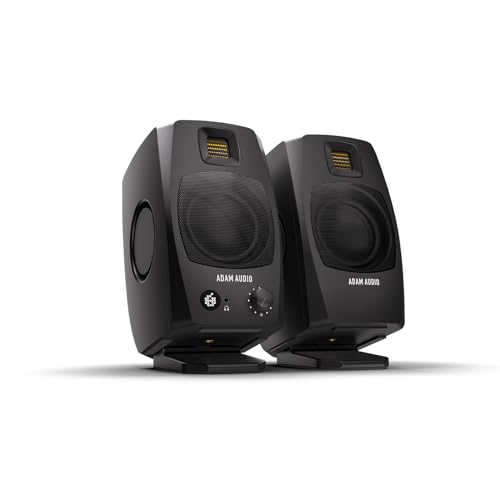
ADAM Audio D3V Active
Laptop based songwriters, producers and creators who want ribbon tweeter accuracy and a headphone hub on a desk over USB-C.
Read the ADAM Audio D3V Active review →Questions Buyers Ask
ADAM Audio T7V
See the current listing, price and included accessories.
About This Review
Mandrillis Team
The Mandrillis editorial team researches and compares audio and music gear using manufacturer documentation, verified specs and real buyer feedback, so you can make a confident purchase without wading through marketing claims.
Read our full research methodology.