Studio Gear Review
Kali Audio LP-6 V2 Review: DSP Tuned 6.5 Inch Monitor With Boundary EQ
The Kali Audio LP-6 V2 is a bi-amped 6.5 inch studio monitor with a 1 inch tweeter, 80 W of power, a published 47 Hz to 21 kHz response, 115 dB maximum SPL, DSP boundary EQ and a front port. This review covers the second generation upgrades, the inputs and what the listing leaves out.
Our Verdict
Research Score 83/100The Kali Audio LP-6 V2 is a budget 6.5 inch monitor engineered around measurable goals. Its published 47 Hz to 21 kHz response, 115 dB maximum SPL and 80 W of bi-amped power give it more bass reach and headroom than 5 inch rivals, while the DSP boundary EQ and front port make it unusually tolerant of desk and wall placement. The second generation also cuts noise by 12 dB and lowers distortion according to the listing. What the listing does not publish are the amplifier split, driver materials, dimensions and weight, and the cabinet is sold singly. For a producer who wants real low end and room compensation without spending more, it is one of the strongest choices in its class.
Editorial research score based on published specifications and documented features, not a customer rating or lab test.

Kali Audio
Kali Audio LP-6 V2
Best for: Budget producers and mix engineers who want a 6.5 inch monitor with real bass extension, DSP room compensation and balanced inputs for a desk or wall placement.
Skip it if: Your desk is too small for a 6.5 inch cabinet or you need driver materials, dimensions and weight confirmed in the listing.
Check Price on AmazonWe may earn a commission at no extra cost to you.
Listing verified: October 2026
Who Should Buy It
Buy it if
- Electronic and hip hop producers who need bass fundamentals without a subwoofer
- Anyone whose monitors must sit against a wall or on a desk
- First generation LP-6 owners wanting lower noise
- Mixers with XLR outputs on their interface
Skip it if
- You work on a very small or shallow desk
- You want Bluetooth or a headphone output
- Your room is untreated and you cannot manage low-frequency modes
Key Specifications
| Type | Active two-way bi-amped powered studio monitor with front port and DSP, sold singly, black |
| Woofer | 6.5 inch driver, cone material not published in listing |
| Tweeter | 1 inch tweeter, dome material not published in listing |
| Power | 80 W bi-amped, divided between tweeter and woofer; split not published |
| Frequency response | 47 Hz to 21 kHz, 115 dB maximum SPL |
| Inputs | TRS, RCA and XLR |
| Room controls | Boundary EQ via onboard DSP |
| Dimensions | Not published in listing |
| Weight | Not published in listing |
| Included accessories | Not published in listing |
Overview
The Kali Audio LP-6 V2 is the second generation of the Project Lone Pine 6.5 inch powered studio monitor, sold here as a single black cabinet. It is a two-way bi-amped design with a 6.5 inch driver and a 1 inch tweeter, 80 W of total power, a published 47 Hz to 21 kHz response and a maximum SPL of 115 dB. The listing places it in the budget tier.
The V2 revision is defined by its DSP. Kali says the second generation has a more robust DSP system for flat frequency response, an updated boundary EQ for placement against walls or on desks, 12 dB of noise reduction and lower distortion than the first generation. A front port is used to let air leave the cabinet at uniform velocity and reduce turbulence.
Inputs are TRS, RCA and XLR, which covers balanced and unbalanced sources. Dimensions, weight and included accessories are not published in the listing, and neither is the amplifier split between the two drivers. This review examines the published specification, the DSP based room tools and how the LP-6 V2 compares with the Yamaha, JBL and ADAM monitors it is usually shopped against.
Accuracy and Sound Signature
Kali's pitch for the LP-6 V2 is superior sonic accuracy, with the listing stating that the monitor emits sound as it is in the mix with no alterations, boosts or suppressions. That is a claim about neutral tuning rather than a measurement, but the DSP based crossover and EQ give the company the tools to hold the response flat across production units.
The published 47 Hz to 21 kHz range is strong for a 6.5 inch cabinet in this tier, and the listing does not state the tolerance in dB. A 47 Hz lower limit means most bass fundamentals are represented, which is a real advantage over 5 inch rivals for anyone mixing electronic or hip hop material. Maximum SPL of 115 dB gives plenty of headroom for a near-field or mid-field desk.
The noise floor improvements matter more than they sound. The listing credits the V2 with 12 dB less noise than its predecessor and describes the result as no chuffing or hissing, which addresses a common complaint about the first generation at idle. Lower distortion is also claimed, though no figure is given.
Drivers, Amplification and Power
The LP-6 V2 carries a 6.5 inch low-frequency driver and a 1 inch tweeter. This particular listing does not state the cone or dome materials, so those details have to come from the manufacturer's documentation rather than from the published data here. Kali credits its waveguide design with wide, even dispersion across the listening area.
Amplification is bi-amped at 80 W total, divided between the tweeter and the 6.5 inch driver. The listing does not publish how the 80 W is split, and it does not state the amplifier class. Bi-amping with a DSP crossover is the main reason a budget monitor can hold a flat response, since each driver gets its own tailored signal and amplifier.
The front port is a design choice with practical consequences. Rear ported monitors push air at the wall behind them and exaggerate bass when placed close to it, while the LP-6 V2's front port lets the cabinet sit nearer a wall with less penalty. Kali describes the port as letting air exit at uniform velocity to minimize turbulence, which is a claim about port noise rather than bass extension.
Room Fit, Placement and Controls
The boundary EQ is the headline room tool. Kali says the updated V2 version delivers high-quality output no matter where the monitor is placed, naming stands, a wall position and a desk as the three scenarios. In practice this is a set of DSP presets that compensate for the bass boost each placement creates, and the listing does not state how many settings are available or how they are selected.
A 6.5 inch monitor with a 47 Hz lower limit will excite room modes more than a 5 inch cabinet, so an untreated bedroom will show more low-end unevenness with the LP-6 V2 than with a smaller speaker. The boundary EQ helps with placement effects but not with room modes, and some bass trapping or careful positioning remains worthwhile.
Because the cabinet is sold singly, buyers building a stereo pair should order two and place them symmetrically with the tweeters at ear height. The front port and the DSP make the LP-6 V2 more forgiving of a desk setup than most monitors of its size. Dimensions are not published, so check the manufacturer's data if the desk is shallow.
- DSP boundary EQ with stand, wall and desk scenarios
- Front port reduces wall interaction
- 47 Hz lower limit suits bass-heavy genres
- Sold singly, order two for stereo
- Dimensions and weight not published in the listing
Build, Design and Finish
This listing is the black version of the LP-6 V2, sold as a single unit. Cabinet material, bracing and weight are not published, and the listing does not mention grilles or mounting hardware. The front port and waveguide define the look, with the tweeter set into a shaped baffle above the 6.5 inch driver.
Kali's design priority is measurable performance over cosmetics, and the listing reflects that by concentrating on DSP, noise and port behavior rather than on finish quality. Buyers report that the first generation cabinets were functional and plain, and nothing in the V2 listing suggests a different approach.
The closing bullet of the listing says the monitor was crafted by audio professionals and performs well above its price point, which is marketing but also a fair summary of the brand's reputation. A buyer who wants a premium finish should look elsewhere; one who wants engineering priorities in a budget box is the target.
Connectivity and Inputs
The LP-6 V2 offers TRS, RCA and XLR inputs. XLR and TRS are balanced and suit an audio interface or monitor controller, while RCA handles consumer sources such as a DJ mixer, a television or a phone adapter. The listing does not say whether the inputs can be used at the same time.
Having XLR on a budget monitor is a real convenience for anyone whose interface has XLR outputs, and it avoids adapter cables that add noise. The three input types mean the monitor will fit most desks without changes to existing cabling.
There is no Bluetooth, no USB and no headphone output, which is consistent with a monitor aimed at mixing rather than casual listening. Input sensitivity and level control details are not published in the listing, so expect to set gain from the interface.
Setup and Daily Use
Setting up the LP-6 V2 involves choosing the boundary EQ setting that matches your placement, connecting a balanced source and matching levels between the two cabinets if you bought a pair. Kali's documentation covers the DSP settings in detail, and the three placement scenarios named in the listing make the choice straightforward.
Day to day the quieter noise floor is the improvement most owners of the first generation notice, since a monitor that hisses at idle is tiring in a small room. The 115 dB maximum SPL means the LP-6 V2 will not run out of level on a desk, and the 47 Hz reach reduces how often you need to check bass on headphones.
There is no mention of auto standby or a front volume control in the listing, so these are details to confirm in the manual. Buyers moving from a 5 inch monitor should expect to re-learn how bass sits in their room, because the LP-6 V2 reveals more of the low end than they are used to.
Who Should Buy It
The LP-6 V2 suits producers and mix engineers on a budget who want a 6.5 inch monitor with a published response, DSP room compensation and XLR inputs. It is a particularly good fit for electronic, hip hop and pop producers who need to hear bass fundamentals without a subwoofer.
It also fits anyone with a difficult placement, such as a desk against a wall, because the boundary EQ and front port are designed for exactly that. Buyers upgrading from a first generation LP-6 will value the lower noise and distortion.
Buyers with a very small desk may find a 6.5 inch cabinet too large and should consider the LP-6 V2's smaller siblings or the Yamaha HS5. Anyone who needs dimensions, weight or driver materials confirmed in the listing will have to look to the manufacturer's spec sheet.
Alternatives Worth Considering
The Yamaha HS5 is the classic rival, with a 5 inch woofer and a more forward midrange but without DSP room correction and with a higher low-frequency limit. The JBL 305P MkII offers a waveguide and a lively presentation at a similar tier, with boundary and HF trim switches rather than full DSP.
The ADAM Audio T5V brings a ribbon style tweeter and a refined top end to the same budget, with a rear port that is less forgiving of wall placement. The KRK Rokit 5 G5 adds DSP room correction with a visual interface and a punchier voicing favored by electronic producers.
Within Kali's own range, the larger LP-8 V2 extends bass further for bigger rooms, while the smaller LP-UNF is the answer for a tight desk. For most budget mixing rooms the LP-6 V2 sits at the sweet spot of size, extension and price, which is why it is so often recommended.
Verdict
The Kali Audio LP-6 V2 is one of the most complete budget 6.5 inch monitors on paper. The published 47 Hz to 21 kHz response, 115 dB maximum SPL, 80 W bi-amping, DSP boundary EQ and front port add up to a monitor engineered for real rooms rather than showrooms.
The gaps in the listing are the amplifier split, driver materials, dimensions and weight, none of which affect how the monitor performs but all of which a careful buyer may want to confirm. The cabinet is sold singly, so stereo costs two orders.
For a producer who wants real bass extension and room compensation at a budget tier, the LP-6 V2 is an easy recommendation and one of the strongest value propositions in its class.
Strengths and Limitations
Strengths
- Published 47 Hz to 21 kHz response and 115 dB maximum SPL
- DSP boundary EQ for stand, wall and desk placement
- Front port reduces wall interaction
- 12 dB lower noise than the first generation
- XLR, TRS and RCA inputs
- 80 W bi-amped power
Limitations
- Sold singly, two needed for stereo
- Amplifier split and class not published
- Driver materials, dimensions and weight not published
- Large for a shallow desk
How We Scored It
Scores reflect published specifications, documented features and value against the alternatives below. They are editorial research scores, not laboratory measurements.
Alternatives to Consider

Yamaha HS4
Creators and producers on a small desk who want the Yamaha HS character in a compact white pair at a budget tier.
Read the Yamaha HS4 review →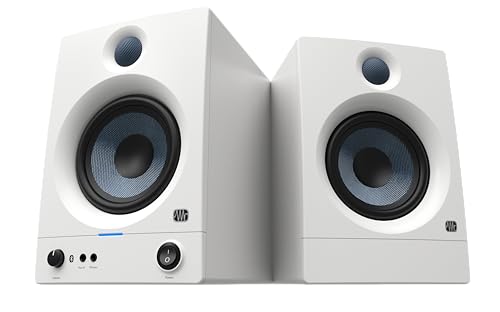
PreSonus Eris 5BT 5.25-inch
Producers and creators who want one white pair of near-field monitors to handle production, video work and Bluetooth listening on the same desk at a lower mid-range tier.
Read the PreSonus Eris 5BT 5.25-inch review →
Kali Audio LP-8V2
Producers and mix engineers in a medium or larger room who want 8 inch reach, high SPL headroom and precise switch-based room correction at a lower mid-range tier.
Read the Kali Audio LP-8V2 review →Questions Buyers Ask
Kali Audio LP-6 V2
See the current listing, price and included accessories.
About This Review
Mandrillis Team
The Mandrillis editorial team researches and compares audio and music gear using manufacturer documentation, verified specs and real buyer feedback, so you can make a confident purchase without wading through marketing claims.
Read our full research methodology.