Studio Gear Review
Yamaha HS4 Review: Compact HS Series Pair for Small Desks
The Yamaha HS4 is a compact two-way powered studio monitor pair in white with a 4.5 inch cone woofer, a 1 inch dome tweeter, a 60 Hz to 22 kHz response, room control and high trim switches and combo, RCA and stereo mini inputs. This review covers the published figures and the gaps.
Our Verdict
Research Score 75/100The Yamaha HS4 takes the HS family's honest, slightly forward voicing and fits it into a 4.5 inch cabinet for small desks. The published 60 Hz to 22 kHz response, room control and high trim switches and the combo, RCA and stereo mini inputs make it a flexible budget pair, and the included cables and anti-slip pad mean most buyers can set up immediately. The listing's 26 W plus 26 W power figure is not explained, and dimensions, weight and port position are missing. Bass reach and playback level are limited by the small driver. For a bedroom studio or a shared living space it is a confident recommendation, with the HS5 as the step up for anyone with more room.
Editorial research score based on published specifications and documented features, not a customer rating or lab test.

Yamaha
Yamaha HS4
Best for: Creators and producers on a small desk who want the Yamaha HS character in a compact white pair at a budget tier.
Skip it if: You need deep bass, high playback levels or confirmed dimensions and power figures before buying.
Check Price on AmazonWe may earn a commission at no extra cost to you.
Listing verified: October 2026
Who Should Buy It
Buy it if
- Bedroom producers with limited desk space
- Podcasters and video editors who need an honest midrange reference
- Buyers connecting mixed sources such as an interface, a console and a phone
- Anyone who wants a white monitor pair for a shared room
Skip it if
- You mix bass-heavy music without a subwoofer
- Your room is medium sized or larger
- You want wireless or headphone convenience features
Key Specifications
| Type | Active two-way bass-reflex powered studio monitor, sold as a pair, white finish |
| Woofer | 4.5 inch cone woofer |
| Tweeter | 1 inch dome tweeter |
| Power | 26 W plus 26 W output power as published; the listing does not say whether that is per speaker or across the pair |
| Frequency response | 60 Hz to 22 kHz at minus 10 dB |
| Inputs | XLR/TRS combo, RCA and stereo mini |
| Room controls | Room control and high trim response controls |
| Dimensions | Not published in listing |
| Weight | Not published in listing |
| Included accessories | Stereo mini to RCA cable, speaker cable and anti-slip pad |
Overview
The Yamaha HS4 is the smallest full member of the HS studio monitor family, sold here as a pair in a white finish. Each cabinet is a two-way bass-reflex powered design with a 4.5 inch cone woofer and a 1 inch dome tweeter, and the published frequency response runs from 60 Hz to 22 kHz at the minus 10 dB point. The listing places it in the budget tier.
Yamaha pitches the HS4 at the uncompromising creator who needs a compact monitor, which in practice means a desk too small for the HS5 or a bedroom studio where a larger cabinet would overload the room. Output power is published as 26 W plus 26 W. Room control and high trim switches are included, carried over from the larger HS models.
Inputs cover an XLR and TRS combo jack, RCA and a stereo mini jack, and the box includes a stereo mini to RCA cable, a speaker cable and an anti-slip pad. Dimensions and weight are not published in the listing. This review works through the published figures, the design choices they imply and where a buyer might want to step up to a bigger HS.
Accuracy and Sound Signature
The HS family has a reputation for a flat, slightly forward presentation that shows up problems in a mix rather than hiding them, and the HS4 is marketed on that same honesty. A 4.5 inch woofer cannot deliver the low-end weight of a 5 inch or 6.5 inch cabinet, and the 60 Hz lower limit at minus 10 dB confirms that sub-bass is outside its reach. For checking midrange balance, vocals and stereo placement it is well suited.
The upper limit of 22 kHz from the 1 inch dome tweeter is in line with the rest of the HS line. Yamaha does not state the tweeter material in the listing, though the dome design and the family's history suggest a clean rather than soft top end. The high trim control exists to tame that if the room is bright.
Because the published response is given at minus 10 dB rather than minus 3 dB, the usable flat band is narrower than the headline numbers suggest, and buyers should read 60 Hz as the point where output has fallen substantially. That is normal practice in the category but worth understanding when comparing against rivals that publish a minus 3 dB figure.
Drivers, Amplification and Power
Each HS4 cabinet holds a 4.5 inch cone woofer and a 1 inch dome tweeter in a bass-reflex enclosure. The cone material and the port position are not stated in the listing, so the white cabinet's internal design has to be judged from Yamaha's broader HS practice rather than from published detail.
The listing gives output power as 26 W plus 26 W, which is modest and appropriate for a 4.5 inch driver on a desk. What it does not clarify is whether those two figures describe the two speakers in the pair or the two amplifier channels inside a single cabinet. The inclusion of a speaker cable in the box points toward the cabinets being wired to each other, which would make one of them the powered unit, but that arrangement is an inference rather than a stated fact.
In practical terms, 26 W per channel is enough for near-field listening at arm's length and will run out of headroom in a larger room. The HS4 is not designed for loud playback and should be paired with a subwoofer or replaced by an HS5 or HS7 if more level is required. Amplifier class is not published.
Room Fit, Placement and Controls
Room control and high trim response controls are the two adjustments the listing names, and they mirror the switches on the larger HS models. Room control typically cuts low frequencies to counter the boost that comes from placing a monitor close to a wall, while high trim raises or lowers the treble shelf. The exact steps are not published here.
The compact size is the main placement advantage. A 4.5 inch monitor sits comfortably on a desk beside a laptop or a small interface, and the anti-slip pad in the box helps keep it in place and provides a little isolation from the desktop. Cabinet dimensions are not stated, so measure your space against the HS5 if you know that model.
For best results the tweeters should be aimed at ear level with the pair forming a triangle with the listening position. Small monitors are forgiving of imperfect rooms because they do not excite low-frequency room modes as strongly, which makes the HS4 a sensible choice for an untreated bedroom. A subwoofer is the eventual upgrade if bass monitoring matters.
- Room control switch to tame wall boost
- High trim control for treble balance
- Anti-slip pad included for desk placement
- Compact cabinet suited to small untreated rooms
- Dimensions and weight not published in the listing
Build, Design and Finish
This listing is the white version of the HS4, which keeps the family's clean look and should pair visually with other white Yamaha gear. The HS line is known for a plain, functional cabinet with the driver surrounds in a contrasting ring, and the HS4 follows that pattern in the published photos.
Cabinet material, bracing and weight are not published in the listing. The bass-reflex design means there is a port somewhere on the cabinet, but the listing does not say whether it is front or rear facing, which affects how close to a wall the speakers can sit.
The package is sold as a pair, with a stereo mini to RCA cable, a speaker cable and an anti-slip pad included. That is a more complete bundle than many rivals provide and means a buyer with a phone or laptop can start listening without buying extra cables. There is no mention of grilles or mounting points.
Connectivity and Inputs
The HS4 offers an XLR and TRS combo input, an RCA input and a stereo mini input according to the listing. The combo jack handles balanced connections from an audio interface, RCA suits consumer sources and the mini jack takes a phone or laptop headphone output directly.
Having three input types on a budget monitor pair is generous and reflects the creator audience Yamaha is targeting. The listing does not say whether the inputs can be used simultaneously or whether there is a selector, so expect to unplug one source to use another.
There is no Bluetooth, no USB and no headphone output, which keeps the HS4 a purely wired monitor. The included stereo mini to RCA cable suggests Yamaha expects many buyers to connect a consumer device, while the speaker cable links the two cabinets. Balanced users should bring their own TRS or XLR cables.
Setup and Daily Use
Setting up the HS4 pair should take a few minutes. Place the cabinets on the anti-slip pads, run the included speaker cable between them, connect your source to the combo, RCA or mini input and set the room control switch according to how close the speakers are to a wall.
For daily work the modest power means you will run the HS4 closer to its ceiling than a larger HS, and the 60 Hz lower limit means kick drums and bass lines will sound lighter than they are. Many engineers manage this by cross-checking on headphones or a subwoofer. On vocals, guitars and midrange balance the HS4 is a trustworthy desk reference.
There is no auto standby or power saver listed, and the listing does not mention a volume knob position, so check the published manual if front-panel access matters to you. The pair's small footprint makes it easy to move between rooms or take to a second workspace.
Who Should Buy It
The HS4 suits a creator working on a small desk who wants the HS family's honest voicing without the size of an HS5. Podcasters, video editors and producers in a bedroom studio will find it a sensible and affordable reference, especially if they already monitor bass on headphones.
It is also a good match for a buyer whose sources are mixed, since the combo, RCA and mini inputs cover an interface, a TV or console and a phone without adapters. The white finish will appeal to anyone whose workspace is shared with living space.
Buyers who need deep bass, high playback levels or a larger room should move up to the HS5 or HS7. The listing's unclear power description and missing dimensions may also frustrate shoppers who like every figure confirmed before they commit.
Alternatives Worth Considering
The Yamaha HS5 is the natural step up, with a 5 inch woofer, more power and the same room control and high trim switches. It costs more and takes more desk space but reaches lower and plays louder. If your desk can fit it, the HS5 is usually the better long-term buy.
The PreSonus Eris 3.5 competes directly on size and tier with a 3.5 inch woofer, a front headphone output and a stereo aux input, which makes it more convenient for casual listening but less of a pure monitor. The Yamaha HS3, the HS4's smaller sibling, is the pick for a very tight desk.
The Kali Audio LP-6 and KRK Rokit 5 G5 are larger and more capable monitors that offer DSP based room correction, a feature the HS4 lacks. For a buyer willing to spend a little more and give up some desk space, either provides a more complete mixing tool, though neither matches the HS4's compact footprint.
Verdict
The Yamaha HS4 brings the HS family's straightforward, honest character down to a 4.5 inch cabinet that fits where the HS5 cannot. The published 60 Hz to 22 kHz response, room control and high trim switches and three input types make it a well-rounded budget monitor pair.
Its limits are physical. A 4.5 inch woofer and 26 W plus 26 W of power will not deliver deep bass or loud playback, and the listing leaves the power arrangement, cabinet size and port position unstated.
For a small desk, a shared living space or a first set of real monitors, the HS4 in white is an easy recommendation. Buyers with more room should step up to the HS5.
Strengths and Limitations
Strengths
- Honest HS family voicing in a compact cabinet
- Published 60 Hz to 22 kHz response
- Room control and high trim switches
- Combo, RCA and stereo mini inputs
- Cables and anti-slip pad included
- White finish for shared spaces
Limitations
- Power figure is ambiguous in the listing
- Dimensions, weight and port position not published
- Limited bass reach from a 4.5 inch woofer
- No headphone output or Bluetooth
How We Scored It
Scores reflect published specifications, documented features and value against the alternatives below. They are editorial research scores, not laboratory measurements.
Alternatives to Consider

PreSonus Eris 5BT 5.25-inch
Producers and creators who want one white pair of near-field monitors to handle production, video work and Bluetooth listening on the same desk at a lower mid-range tier.
Read the PreSonus Eris 5BT 5.25-inch review →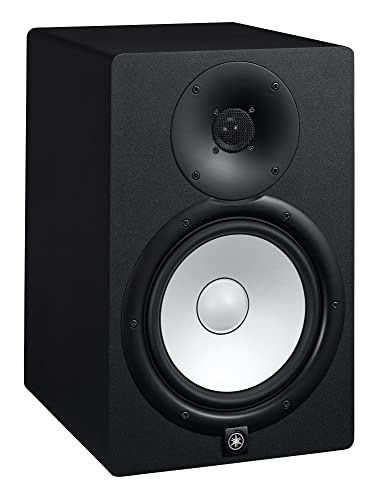
Yamaha HS8
Producers and mix engineers in medium sized rooms who want full range low end from a trusted reference without a subwoofer.
Read the Yamaha HS8 review →Questions Buyers Ask
Yamaha HS4
See the current listing, price and included accessories.
About This Review
Mandrillis Team
The Mandrillis editorial team researches and compares audio and music gear using manufacturer documentation, verified specs and real buyer feedback, so you can make a confident purchase without wading through marketing claims.
Read our full research methodology.