Studio Gear Review
MOTU 10Pre USB Thunderbolt Audio Interface Review: Multichannel Thunderbolt 4 with AVB
The MOTU 10Pre USB Thunderbolt Audio Interface delivers 10 mic preamps, 26 inputs and 28 outputs, Thunderbolt 4 and USB4, AVB networking and a 64 channel DSP mixer. The listing highlights a high resolution display and control room tools for Mac, Windows and iOS users.
Our Verdict
Research Score 84/100The MOTU 10Pre USB Thunderbolt Audio Interface offers a lot for an upper mid-range multichannel interface. Its 10 preamps, 26 by 28 I/O, Thunderbolt 4 and USB4, AVB, and 64 channel DSP mixer are strong on paper. The front panel display and control room tools add practical value. Main unknowns are physical build details and the absence of a bundled software package. The listing does not state chassis material or dimensions, and the exact headphone output routing deserves clarification. Still, the published specs and feature set make it a compelling option for studios needing many inputs and modern connectivity. Buyers upgrading from basic two channel interfaces will find the 10Pre a significant step up, especially with AVB expansion and low latency drivers.
Editorial research score based on published specifications and documented features, not a customer rating or lab test.
MOTU
MOTU 10Pre USB Thunderbolt Audio Interface
Best for: Project and commercial studios needing many mic inputs, Thunderbolt low latency, AVB expansion and advanced monitoring control.
Skip it if: You only need a basic two channel interface and do not require multichannel recording, DSP mixing or network expansion.
Check Price on AmazonWe may earn a commission at no extra cost to you.
Listing verified: October 2026
Who Should Buy It
Buy it if
- Recording engineers tracking full bands or drum kits
- Live sound and location recorders needing many inputs in one box
- Users building or expanding an AVB audio network
- Mac, Windows or iOS musicians who want class compliant Thunderbolt connectivity
Skip it if
- You need a simple portable interface for one or two microphones
- You rely on bundled DAW software from the interface manufacturer
- You want detailed published specs for physical build and routing before purchase
Key Specifications
| Type | Thunderbolt 4 / USB4 audio interface |
| Inputs | 26 total (10 mic/line/instrument combo jacks, 16 optical via two banks of 8-channel ADAT) |
| Outputs | 28 total (8 TRS analog line, 16 optical via two banks of 8-channel ADAT, 2 front-panel headphone outputs) |
| Preamps | 10 mic/line/instrument preamps, up to 74 dB gain, -20 dB pad, 48V phantom power, phase invert, inputs 1-2 have insert send/return |
| Resolution | Up to 192 kHz sample rates, ESS Sabre32 DAC with 125 dB dynamic range, bit depth not published in listing |
| Phantom power | 48V phantom power per mic channel |
| Connection | Thunderbolt 4 / USB4 USB-C, compatible with USB3 and USB2, second Thunderbolt port, dual Gigabit AVB network ports |
| Monitoring | Two front-panel headphone outputs, talkback, A/B/C speaker select, mute, sum-to-mono, 3.9-inch TFT display with metering |
| Bundled software | Not published in listing |
| Included accessories | 40 Gbps Thunderbolt-compatible USB4 cable, other accessories not listed |
Overview
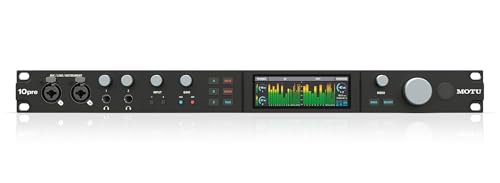
The MOTU 10Pre USB Thunderbolt Audio Interface is a rackmount multichannel audio interface described in the listing as a next generation 26 by 28 Thunderbolt 4 and USB4 device for Mac, Windows and iOS. The listing highlights 10 mic, line and instrument inputs on combo jacks, 8 analog TRS outputs, two ADAT optical banks and two headphone outputs, giving it a total of 54 simultaneous audio channels. This positions the interface for project studios, live recording rigs and AVB based setups that need a high input count in a single unit.
The product listing does not state the chassis dimensions or weight, but the feature set suggests a 19 inch rackmount form factor typical of this class. It includes a built in 3.9 inch TFT display for metering and hardware settings, dedicated control room buttons and dual Gigabit AVB network ports. On paper the MOTU 10Pre USB Thunderbolt Audio Interface offers a strong blend of modern connectivity, high channel count and DSP mixing.
The price tier is upper mid-range according to the listing, which places it above basic two channel desktop interfaces and below flagship modular systems. Buyers considering this unit are likely comparing it to other multichannel interfaces from PreSonus, Focusrite and Behringer, as well as MOTU's own line. The listing positions the 10Pre as a flexible hub for both studio and stage.
Preamps and Sound Quality
The 10 mic preamps on the MOTU 10Pre USB Thunderbolt Audio Interface are a core selling point. Each mic channel provides individual controls for up to 74 dB of preamp gain, a 20 dB pad, 48V phantom power and phase invert. The listing specifies -114 dB THD+N, 118 dB dynamic range and -129 dBu EIN for the mic channels, numbers that indicate very low noise and distortion on paper.
Mic inputs 1 and 2 include a dedicated send and return insert for outboard gear processing, which is a useful addition for hardware compressors or EQs during tracking. The listing describes the analog components as cutting edge and the sound as ultra transparent, but no in-person evaluation is possible from the product data alone. Buyers report that the preamps are clean and quiet, though exact sound character depends on the source and monitoring chain.
The interface uses ESS Sabre32 DAC technology for its main outputs, with a published dynamic range of 125 dB. It supports all standard sample rates up to 192 kHz, although the listing does not publish the bit depth. On paper this converter spec is competitive with many professional interfaces in this price range and should deliver detailed playback when paired with good monitors.
Inputs, Outputs and Routing
The MOTU 10Pre USB Thunderbolt Audio Interface offers 26 inputs and 28 outputs according to the listing. The analog side includes 10 combo jacks that accept mic, line or instrument signals, plus 8 TRS analog line level outputs on the rear panel. Two banks of 8 channel optical I/O provide 16 digital inputs and 16 digital outputs over ADAT or optical formats, and two front panel headphone outputs are available for monitoring.
The listing does not clarify whether the headphone outputs are independent stereo buses or share the same mix, and it does not specify whether the optical ports support S/PDIF as well as ADAT. This is a minor gap for buyers who need exact routing details. The interface includes a 64 channel digital mixer with 64 inputs, 32 buses and DSP effects, which allows extensive routing and monitor mixing inside the unit without taxing the computer CPU.
Routing flexibility is a key strength on paper. The DSP mixer includes reverb, 4 band double precision EQ, high pass filter, gate and compression at sample rates up to 96 kHz. This means users can create low latency cue mixes for performers, apply processing to inputs before recording or set up complex monitor sends. The control room features such as talkback and A/B/C speaker select further support daily studio workflows.
Features, Monitoring and Software
The front panel includes a 3.9 inch TFT display with 480 by 128 pixel resolution and 24 bit RGB color. The listing states this display provides high resolution metering for all analog and digital I/O, plus detailed status information and access to hardware settings through a simple menu. This reduces reliance on computer software for basic configuration and monitoring.
Control room features include dedicated talkback, A/B/C speaker select, mute and sum to mono buttons. These are practical tools for comparing mixes on multiple monitor sets and communicating with musicians. The interface also supports AVB networking through two Gigabit ports, allowing multiple units to be daisy chained or connected through a standard AVB switch over long cable runs.
The listing does not mention any bundled DAW or plug in software. Buyers should expect to use their own recording software, relying on MOTU's drivers and class compliant firmware for compatibility. The hardware DSP covers mixing and effects, but no software bundle is included according to the product listing.
- 64 channel DSP mixer with reverb, EQ, gate and compression
- 3.9 inch high resolution TFT display for metering and settings
- Talkback, A/B/C speaker select, mute and sum to mono
- AVB networking via dual Gigabit ports
- Class compliant firmware for Mac, Windows and iOS
Build, Design and Controls
The MOTU 10Pre USB Thunderbolt Audio Interface is presented as a desktop or rackmount unit, though the listing does not publish exact dimensions, weight or chassis material. The front panel is dominated by the color display, 10 combo input jacks, headphone outputs and control room buttons, while the rear likely holds analog outputs, optical ports, network ports and the Thunderbolt connection. Without in-person inspection, the build quality cannot be verified, but the feature set implies a professional product.
The controls are straightforward: each mic channel has gain, pad, phantom and phase controls accessible from the display menu or remotely, and the front panel gives immediate access to monitoring shortcuts. The listing mentions that all settings can be controlled remotely from a computer or iOS device, which adds convenience. The inclusion of input inserts on channels 1 and 2 is a thoughtful hardware design choice for integrating outboard gear.
Connectivity, Drivers and Latency
The interface connects to computers via a Thunderbolt 4 / USB4 USB-C port, and the listing includes a 40 Gbps Thunderbolt compatible USB4 cable. The cable is also compatible with USB3 and USB2 connections, though the channel count will depend on the host computer's bandwidth. A second Thunderbolt port allows daisy chaining of peripherals, USB hubs or Thunderbolt docks, which is useful for expanding connectivity.
On the network side, two Gigabit AVB ports support daisy chaining multiple MOTU units or connecting to an AVB switch. This enables streaming hundreds of audio channels between devices and computers over standard Ethernet cabling, with latency described as ultra low even over hundreds of meters. The listing states compatibility with previous generation MOTU AVB devices, which protects existing investments.
MOTU's driver performance is specified as round trip latency as low as 1.8 ms at 96 kHz with high performance DAW hosts. Class compliant firmware means the interface can work without custom drivers on many systems, and it connects to iPads with USB-C or a Lightning adapter sold separately. The listing does not mention specific driver support for Linux, so that remains an unknown.
Setup and Daily Use
Setting up the MOTU 10Pre USB Thunderbolt Audio Interface should be straightforward according to the listing. Connect the included Thunderbolt cable to a Mac, Windows PC or iPad, and the class compliant firmware should make it recognized as an audio device. For full control including the DSP mixer and remote preamp settings, users would install MOTU's software, but basic operation may work without it.
The front panel display and menu system allow adjusting preamp gain, phantom power, pad, phase and routing without reaching for the computer. This is handy for live sound or when the interface is mounted away from the workstation. The talkback and speaker select buttons streamline monitor management, and the two headphone outputs let an engineer and artist monitor separately.
Daily use would likely revolve around the DSP mixer for cue mixes and the AVB network for expanding channel counts. The listing implies that all settings can be controlled remotely from a computer or iOS device, which is a nice quality of life feature for studio workflows. However, because the listing does not include a software bundle, users will need to bring their own DAW.
Who Should Buy It
The MOTU 10Pre USB Thunderbolt Audio Interface is suited for project and commercial studios that need many microphone inputs in one box. Drum kits, full bands and multi mic acoustic sessions can be recorded without an external mixer, and the insert points on channels 1 and 2 allow hardware processing on critical sources. The high channel count over Thunderbolt and AVB also works for live recording rigs.
Users who already have or plan to build an AVB network will appreciate the dual Gigabit ports and compatibility with previous MOTU AVB gear. The interface can serve as a central hub or be expanded with additional units over standard network cabling. Mac and Windows users, as well as iPad musicians, get a single interface that covers desktop and mobile recording.
Those who need advanced monitoring control, like A/B/C speaker switching and talkback, will find the front panel buttons practical. The color display reduces guesswork when setting gain and checking levels. Overall, this is a strong candidate for anyone moving up from a basic two channel interface to a more capable multichannel system.
Alternatives Worth Considering
Buyers shopping in this class may also look at rackmount interfaces from PreSonus, Focusrite and Behringer that offer similar numbers of mic preamps and ADAT expansion. Those units often include different software bundles or driver ecosystems, so the choice may come down to preferred DAW integration and brand support. The listing does not compare these alternatives directly.
For users who do not need 10 mic preamps but want Thunderbolt low latency and high quality conversion, smaller desktop interfaces from Universal Audio or MOTU's own M series may be sufficient. These are generally lower in price and easier to transport, but they lack the channel count, AVB networking and control room features of the 10Pre.
If the AVB networking and DSP mixer are not essential, a simpler USB interface with 8 mic preamps and ADAT expansion could save space and money. However, the MOTU 10Pre USB Thunderbolt Audio Interface stands out for its combination of Thunderbolt 4, USB4, AVB and onboard DSP in one unit, which is not universal among competitors at this price tier.
Verdict
The MOTU 10Pre USB Thunderbolt Audio Interface offers a lot for an upper mid-range multichannel interface. Its 10 preamps, 26 by 28 I/O, Thunderbolt 4 and USB4, AVB, and 64 channel DSP mixer are strong on paper. The front panel display and control room tools add practical value.
Main unknowns are physical build details and the absence of a bundled software package. The listing does not state chassis material or dimensions, and the exact headphone output routing deserves clarification. Still, the published specs and feature set make it a compelling option for studios needing many inputs and modern connectivity.
Buyers upgrading from basic two channel interfaces will find the 10Pre a significant step up, especially with AVB expansion and low latency drivers.
Strengths and Limitations
Strengths
- 10 high quality mic preamps with 74 dB gain and very low noise specs
- 26 inputs and 28 outputs including ADAT and analog
- Thunderbolt 4 / USB4 with low 1.8 ms latency at 96 kHz
- 64 channel DSP mixer with reverb, EQ, gate and compression
- AVB networking via dual Gigabit ports for expansion
- 3.9 inch high resolution display and dedicated control room buttons
Limitations
- No bundled DAW or plug in software listed
- Physical build details such as chassis material and weight not published
- Exact headphone output routing and optical format details not clarified
- Upper mid-range price may be high for home users who only need two channels
How We Scored It
Scores reflect published specifications, documented features and value against the alternatives below. They are editorial research scores, not laboratory measurements.
Alternatives to Consider

Arturia Audiofuse 16 Rig Audio Interface
A project studio with outboard preamps and multiple hardware synthesizers that needs high analog channel count, ADAT expansion, and MIDI routing.
Read the Arturia Audiofuse 16 Rig Audio Interface review →
Roland Rubix44 USB Audio Interface Recording
Musicians and small studios that need four mic preamps, MIDI I/O and a compact metal interface in a lower mid-range price tier.
Read the Roland Rubix44 USB Audio Interface Recording review →Questions Buyers Ask
MOTU 10Pre USB Thunderbolt Audio Interface
See the current listing, price and included accessories.
About This Review
Mandrillis Team
The Mandrillis editorial team researches and compares audio and music gear using manufacturer documentation, verified specs and real buyer feedback, so you can make a confident purchase without wading through marketing claims.
Read our full research methodology.