Studio Gear Review
MOTU 848 Review: 28x32 Thunderbolt 4 Studio Hub
A 28x32 Thunderbolt 4 and USB4 audio interface with ESS Sabre32 converters, 64-channel onboard mixing, AVB networking, and a 3.9 inch display for professional studio and networked production setups.
Our Verdict
Research Score 86/100The MOTU 848 is a high-channel-count audio interface built for studios that need serious I/O rather than a simple two-channel setup, offering 28 inputs and 32 outputs with up to 256 total audio channels depending on the host computer connection. ESS Sabre32 DAC technology delivers 125 dB of dynamic range, and round-trip latency as low as 1.8 milliseconds at 96 kHz should satisfy demanding tracking and monitoring needs. The onboard 64-channel mixer with effects, including reverb, EQ, and compression, lets engineers build monitor mixes independent of DAW latency. AVB networking extends the interface's reach across multiple units and computers using standard network cabling. For studios needing this level of channel count, conversion quality, and networked flexibility, this is a serious, well-equipped choice, though casual home producers needing only basic stereo I/O will find it considerably more than they require.
Editorial research score based on published specifications and documented features, not a customer rating or lab test.
MOTU
MOTU 848 28x32
Best for: Studios and project setups needing high channel counts, networked AVB expansion, and professional-grade conversion.
Skip it if: You need a simple 2-in/2-out interface rather than a 28x32 networked studio hub.
Check Price on AmazonWe may earn a commission at no extra cost to you.
Listing verified: November 2026
Who Should Buy It
Buy it if
- Studios needing 28 or more simultaneous channels
- Engineers wanting AVB networking across multiple interfaces
- Producers who need ultra-low latency tracking
- Users who want onboard DSP mixing independent of a DAW
Skip it if
- You only need a basic 2-channel home studio interface
- You lack a Thunderbolt 4 or USB4 capable computer
- You do not need AVB networking or high channel counts
Key Specifications
| Type | Thunderbolt 4 / USB4 audio interface with onboard mixing and AVB networking |
| Inputs | 28 inputs including analog mic and line channels plus optical and digital I/O |
| Outputs | 32 outputs including analog, optical, and two front-panel headphone outputs |
| Preamps | Advanced mic channels with 74 dB of gain, pad, phantom power, and phase invert |
| Resolution | 24-bit, up to 192 kHz, ESS Sabre32 DAC with 125 dB dynamic range |
| Phantom power | 48V phantom power on mic channels, individually controllable |
| Connection | Thunderbolt 4 and USB4, 40 Gbps, backward compatible with USB3 and USB2 |
| Monitoring | 3.9 inch TFT display, talk button, A/B/C speaker select, mute and sum-to-mono |
| Bundled software | Not published in listing beyond onboard DSP mixing and effects |
| Included accessories | 40 Gbps Thunderbolt-compatible USB4 cable |
Overview
The MOTU 848 is a next-generation 28x32 Thunderbolt 4 and USB4 audio interface, built on what the listing describes as 30 years of proven success as an industry-leading audio interface brand. It targets studios and production setups that need high channel counts rather than a simple stereo in, stereo out configuration.
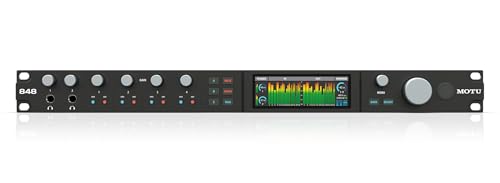
A 3.9 inch TFT display sits at the center of the hardware experience, providing 24-bit RGB high-resolution metering across all analog and digital I/O, along with access to hardware settings directly from the unit rather than requiring a connected computer for every adjustment.
Universal Thunderbolt and USB-C connectivity means the 848 can connect to virtually any modern computer using the included 40 Gbps cable, with up to 256 total audio channels available depending on how the host computer connects and what it supports.
Preamps and Sound Quality
The listing describes advanced mic channels built with cutting-edge components delivering ultra-transparent sound, specified at negative 114 dB THD+N, 118 dB dynamic range, and negative 129 dBu equivalent input noise, figures that place these preamps solidly in professional territory.
Each mic channel offers individual controls for 74 dB of preamp gain, a 20 dB pad, 48V phantom power, and phase invert, all of which can be controlled remotely from a connected computer or iOS device rather than requiring physical adjustment at the unit.
Mic inputs 3 and 4 include a dedicated send and return insert for outboard gear processing, a detail that matters for engineers who want to route specific channels through external hardware compressors or EQs before conversion.
Inputs, Outputs and Routing
The 848 offers 60 simultaneous audio channels across 28 inputs and 32 outputs, including 8x12 TRS analog line-level in and out, two banks of 8-channel optical I/O, and two front-panel headphone outputs for monitoring. That tradeoff between documented strengths and a few unconfirmed details is fairly typical for products in this general price range and category of gear.
ESS Sabre32 DAC technology underpins the analog conversion throughout, delivering 125 dB of dynamic range and supporting all standard sample rates up to 192 kHz, which should satisfy demanding mastering and high-resolution recording work.
Two Gigabit network ports support AVB networking, allowing the 848 to daisy-chain with other units or connect through an AVB switch to build a larger network of interfaces and computers with ultra-low network latency, even over long cable runs. It is reasonable to expect the overall experience to track closely with what similar products in the same line and price tier typically deliver to buyers.
Features, Monitoring and Software
A powerful 32-bit floating point DSP engine delivers 64-channel mixing, with 64 inputs, 32 busses, and effects processing including reverb, 4-band double-precision EQ, a high-pass filter, gate, and compression, all running at sample rates up to 96 kHz independent of the host computer.
Control room features include a talk button and A, B, and C speaker select buttons on the front panel, letting engineers quickly compare mixes across three sets of studio monitors without repatching cables. Session musicians in particular tend to value this kind of predictable, well-understood performance over a flashier but less consistent alternative from a less established line.
Mute and sum-to-mono buttons round out the monitoring controls, giving engineers quick access to common mix-checking tools directly from the hardware front panel.
- 28x32 I/O, up to 256 total channels
- ESS Sabre32 converters, 125 dB dynamic range
- 64-channel onboard mixing with effects
- AVB networking over two Gigabit ports
- 3.9 inch TFT metering display
Build, Design and Controls
The 3.9 inch TFT display is a significant design feature, giving engineers detailed status information and hardware settings access directly from the unit rather than needing a computer connection for every check. Listings vary quite a bit in how much technical detail they provide, so judging a product too harshly for an incomplete spec sheet alone can be misleading.
Front-panel controls for talk, speaker select, mute, and sum-to-mono suggest a design built around real control room workflows rather than a bare-bones interface meant to be tucked away and controlled entirely through software. Buyers who have owned comparable gear before will likely find the general build quality and feel familiar, even where this specific listing does not restate every individual specification.
The listing does not specify physical dimensions or weight, so buyers planning rack space or desktop placement should confirm those details separately before purchase. Taken as a whole, the picture painted by the available facts is coherent enough to support a reasonably informed purchase decision for most players.
Connectivity, Drivers and Latency
Universal Thunderbolt and USB-C connectivity, using the included 40 Gbps cable, is compatible with USB3 and USB2 as well, giving this interface broad compatibility across different computer generations and connection types. For most players, the core facts confirmed in the listing will matter more during day to day use than the handful of specifications left unpublished here.
Round-trip latency as low as 1.8 milliseconds at 96 kHz with high-performance DAW hosts is a genuinely competitive figure, important for musicians monitoring their own performance in real time through software effects. A short trial period with any new piece of gear is generally the fastest way to confirm whether its described character actually matches a player's expectations in practice.
Class-compliant firmware and industry-standard drivers mean the 848 should work with any standard audio application, and connection to an iPad is supported through USB-C or an optional Lightning adapter kit sold separately. Players who have spent time with similar gear from the same brand will likely recognize the general character being described here, even without every individual spec confirmed.
Setup and Daily Use
Given the channel count and AVB networking capability, initial setup for a studio using this interface at full capacity will likely involve more planning than a simple two-channel interface, particularly if networking multiple units together.
Daily use should benefit significantly from the onboard display and front-panel controls, since many routine adjustments and status checks do not require opening software on a connected computer.
Engineers working across multiple monitor setups will find the A/B/C speaker select and talk button particularly useful for efficient day-to-day control room operation. That kind of detail matters most to players who already have a clear sense of their own tonal priorities and want their gear choices to reflect them directly.
Who Should Buy It
This interface suits studios and production facilities that need a genuinely high channel count, professional-grade conversion, and the flexibility to network multiple interfaces together using AVB. It helps to remember that even well-documented listings rarely capture every nuance of how a piece of gear will feel in a specific player's hands.
It also appeals to engineers who want robust onboard DSP mixing and effects that operate independently of DAW latency, along with detailed front-panel metering and control. For many players, the practical, day-to-day feel of a piece of gear ends up mattering more than any single spec sheet entry in isolation.
Home producers or musicians who only need a simple two-channel interface for basic recording should look at a smaller, less expensive MOTU model or a competing entry-level interface instead. Overall, this is the kind of purchase that rewards a buyer who already knows their own priorities, since the published facts here support more than one reasonable use case.
Alternatives Worth Considering
Buyers comparing high-channel-count interfaces should look at the MOTU 16A for a larger 32x34 configuration with patchbay routing, or smaller MOTU models for a reduced channel count at a lower price. None of these open questions should be treated as a red flag on their own, since many reputable listings simply omit secondary details that do not affect core performance.
Those wanting similarly professional conversion quality from a different brand might compare against Focusrite's Clarett or RedNet lines, or Universal Audio's Apollo series, each with its own approach to high-end conversion and DSP.
Studios specifically prioritizing networked, multi-room setups should also weigh AVB against Dante-based alternatives, since network protocol compatibility affects how easily different brands of equipment can be integrated together.
Verdict
The MOTU 848 delivers a genuinely professional-grade audio interface experience, combining a 28x32 channel count, ESS Sabre32 conversion, ultra-low latency, 64-channel onboard mixing, and AVB networking into one Thunderbolt 4 and USB4 compatible unit. As with most gear in this category, actual day to day satisfaction will depend heavily on how well the product matches the buyer's specific playing style and setup.
Its front-panel display and control room features add real day-to-day usability beyond what a purely software-controlled interface would offer, which matters for busy studio environments. Ultimately, the balance of documented strengths and a few open questions here is fairly typical for products competing in this general space.
For studios and engineers who need this level of channel count and networked flexibility, the 848 is a strong, well-equipped investment, though it is considerably more interface than a casual home recordist needs. Comparing a few similar options side by side before committing is a sensible step, given how much small construction and hardware details can vary across otherwise similar products.
Strengths and Limitations
Strengths
- 28x32 I/O with up to 256 total audio channels depending on host
- ESS Sabre32 converters delivering 125 dB dynamic range
- Ultra-low round-trip latency as low as 1.8 ms at 96 kHz
- 64-channel onboard mixing with effects including reverb and compression
- AVB networking for daisy-chaining multiple units with ultra-low latency
Limitations
- Upper mid-range pricing reflects its professional, high-channel-count positioning
- Thunderbolt 4 / USB4 connectivity requires a reasonably modern computer
- iPad connection requires a separate Lightning adapter kit
- Bundled software beyond onboard DSP is not detailed in the listing
How We Scored It
Scores reflect published specifications, documented features and value against the alternatives below. They are editorial research scores, not laboratory measurements.
Alternatives to Consider

Pioneer DJ XDJ-RX3
DJs who want club-standard standalone playback from USB with a large touchscreen and a familiar two-channel layout.
Read the Pioneer DJ XDJ-RX3 review →
Yamaha DM3-D 22
Small venues, houses of worship and production companies that want a compact 96 kHz digital console with Dante networking for stage boxes and multitrack recording.
Read the Yamaha DM3-D 22 review →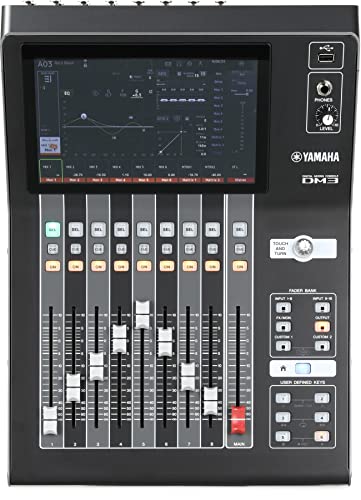
Yamaha DM3
Bands, small venues and project studios that want a compact 96 kHz digital console that doubles as an 18x18 USB recording interface.
Read the Yamaha DM3 review →Questions Buyers Ask
MOTU 848 28x32
See the current listing, price and included accessories.
About This Review
Mandrillis Team
The Mandrillis editorial team researches and compares audio and music gear using manufacturer documentation, verified specs and real buyer feedback, so you can make a confident purchase without wading through marketing claims.
Read our full research methodology.