Best Multi-Channel Audio Interfaces: Eight Picks for Bands and Full Studios
This guide is for bands, podcast teams and growing studios choosing a multi-channel audio interface or mixer that needs to run several microphones at once rather than a single USB mic. Picks were narrowed from 356 researched microphones and related recording gear by comparing preamps and sound quality, inputs and outputs, features and software, build and design, connectivity and latency, and overall value, so each entry reflects a documented score rather than a marketing claim, with every spec traced back to its listing.
Quick Answer
The Universal Audio Apollo X8P is the best overall pick with a confirmed 16 x 22 Thunderbolt 3 configuration and 8 Unison-enabled preamps. The Yamaha DM3-D 22 is the best value choice as an ultracompact 22-channel console with 16 preamps and Dante networking. The Yamaha MG10XU is the best budget pick as a complete bundle with two powered speakers, while the MOTU 848 stands out for its 28x32 I/O and ultra-low round-trip latency as low as 1.8 milliseconds at 96 kHz.
Why You Can Trust This Guide
We compared products using verified manufacturer specifications, available manuals and documentation, retailer listings, owner feedback, and editorial research.
We focus on measurable differences such as performance, compatibility, usability, build quality, features, and value.
Mandrillis presents editorial research as editorial research, not as laboratory testing, unless physical testing was actually performed.
Read our full research methodology.
Quick Picks
Comparison Table
| Model | Inputs | Outputs | Preamps | Connection | Best For | Main Advantage | Score |
|---|---|---|---|---|---|---|---|
| Universal Audio Apollo X8P | 16 inputs as part of the stated 16 x 22 configuration, including 8 Unison-enabled mic and line preamps | 22 outputs as part of the stated 16 x 22 configuration | 8 Unison-enabled mic and line preamps described in the listing as giving fully authentic preamp emulations from Neve, Manley, SSL and more | Thunderbolt 3, with the listing stating backward compatibility with Thunderbolt 1 and 2 on Mac | Studios that want a confirmed 16 x 22 Thunderbolt 3 channel count with 8 Unison preamps and front panel monitoring controls built for daily tracking and mixing sessions. | Confirmed 16 x 22 Thunderbolt 3 I/O configuration | 89/100 |
| Yamaha DM3-D 22 | 22 channels: 16 mono, 1 stereo, 2 stereo FX returns; 16 analog mic inputs (12 XLR plus 4 combo jack); 16 Dante input channels | 8 analog XLR outputs; 16 Dante output channels; 6 mono or 3 stereo mixes, 2 matrixes, 1 stereo bus | 16 Yamaha professional preamps | 16x16 Dante network audio; USB connectivity not published in listing | Small venues, houses of worship and production companies that want a compact 96 kHz digital console with Dante networking for stage boxes and multitrack recording. | 16 Yamaha preamps with 12 XLR and 4 combo jack inputs in an ultracompact frame | 88/100 |
| Allen & Heath Qu-5D | A 38-input mixing platform as stated in the listing, including 16 XLR/TRS combi mic-line inputs plus additional stereo inputs | 12 configurable mixes and 4 matrix outputs, alongside a 16x16 Dante network connection and a 128x128 SLink expansion port | 16 XLR/TRS combi mic-line preamps as part of the 38-input platform. An exact gain range is not published | USB-C 32x32 multichannel audio interface, USB-A stereo recording and playback, 16x16 Dante networking, and a 128x128 SLink expansion port | Live sound engineers and houses of worship that need a documented 38-input digital platform with Dante networking, built-in multi-FX and a USB-C multichannel recording interface in one. | 38-input mixing platform with 16 XLR/TRS combi mic-line preamps | 86/100 |
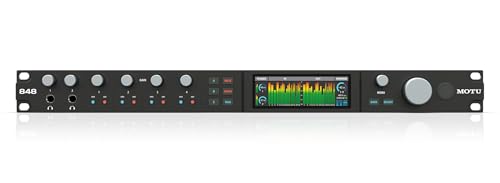
| MOTU 848 28x32 | 28 inputs including analog mic and line channels plus optical and digital I/O | 32 outputs including analog, optical, and two front-panel headphone outputs | Advanced mic channels with 74 dB of gain, pad, phantom power, and phase invert | Thunderbolt 4 and USB4, 40 Gbps, backward compatible with USB3 and USB2 | Studios and project setups needing high channel counts, networked AVB expansion, and professional-grade conversion. | 28x32 I/O with up to 256 total audio channels depending on host | 86/100 |
| Solid State Logic SSL 18 | 8 mic/line inputs, 2 Hi-Z inputs and 2 send/return paths, as stated in the listing | Not published in listing as a separately itemized output count beyond the stated send/return paths and the digital I/O described below | 8 mic/line preamps. An exact gain range is not published in the listing | Not published in listing as a specific computer connection standard. 16-channel ADAT, S/PDIF and MIDI I/O are confirmed for digital expansion | Studios that want a high resolution 32-bit, 192 kHz interface with 8 mic/line inputs, dedicated send/return paths and digital expansion through ADAT and S/PDIF. | 8 mic/line inputs plus 2 Hi-Z inputs for instruments | 85/100 |
| PreSonus Quantum HD 2 x 24 | 20 input channels including two MAX-HD mic preamps and a Fender co-developed instrument input (how the remaining channels are provided is not published in listing) | 24 output channels including re-amp outputs (physical connector count not published in listing) | Two MAX-HD digitally controlled analog mic preamps with +75 dB of gain | USB-C | Guitarists, bassists and growing home studios that want high-gain digitally controlled preamps, Auto Gain, re-amp outputs. | Two MAX-HD preamps with +75 dB of gain | 84/100 |
| Focusrite Clarett+ 4Pre | 18 inputs including 4 Clarett+ mic preamps, 2 Hi-Z JFET instrument inputs, 4 line inputs, and ADAT optical expansion | 8 outputs including 4 balanced line outputs plus 2 improved analogue headphone outputs | 4 Clarett+ preamps with all-analogue Air Premium circuitry emulating the classic Focusrite ISA110, adding a 4dB boost across two cumulative high shelf frequencies | USB-C | Project studios and solo producers who want all-analogue Air Premium preamp coloring and a genuinely high 124dB dynamic range, with a clear path to more channels through ADAT. | 4 Clarett+ preamps with all-analogue Air Premium circuitry modeled on the classic Focusrite ISA110 | 83/100 |
| Yamaha MG10XU | 10 channels; 4 mono channels with D-PRE mic preamps and 1-knob compressors; remaining input types not published in listing | Stereo main feed to the two DBR12 speakers, a monitor output and a phones output; connector types not published in listing | 4 discrete Class-A D-PRE preamps, -128 dBu input noise | Class-compliant USB to computer or tablet, no driver required | Bands, mobile DJs and worship teams that want a complete small-venue PA with a USB mixer, two 12-inch powered mains and monitoring headphones in one order. | Four Class-A D-PRE preamps with a published -128 dBu noise figure | 82/100 |
#1. Universal Audio Apollo X8P (Best Overall)

Mandrillis Research Score: 89/100
This is an editorial research score, not a customer rating or laboratory test score.
Who Should Buy It
- Studios that need a confirmed 16 x 22 channel count for full band or ensemble tracking
- Engineers who want 8 Unison preamps with named console emulations in one chassis
- Mac based facilities using LUNA as their primary recording application
- Operators who value front panel Talkback, Alt Speakers and Dim or Mono monitoring controls
Skip It If
- You want every UAD plug-in bundled in rather than sold separately
- You need phantom power specifications confirmed up front
- You require guaranteed Windows driver support
Pros
- Confirmed 16 x 22 Thunderbolt 3 I/O configuration
- 8 Unison-enabled preamps with named analog emulations
- Class leading 24-bit, 192 kHz conversion stated directly in the listing
- Realtime HEXA Core style onboard processing for near-zero latency plug-in tracking
- Front panel monitoring with Alt Speakers, Talkback mic and assignable Dim or Mono
- Backward compatible with Thunderbolt 1 and 2 on Mac
Cons
- Phantom power is not stated despite 8 mic preamps
- Only the Realtime Analog Classics Plus bundle is included, with other UAD plug-ins sold separately
- Chassis weight and dimensions are not published
- No Windows compatibility is mentioned for the Thunderbolt connection
Key Specs
Type: 16 x 22 Thunderbolt 3 studio audio interface, Universal Audio Apollo X8P
Inputs: 16 inputs as part of the stated 16 x 22 configuration, including 8 Unison-enabled mic and line preamps
Outputs: 22 outputs as part of the stated 16 x 22 configuration
Preamps: 8 Unison-enabled mic and line preamps described in the listing as giving fully authentic preamp emulations from Neve, Manley, SSL and more
Resolution: 24-bit, 192 kHz conversion, described in the listing as class leading
Phantom power: Not published in listing
Connection: Thunderbolt 3, with the listing stating backward compatibility with Thunderbolt 1 and 2 on Mac
Monitoring: Surround monitor controller up to 7.1 format, plus front panel monitoring functions including Alt Speakers, Talkback mic, and assignable Dim or Mono
Bundled software: LUNA recording application for Mac over Thunderbolt, the Realtime Analog Classics Plus plug-in bundle included, with other UAD plug-ins sold separately, and onboard processing support for Pro Tools, Logic, Cubase, Ableton and other major DAWs
Included accessories: Not published in listing
Why We Picked It
The Apollo X8P earns best overall with a confirmed 16 x 22 Thunderbolt 3 configuration, including 8 Unison-enabled preamps the listing describes as giving authentic analog emulations from Neve, Manley, SSL and more. Class leading 24-bit, 192 kHz conversion and front panel monitoring with Alt Speakers and a Talkback mic round out the package, though phantom power is unstated, and Windows compatibility is not mentioned.
Read our full Universal Audio Apollo X8P review →
Check Price on AmazonWe may earn a commission at no extra cost to you.
Last verified: November 2026
Why This Product Ranks Best Overall
#2. Yamaha DM3-D 22 (Best Value)

Mandrillis Research Score: 88/100
This is an editorial research score, not a customer rating or laboratory test score.
Who Should Buy It
- Installers building a networked audio system around Dante stage boxes
- Houses of worship that need a compact console with 16 preamps
- Production companies that want a 96 kHz desk for corporate and small-stage work
- Engineers who record multitrack through Dante to a computer or recorder
Skip It If
- You will never connect a Dante device and want to save money
- You need more than 16 local analog preamps without a stage box
- You prefer physical knobs on every channel instead of a touchscreen
Pros
- 16 Yamaha preamps with 12 XLR and 4 combo jack inputs in an ultracompact frame
- 96 kHz sample rate on a 22-channel digital console
- 16x16 Dante interface for networked stage boxes and recording
- 6 mono or 3 stereo mixes plus 2 matrixes and a stereo bus
- 9-inch touchscreen for direct mix control
- 8 balanced XLR analog outputs
Cons
- Premium price tier compared with the USB-only DM3 model
- Listing does not publish phantom power, headphone or USB details
- Bit depth and converter specifications not stated
- Dante requires network knowledge that casual users may not have
- Bundled software and included accessories are not listed
Key Specs
Type: Ultracompact 22-channel digital mixing console with Dante networking
Inputs: 22 channels: 16 mono, 1 stereo, 2 stereo FX returns; 16 analog mic inputs (12 XLR plus 4 combo jack); 16 Dante input channels
Outputs: 8 analog XLR outputs; 16 Dante output channels; 6 mono or 3 stereo mixes, 2 matrixes, 1 stereo bus
Preamps: 16 Yamaha professional preamps
Resolution: 96 kHz sample rate; bit depth not published in listing
Phantom power: Not published in listing
Connection: 16x16 Dante network audio; USB connectivity not published in listing
Monitoring: Not published in listing
Bundled software: Not published in listing
Included accessories: Not published in listing
Why We Picked It
This pick takes best value as an ultracompact 22-channel digital console with 16 Yamaha preamps across 12 XLR and 4 combo jack inputs, running at a 96 kHz sample rate with full 16x16 Dante networking built in. A 9-inch touchscreen and 8 balanced XLR outputs support direct mix control on stage, though phantom power, headphone output and USB connectivity details are all left completely unpublished in the listing itself.
Read our full Yamaha DM3-D 22 review →
Check Price on AmazonWe may earn a commission at no extra cost to you.
Last verified: October 2026
Why This Product Ranks Best Value
#3. Allen & Heath Qu-5D (Best Preamps)

Mandrillis Research Score: 86/100
This is an editorial research score, not a customer rating or laboratory test score.
Who Should Buy It
- Live sound engineers who need 16 mic-line inputs with configurable mixes and matrix outputs
- Houses of worship and AV installers who want built-in Dante networking and SLink expansion
- Engineers who want multitrack recording to SD card or USB-A without extra hardware
- Operators who prefer motorized faders and a touchscreen over menu-diving on a small display
Skip It If
- You need a confirmed phantom power specification before purchasing
- You require an exact preamp gain range for every mic-line input
- You need chassis weight and dimensions confirmed for a fixed installation
Pros
- 38-input mixing platform with 16 XLR/TRS combi mic-line preamps
- 16x16 Dante networking plus a 128x128 SLink expansion port
- USB-C 32x32 multichannel audio interface built in
- 6 multi-FX engines with dedicated return channels
- SD card multitrack recording alongside USB-A stereo capture
- 7-inch touchscreen with 17 motorized faders and 8 SoftKeys
Cons
- No exact gain range is published for the 16 mic-line preamps
- Phantom power is not mentioned anywhere in the listing
- No bit depth figure accompanies the stated 96 kHz processing
- Chassis weight and dimensions are not published
Key Specs
Type: 96 kHz digital mixing console with built-in USB-C 32x32 audio interface and Dante networking, Allen & Heath Qu-5D
Inputs: A 38-input mixing platform as stated in the listing, including 16 XLR/TRS combi mic-line inputs plus additional stereo inputs
Outputs: 12 configurable mixes and 4 matrix outputs, alongside a 16x16 Dante network connection and a 128x128 SLink expansion port
Preamps: 16 XLR/TRS combi mic-line preamps as part of the 38-input platform. An exact gain range is not published
Resolution: 96 kHz XCVI FPGA processing, described in the listing as delivering exceptional audio quality with ultra-low latency. A specific bit depth is not stated
Phantom power: Not published in listing
Connection: USB-C 32x32 multichannel audio interface, USB-A stereo recording and playback, 16x16 Dante networking, and a 128x128 SLink expansion port
Monitoring: Chromatic channel metering and a 7-inch capacitive touchscreen for monitoring mix status. A dedicated monitor output section is not described separately in the listing
Bundled software: Remote control apps for Windows, macOS, iOS and Android, plus 6 built-in multi-FX engines with dedicated return channels
Included accessories: Not published in listing
Why We Picked It
Rated Best Preamps, the Qu-5D offers a documented 38-input mixing platform with 16 XLR or TRS combi mic-line preamps, a built-in USB-C 32x32 multichannel audio interface and 16x16 Dante networking alongside a 128x128 SLink expansion port. Six multi-FX engines with dedicated return channels and SD card multitrack recording add real depth, though exact preamp gain range and phantom power are not published anywhere in the feature list.
Read our full Allen & Heath Qu-5D review →
Check Price on AmazonWe may earn a commission at no extra cost to you.
Last verified: November 2026
Why This Product Ranks Best Preamps
#4. MOTU 848 28x32 (Best Expandability)
Mandrillis Research Score: 86/100
This is an editorial research score, not a customer rating or laboratory test score.
Who Should Buy It
- Studios needing 28 or more simultaneous channels
- Engineers wanting AVB networking across multiple interfaces
- Producers who need ultra-low latency tracking
- Users who want onboard DSP mixing independent of a DAW
Skip It If
- You only need a basic 2-channel home studio interface
- You lack a Thunderbolt 4 or USB4 capable computer
- You do not need AVB networking or high channel counts
Pros
- 28x32 I/O with up to 256 total audio channels depending on host
- ESS Sabre32 converters delivering 125 dB dynamic range
- Ultra-low round-trip latency as low as 1.8 ms at 96 kHz
- 64-channel onboard mixing with effects including reverb and compression
- AVB networking for daisy-chaining multiple units with ultra-low latency
Cons
- Upper mid-range pricing reflects its professional, high-channel-count positioning
- Thunderbolt 4 / USB4 connectivity requires a reasonably modern computer
- iPad connection requires a separate Lightning adapter kit
- Bundled software beyond onboard DSP is not detailed in the listing
Key Specs
Type: Thunderbolt 4 / USB4 audio interface with onboard mixing and AVB networking
Inputs: 28 inputs including analog mic and line channels plus optical and digital I/O
Outputs: 32 outputs including analog, optical, and two front-panel headphone outputs
Preamps: Advanced mic channels with 74 dB of gain, pad, phantom power, and phase invert
Resolution: 24-bit, up to 192 kHz, ESS Sabre32 DAC with 125 dB dynamic range
Phantom power: 48V phantom power on mic channels, individually controllable
Connection: Thunderbolt 4 and USB4, 40 Gbps, backward compatible with USB3 and USB2
Monitoring: 3.9 inch TFT display, talk button, A/B/C speaker select, mute and sum-to-mono
Bundled software: Not published in listing beyond onboard DSP mixing and effects
Included accessories: 40 Gbps Thunderbolt-compatible USB4 cable
Why We Picked It
This pick earns Best Expandability for its 28x32 I/O reaching up to 256 total audio channels depending on the host, built around ESS Sabre32 converters delivering a confirmed 125 dB of dynamic range. Ultra-low round-trip latency as low as 1.8 ms at 96 kHz and AVB networking for daisy-chaining units stand out, though it needs a modern Thunderbolt 4 or USB4 computer, and bundled software is undetailed.
Read our full MOTU 848 28x32 review →
Check Price on AmazonWe may earn a commission at no extra cost to you.
Last verified: November 2026
Why This Product Ranks Best Expandability
#5. Solid State Logic SSL 18 (Best for Bands)

Mandrillis Research Score: 85/100
This is an editorial research score, not a customer rating or laboratory test score.
Who Should Buy It
- Studios that want 8 mic/line inputs with dedicated send/return paths for outboard processing
- Engineers who specifically want 32-bit, 192 kHz conversion for high resolution tracking
- Producers who need MIDI I/O alongside audio recording in one interface
- Facilities that already use ADAT or S/PDIF for channel expansion
Skip It If
- You need the computer connection type confirmed before ordering
- You require a documented preamp gain range and phantom power specification
- You need the bundled ALPHA 8 expander's own specifications spelled out separately
Pros
- 8 mic/line inputs plus 2 Hi-Z inputs for instruments
- 2 dedicated send/return paths for outboard gear
- 32-bit, 192 kHz AD/DA conversion, among the highest resolution figures in this review group
- 16-channel ADAT and S/PDIF digital expansion
- MIDI I/O built in for hardware synths and controllers
- Talkback mic input and word clock output for studio integration
Cons
- No specific computer connection standard, such as USB-C, is named in the bullets
- No preamp gain range is published
- Phantom power is not mentioned anywhere in the listing
- The bundled ALPHA 8 expander's own specifications are not described in the available bullets
Key Specs
Type: Studio audio and MIDI interface for recording and mixing, Solid State Logic SSL 18
Inputs: 8 mic/line inputs, 2 Hi-Z inputs and 2 send/return paths, as stated in the listing
Outputs: Not published in listing as a separately itemized output count beyond the stated send/return paths and the digital I/O described below
Preamps: 8 mic/line preamps. An exact gain range is not published in the listing
Resolution: 32-bit, 192 kHz AD/DA conversion
Phantom power: Not published in listing
Connection: Not published in listing as a specific computer connection standard. 16-channel ADAT, S/PDIF and MIDI I/O are confirmed for digital expansion
Monitoring: A talkback mic input and a word clock output are stated. No further monitoring section detail, such as speaker switching, is given
Bundled software: Not published in listing
Included accessories: Not published in listing. The product's listing title indicates it ships as a bundle with an ALPHA 8 AD/DA converter and expander, though no feature bullet describes that second unit's own specifications
Why We Picked It
Rated Best for Bands, the SSL 18 pairs a documented 26x28 total I/O with 8 high-performance SSL-designed mic preamps, switchable between mic and line, and next-generation 32-bit, 192 kHz converters offering 120 dB of dynamic range across every input. Ten balanced line-level outputs and 125 dB of dynamic range on monitoring add flexible headroom, though specific preamp gain figures and phantom power voltage are not published anywhere in the listing.
Read our full Solid State Logic SSL 18 review →
Check Price on AmazonWe may earn a commission at no extra cost to you.
Last verified: November 2026
Why This Product Ranks Best for Bands
#6. PreSonus Quantum HD 2 x 24 (Best Build)

Mandrillis Research Score: 84/100
This is an editorial research score, not a customer rating or laboratory test score.
Who Should Buy It
- Guitarists who want to re-amp DAW tracks through real amplifiers
- Home producers planning to expand beyond two analog inputs
- Engineers who value recallable gain and remote control from a tablet
- Anyone who wants a perpetual DAW license with the interface
Skip It If
- You need four or more analog mic preamps on the unit itself
- You want a simple class-compliant two-channel interface
- You cannot confirm the expansion and headphone details in the manual
Pros
- Two MAX-HD preamps with +75 dB of gain
- 32-bit, 192 kHz operation with high-performance converters
- Auto Gain button and digitally controlled preamps
- Re-amp outputs for guitar and bass
- Universal Control app on mobile and desktop
- Perpetual DAW license included
Cons
- How the 20 x 24 channels are provided is not published
- Headphone and physical output details are missing
- Listing names two different bundled DAWs
- Only two analog mic preamps
Key Specs
Type: 20 x 24 USB-C audio interface
Inputs: 20 input channels including two MAX-HD mic preamps and a Fender co-developed instrument input (how the remaining channels are provided is not published in listing)
Outputs: 24 output channels including re-amp outputs (physical connector count not published in listing)
Preamps: Two MAX-HD digitally controlled analog mic preamps with +75 dB of gain
Resolution: 32-bit / 192 kHz
Phantom power: Yes, controllable from the front panel, Studio One or the Universal Control app (voltage not published in listing)
Connection: USB-C
Monitoring: Not published in listing
Bundled software: Studio One Pro perpetual license per the feature list (the listing title refers to Fender Studio Pro software); Universal Control app
Included accessories: Not published in listing
Why We Picked It
This pick is rated Best Build for its 20 x 24 USB-C channel count, including two MAX-HD digitally controlled analog mic preamps offering plus 75 dB of gain and 32-bit, 192 kHz operation. An Auto Gain button, re-amp outputs and a perpetual Studio One Pro license are included, though exactly how the full channel count is provided, and headphone outputs, are left unstated.
Read our full PreSonus Quantum HD 2 x 24 review →
Check Price on AmazonWe may earn a commission at no extra cost to you.
Last verified: October 2026
Why This Product Ranks Best Build
#7. Focusrite Clarett+ 4Pre (Best Premium)

Mandrillis Research Score: 83/100
This is an editorial research score, not a customer rating or laboratory test score.
Who Should Buy It
- Solo producers and small studios who want Air Premium preamp coloring on vocals and instruments
- Guitarists and bassists who want extreme bandwidth Hi-Z instrument inputs for direct recording
- Engineers planning to expand channel count later through an ADAT connected preamp unit
- Buyers who want transparent, flat response headphone outputs for accurate monitoring
Skip It If
- You need more than 4 simultaneous mic inputs without buying a separate ADAT expander
- You require a confirmed phantom power voltage specification before purchase
- You want the simplest possible interface without a software control layer to manage
Pros
- 4 Clarett+ preamps with all-analogue Air Premium circuitry modeled on the classic Focusrite ISA110
- 2 Hi-Z JFET instrument inputs with extremely wide audio bandwidth for guitar and bass
- ADAT optical expansion for adding up to 8 additional channels from a compatible expander
- 124dB dynamic range on new, independent A-D and D-A converters
- Two improved, transparent analogue headphone outputs with flat frequency response
- Focusrite Control software for complete management of the interface's settings
Cons
- Phantom power voltage is not specifically published in the listing
- Chassis dimensions and weight are not stated
- Only 4 built in preamps before ADAT expansion is needed for more inputs
- Bundled plug in and instrument titles are not itemized beyond a general description
Key Specs
Type: USB-C audio interface with 18 inputs and 8 outputs, built around Clarett+ mic preamps with ADAT expansion
Inputs: 18 inputs including 4 Clarett+ mic preamps, 2 Hi-Z JFET instrument inputs, 4 line inputs, and ADAT optical expansion
Outputs: 8 outputs including 4 balanced line outputs plus 2 improved analogue headphone outputs
Preamps: 4 Clarett+ preamps with all-analogue Air Premium circuitry emulating the classic Focusrite ISA110, adding a 4dB boost across two cumulative high shelf frequencies
Resolution: 24-bit, 192kHz conversion with a 124dB dynamic range, using new and improved independent A-D and D-A converters
Phantom power: Not published in listing as a specific voltage figure; phantom power is implied for the 4 mic preamp inputs
Connection: USB-C
Monitoring: Two improved, transparent analogue headphone outputs with a flat frequency response at all output levels
Bundled software: A software bundle of mixing plug-ins and virtual instruments, plus Focusrite Control software for complete control over the interface
Included accessories: Not published in listing beyond the bundled software
Why We Picked It
The Clarett+ 4Pre earns Best Premium for four preamps with all-analogue Air Premium circuitry modeled on the classic Focusrite ISA110, adding a confirmed 4dB boost across two cumulative high shelf frequencies for recording. Two Hi-Z JFET instrument inputs and ADAT optical expansion extend the channel count well beyond the base four preamps, though phantom power voltage is not specifically published anywhere in the listing's feature bullets.
Read our full Focusrite Clarett+ 4Pre review →
Check Price on AmazonWe may earn a commission at no extra cost to you.
Last verified: November 2026
Why This Product Ranks Best Premium
#8. Yamaha MG10XU (Best Upgrade)

Mandrillis Research Score: 82/100
This is an editorial research score, not a customer rating or laboratory test score.
Who Should Buy It
- Gigging bands playing rooms of roughly 100 to 300 people
- Mobile DJs and event hosts who need a matched console and speaker pair
- Worship volunteers who want simple analog controls with onboard effects
- Home recordists who want a mixer, USB interface and headphones together
Skip It If
- You record several sources to separate tracks over USB
- Your band needs six or more microphone channels
- You already have powered speakers and headphones
Pros
- Four Class-A D-PRE preamps with a published -128 dBu noise figure
- 1-knob compressors on all four mono channels
- SPX engine with 24 reverb, delay and modulation programs
- 24-bit/192 kHz class-compliant USB recording with Cubase AI
- Two DBR12 speakers rated at 1,000 W and 131 dB SPL each
- HPH-MT5 closed-back headphones included for cueing
Cons
- USB captures the stereo mix only, not individual channels
- Listing does not publish phantom power or main output connectors
- Upper mid-range tier is driven by the speakers rather than the mixer
- Four microphone preamps limits full band setups
- Speaker cables and stands are not listed as included
Key Specs
Type: 10-channel analog USB mixing console sold as a live sound bundle with two DBR12 powered speakers and HPH-MT5 headphones
Inputs: 10 channels; 4 mono channels with D-PRE mic preamps and 1-knob compressors; remaining input types not published in listing
Outputs: Stereo main feed to the two DBR12 speakers, a monitor output and a phones output; connector types not published in listing
Preamps: 4 discrete Class-A D-PRE preamps, -128 dBu input noise
Resolution: 24-bit/192 kHz USB audio interface
Phantom power: Not published in listing
Connection: Class-compliant USB to computer or tablet, no driver required
Monitoring: Phones output on the console; HPH-MT5 closed-back headphones included
Bundled software: Cubase AI download
Included accessories: 2 Yamaha DBR12 12-inch 1,000 W powered loudspeakers, Yamaha HPH-MT5 closed-back studio headphones
Why We Picked It
This pick takes best budget, labeled Best Upgrade, as a 10-channel analog USB mixing console bundled with two DBR12 powered speakers and HPH-MT5 headphones, built around 4 discrete Class-A D-PRE preamps with a published -128 dBu noise figure. An SPX engine with 24 effects programs and 24-bit, 192 kHz class-compliant USB recording round out the package, though USB only captures the stereo mix rather than individual channels separately.
Read our full Yamaha MG10XU review →
Check Price on AmazonWe may earn a commission at no extra cost to you.
Last verified: October 2026
Why This Product Ranks Best Upgrade
Which One Should You Buy?
These eight picks split between studio-grade interfaces built around Thunderbolt or USB-C for a fixed recording room, live-capable digital consoles with Dante networking for touring or houses of worship, and one complete small-venue PA bundle aimed at bands and mobile DJs. The Universal Audio Apollo X8P, MOTU 848, SSL 18, PreSonus Quantum HD and Focusrite Clarett+ 4Pre are all studio-first interfaces differentiated mainly by preamp character, channel count and connection type. The Yamaha DM3-D 22 and Allen & Heath Qu-5D are digital consoles built for live sound with networked stage boxes in mind, while the Yamaha MG10XU stands apart by bundling an entire small PA system around its mixer. A studio buyer should compare preamp character and dynamic range across the first group, a live sound engineer should weigh Dante networking and channel count between the two consoles, and a band needing a complete rig in one order should look straight at the MG10XU bundle.
Buy the Universal Audio Apollo X8P if
you want a confirmed 16 x 22 Thunderbolt 3 interface with 8 Unison preamps offering named analog emulations, and you work primarily on a Mac rather than needing confirmed Windows compatibility over that same connection.
Buy the Yamaha DM3-D 22 if
you need a compact 96 kHz digital console with Dante networking for stage boxes and multitrack recording, and you are comfortable confirming phantom power and USB connectivity details directly before committing to a full purchase order.
Buy the Allen & Heath Qu-5D if
you need a documented 38-input digital platform with Dante networking, built-in multi-FX and a USB-C multichannel recording interface all in one console for live sound work at a house of worship or busy touring venue.
Buy the MOTU 848 if
you need high channel counts, networked AVB expansion and professional-grade conversion for a studio or project setup, and you already have a reasonably modern computer with Thunderbolt 4 or USB4 connectivity readily available today for connecting.
Buy the Solid State Logic SSL 18 if
you want SSL-designed preamps and class-leading 32-bit conversion with flexible balanced output configuration for a band recording multiple instruments simultaneously, and you do not need an exact published preamp gain figure confirmed beforehand in writing.
Buy the PreSonus Quantum HD 2 x 24 if
you are a guitarist or bassist who wants high-gain digitally controlled preamps, an Auto Gain button and dedicated re-amp outputs bundled with a perpetual Studio One Pro software license included at absolutely no extra cost.
Buy the Focusrite Clarett+ 4Pre if
you want all-analogue Air Premium preamp coloring and a genuinely high 124dB dynamic range, with a clear path to more channels later through ADAT expansion once your home studio eventually grows beyond its first four inputs.
Buy the Yamaha MG10XU if
you are a band, mobile DJ or worship team that wants a complete small-venue PA with a USB mixer, two 12-inch powered mains and monitoring headphones all included together in one single convenient order today.
Buying Guide
Preamp gain and character for microphones
A microphone's output signal needs boosting by a preamp before it reaches a usable recording level, and the gain figure published for a preamp indicates how much amplification it can add to a quiet source. The picks in this guide range from a published 76 dB of gain up to plus 75 dB on digitally controlled preamps, and named circuit designs, such as SSL-designed or Unison-enabled preamps modeled on classic hardware, point to a particular tonal character a connected microphone will take on beyond raw gain alone.
Phantom power for condenser microphones
Condenser microphones generally require phantom power, typically supplied through an XLR connection from the interface or console a microphone plugs into, while dynamic microphones need no external power at all. Several picks in this guide confirm phantom power support from the front panel or a companion app, though the specific voltage is frequently left unpublished, so a buyer planning to run condenser microphones through one of these interfaces should confirm phantom power is genuinely available on every channel they intend to use.
Channel count and simultaneous microphone inputs
How many microphones a system can run at once depends directly on its named input count, and the picks here range from a 10-channel analog console up to a 38-input digital mixing platform with Dante networking for additional stage boxes. A band or podcast team recording several performers simultaneously should count actual microphone preamp inputs carefully, since some published channel counts include line or digital inputs that do not each accept a standalone microphone directly.
Conversion quality and dynamic range
The analog to digital converters behind each input shape how cleanly a microphone signal is captured, and dynamic range figures in decibels describe the gap between the quietest and loudest signal a system can record without distortion or excess noise creeping in. The picks here range from 120 dB up to 125 dB of confirmed dynamic range on certain inputs, and a higher published figure generally means more headroom for a microphone capturing both quiet passages and sudden loud moments in the same take.
Connectivity and networking for multiple microphones
Thunderbolt, USB-C, Dante and ADAT connections determine how many microphone channels can reach a computer or mixing desk at once and how far those signals can travel over a stage or venue. Dante networking, confirmed on two picks here, lets microphone signals travel over standard network cabling to remote stage boxes, while ADAT expansion, confirmed on others, adds extra microphone preamp channels to an existing interface without replacing the whole system outright.
Bundled accessories and software value
What ships alongside an interface or console changes its real starting value for a buyer running multiple microphones, since a bundled DAW license, monitoring headphones or even full powered speakers can offset a meaningful part of the purchase price. One pick here bundles two complete powered loudspeakers and studio headphones alongside its mixer, while others bundle a perpetual DAW license or a curated plug-in collection, so comparing what is actually included matters as much as comparing raw preamp specifications alone.
How We Compared
- Each pick was scored out of 100 across preamps and sound quality, inputs and outputs, features and software, build and value.
- Only specifications, pros, cons and best-for notes published in each product listing were used to build these profiles.
- Where a listing left a spec such as phantom power voltage or gain range unstated, that gap is reported rather than guessed.
- Picks were drawn from a pool of 356 researched microphones and related multi-channel recording gear in this category.
- Role labels such as best value or best budget reflect how each pick scored relative to price and features in its own listing.
- Rank labels assigned to each pick are carried over directly from the underlying research data used to build this guide.
FAQ
Related Guides

About This Guide
Mandrillis Team
The Mandrillis editorial team researches and compares audio and music gear using manufacturer documentation, verified specs and real buyer feedback, so you can make a confident purchase without wading through marketing claims.
Read our full research methodology.