Studio Gear Review
Allen & Heath Qu-5D Review: 38 Inputs, Dante and Multi-FX
The Allen & Heath Qu-5D is a 38-input digital mixer with 16 mic-line preamps, Dante networking, a USB-C 32x32 interface and SD multitrack recording. This research review covers its documented specifications and the details the listing leaves unstated, including phantom power.
Our Verdict
Research Score 86/100The Allen & Heath Qu-5D is one of the more thoroughly documented products in this review group, with a confirmed 38-input platform, 16 XLR/TRS combi mic-line preamps, 12 configurable mixes, 4 matrix outputs, 16x16 Dante networking and a 128x128 SLink expansion port all stated directly in the listing. Six multi-FX engines, SD card multitrack recording and a USB-C 32x32 interface give it real recording depth beyond live mixing duties. The gaps that remain, namely phantom power, preamp gain range and chassis dimensions, are notable but modest compared to how much else is confirmed. For live sound, worship and installed audio applications, this listing supports a genuinely strong score.
Editorial research score based on published specifications and documented features, not a customer rating or lab test.

Allen & Heath
Allen & Heath Qu-5D
Best for: Live sound engineers and houses of worship that need a documented 38-input digital platform with Dante networking, built-in multi-FX and a USB-C multichannel recording interface in one.
Skip it if: You need phantom power and preamp gain range confirmed in writing before buying, since this listing focuses on channel count, networking and recording features rather than those figures.
Check Price on AmazonWe may earn a commission at no extra cost to you.
Listing verified: November 2026
Who Should Buy It
Buy it if
- Live sound engineers who need 16 mic-line inputs with configurable mixes and matrix outputs
- Houses of worship and AV installers who want built-in Dante networking and SLink expansion
- Engineers who want multitrack recording to SD card or USB-A without extra hardware
- Operators who prefer motorized faders and a touchscreen over menu-diving on a small display
Skip it if
- You need a confirmed phantom power specification before purchasing
- You require an exact preamp gain range for every mic-line input
- You need chassis weight and dimensions confirmed for a fixed installation
Key Specifications
| Type | 96 kHz digital mixing console with built-in USB-C 32x32 audio interface and Dante networking, Allen & Heath Qu-5D |
| Inputs | A 38-input mixing platform as stated in the listing, including 16 XLR/TRS combi mic-line inputs plus additional stereo inputs |
| Outputs | 12 configurable mixes and 4 matrix outputs, alongside a 16x16 Dante network connection and a 128x128 SLink expansion port |
| Preamps | 16 XLR/TRS combi mic-line preamps as part of the 38-input platform. An exact gain range is not published |
| Resolution | 96 kHz XCVI FPGA processing, described in the listing as delivering exceptional audio quality with ultra-low latency. A specific bit depth is not stated |
| Phantom power | Not published in listing |
| Connection | USB-C 32x32 multichannel audio interface, USB-A stereo recording and playback, 16x16 Dante networking, and a 128x128 SLink expansion port |
| Monitoring | Chromatic channel metering and a 7-inch capacitive touchscreen for monitoring mix status. A dedicated monitor output section is not described separately in the listing |
| Bundled software | Remote control apps for Windows, macOS, iOS and Android, plus 6 built-in multi-FX engines with dedicated return channels |
| Included accessories | Not published in listing |
Overview
The Allen & Heath Qu-5D is a 96 kHz digital mixing console built around a 38-input platform, with built-in Dante networking and a USB-C 32x32 audio interface for multichannel recording. The listing positions it for live sound, recording, houses of worship and AV installations, which is a broad but coherent set of professional use cases.
Compared to several other products in this review group, the Qu-5D's listing is unusually specific, naming exact input counts, mix and matrix output totals, networking specifications and control surface details. That level of detail gives this review more concrete ground to stand on than a typical thin listing.
This review works strictly from those published bullets. Where a figure such as phantom power or preamp gain range is not stated, that gap is flagged clearly rather than assumed from general knowledge of digital mixers in this class. Given how much the listing does confirm, the handful of remaining gaps stand out precisely because the rest of the specification reads as unusually complete for this review group.
Preamps and Sound Quality
The listing confirms 16 XLR/TRS combi mic-line inputs as part of the 38-input platform, giving a clear picture of how many channels carry a dedicated mic-line preamp. No specific gain range in decibels is given for those preamps, which is the main sound-quality gap in an otherwise detailed listing.
Overall processing quality is described through the 96 kHz XCVI FPGA architecture, which the listing says delivers exceptional audio quality with ultra-low latency. That is a specific processing claim tied to a named architecture rather than a generic marketing phrase, though no bit depth figure accompanies it.
Six built-in multi-FX engines with dedicated return channels add processing depth beyond the preamp stage itself, letting engineers apply effects without needing outboard hardware. The listing does not name the specific effect types available within those engines. Even without that detail, dedicated return channels for each engine suggest a routing design meant for professional use rather than a single shared effects bus.
Inputs, Outputs and Routing
The 38-input platform is one of the most clearly documented specifications in this review group, broken down into 16 XLR/TRS combi mic-line inputs plus additional stereo inputs. That split gives buyers a concrete basis for planning a channel layout before purchase.
On the output side, the listing states 12 configurable mixes and 4 matrix outputs, which together support a wide range of monitor and zone routing scenarios typical of live sound and installed audio work. Customizable channel layers are also mentioned as part of managing that input and output complexity on a single control surface.
Networking and expansion routing is handled through a built-in 16x16 Dante connection and a 128x128 SLink port, both of which extend the console's effective I/O well beyond its onboard analog connections for larger systems. For a venue running stage boxes or satellite mix positions, that expansion capacity can matter as much as the onboard channel count when deciding whether a console will cover a full installation.
Features, Monitoring and Software
Recording and playback are covered from multiple angles in this listing: SD card multitrack recording, USB-A stereo recording and playback, and a USB-C 32x32 audio interface for full multichannel capture to a computer. That range of options gives engineers flexibility depending on whether they need a simple backup or a full multitrack session.
Six multi-FX engines with dedicated return channels are built in, reducing the need for outboard effects processors during a live mix or recording session. The listing frames this as part of an integrated recording and effects feature set rather than a standalone add-on.
Remote control is available through apps for Windows, macOS, iOS and Android, letting an engineer adjust the mix from a tablet or laptop rather than standing at the console for every change. This is paired with chromatic channel metering on the console itself for quick visual status checks. Walking the room with a tablet while adjusting levels remotely is a workflow many touring and installed sound engineers rely on, and this listing confirms the console supports it across every major platform.
- 38-input platform with 16 XLR/TRS combi mic-line inputs
- 12 configurable mixes and 4 matrix outputs
- 16x16 Dante networking and 128x128 SLink expansion
- 6 multi-FX engines with dedicated return channels
- SD card multitrack, USB-A stereo and USB-C 32x32 recording
- Remote control apps for Windows, macOS, iOS and Android
Build, Design and Controls
The control surface is one of the better documented areas of this listing, naming a 7-inch capacitive touchscreen, 17 motorized faders, 4 customizable channel layers and 8 programmable SoftKeys. That is a specific, checkable control layout rather than a vague description of ease of use.
Motorized faders in particular suggest a design built for scene recall, where fader positions can move automatically when switching between stored mix settings. That is a feature common on consoles aimed at houses of worship and repeat live events.
Chassis weight and physical dimensions are not published in this listing, which is the main build-related gap. Installers planning a fixed location or touring engineers planning case space should confirm those figures separately. Given the number of motorized faders and the touchscreen on board, the console is likely a substantial physical unit, though this review will not assign a specific weight figure the listing does not provide.
Connectivity, Drivers and Latency
Connectivity is unusually well documented for this review group. A USB-C 32x32 multichannel audio interface, USB-A stereo recording and playback, 16x16 Dante networking, and a 128x128 SLink expansion port are all named directly in the listing.
Latency is addressed through the 96 kHz XCVI FPGA processing architecture, which the listing describes as delivering ultra-low latency performance. That claim is tied to a named processing platform rather than a generic statement, though no specific millisecond figure is given.
Operating system compatibility for the remote control apps is confirmed across Windows, macOS, iOS and Android, which is a broader cross-platform commitment than several other products in this review group describe. Mixed-platform production teams, where different crew members bring different devices, stand to benefit most from that breadth of support.
Setup and Daily Use
In a live sound or worship setting, an engineer would likely use the 38-input platform to patch microphones and line sources, route them through the 12 configurable mixes and 4 matrix outputs for monitors and zones, and rely on the touchscreen and motorized faders for scene recall between services or sets. Over a week of repeated events, storing and recalling scenes this way can save significant setup time compared with resetting every channel by hand.
During recording, the same console could capture a multitrack session directly to SD card or stream a full 32 channels over USB-C to a computer. The six multi-FX engines would handle reverb or other processing live, without needing separate outboard units patched in.
Who Should Buy It
This console suits live sound engineers who need a documented 38-input platform with Dante networking. It also suits houses of worship and AV installers who want built-in SLink expansion and motorized fader recall, and anyone who wants multitrack recording without extra hardware.
It is a weaker fit for buyers who need a confirmed phantom power specification. The same goes for anyone who needs an exact preamp gain range, or chassis weight and dimensions for a very specific installation, confirmed before committing to a purchase.
Alternatives Worth Considering
Within this same product group, the Allen & Heath Qu-5 covers very similar ground without the Dante networking built into the Qu-5D. That makes it a relevant comparison for buyers who do not need networked audio distribution across a venue.
Studios that want a dedicated recording interface rather than a full live mixing console might instead look at a Thunderbolt based studio interface. That trades the Qu-5D's motorized faders and matrix outputs for a smaller footprint focused purely on tracking and mixing in a DAW.
Venues already standardized on Dante from other manufacturers should weigh this console's 16x16 Dante capacity against their existing network capacity. That comparison helps confirm it fits without requiring additional expansion hardware.
Verdict
The Allen & Heath Qu-5D is one of the more thoroughly documented products in this review group, with a confirmed 38-input platform, 16 XLR/TRS combi mic-line preamps, 12 configurable mixes, 4 matrix outputs, 16x16 Dante networking and a 128x128 SLink expansion port all stated directly in the listing. Six multi-FX engines, SD card multitrack recording and a USB-C 32x32 interface give it real recording depth beyond live mixing duties.
The gaps that remain, namely phantom power, preamp gain range and chassis dimensions, are notable but modest compared to how much else is confirmed. For live sound, worship and installed audio applications, this listing supports a genuinely strong score.
Strengths and Limitations
Strengths
- 38-input mixing platform with 16 XLR/TRS combi mic-line preamps
- 16x16 Dante networking plus a 128x128 SLink expansion port
- USB-C 32x32 multichannel audio interface built in
- 6 multi-FX engines with dedicated return channels
- SD card multitrack recording alongside USB-A stereo capture
- 7-inch touchscreen with 17 motorized faders and 8 SoftKeys
Limitations
- No exact gain range is published for the 16 mic-line preamps
- Phantom power is not mentioned anywhere in the listing
- No bit depth figure accompanies the stated 96 kHz processing
- Chassis weight and dimensions are not published
How We Scored It
Scores reflect published specifications, documented features and value against the alternatives below. They are editorial research scores, not laboratory measurements.
Alternatives to Consider

Pioneer DJ XDJ-RX3
DJs who want club-standard standalone playback from USB with a large touchscreen and a familiar two-channel layout.
Read the Pioneer DJ XDJ-RX3 review →
Yamaha DM3-D 22
Small venues, houses of worship and production companies that want a compact 96 kHz digital console with Dante networking for stage boxes and multitrack recording.
Read the Yamaha DM3-D 22 review →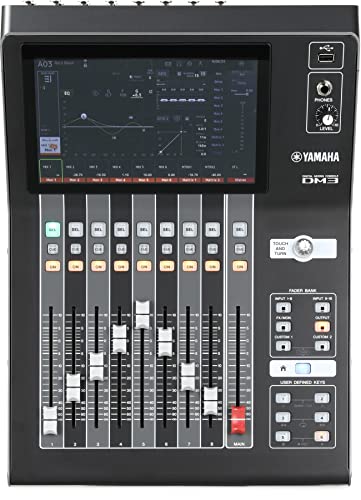
Yamaha DM3
Bands, small venues and project studios that want a compact 96 kHz digital console that doubles as an 18x18 USB recording interface.
Read the Yamaha DM3 review →Questions Buyers Ask
Allen & Heath Qu-5D
See the current listing, price and included accessories.
About This Review
Mandrillis Team
The Mandrillis editorial team researches and compares audio and music gear using manufacturer documentation, verified specs and real buyer feedback, so you can make a confident purchase without wading through marketing claims.
Read our full research methodology.