Best Instrument Microphones: Eight Picks for Guitar, Drums and Strings
This guide is for recording engineers and home studio owners choosing a microphone for guitar amps, drums and acoustic strings rather than lead vocals. The eight picks here were narrowed from 356 researched microphones using scores across sound quality, pickup pattern and noise handling, build quality, connectivity and setup, features and extras, and value. Picks range from large-diaphragm condensers for detailed acoustic work to rugged dynamic and ribbon designs built for loud guitar cabinets and drum kits, so match the pick to the source you actually need to capture.
Quick Answer
The Audio-Technica AT4040 is the best overall pick at a score of 86, a large-diaphragm true condenser with transformerless circuitry and high-SPL capability for vocals, acoustic instruments and loud sources alike. The Sennheiser Neumann TLM 102 MT is the best value pick at 85, a compact cardioid condenser rated to 144 dB maximum sound pressure level. Drummers and singer-guitarists should consider the Shure SM57 SM58 set at 85, pairing one instrument mic with one vocal mic. Guitar amp recording is covered by the Electro-Voice RE320 at 77, and budget buyers who need onboard EQ for kick drum and bass amps can choose the Telefunken Elektroakustik M82 at 71.
Why You Can Trust This Guide
We compared products using verified manufacturer specifications, available manuals and documentation, retailer listings, owner feedback, and editorial research.
We focus on measurable differences such as performance, compatibility, usability, build quality, features, and value.
Mandrillis presents editorial research as editorial research, not as laboratory testing, unless physical testing was actually performed.
Read our full research methodology.
Quick Picks
Comparison Table
| Model | Type | Polar pattern | Connection | Max SPL or sensitivity | Best For | Main Advantage | Score |
|---|---|---|---|---|---|---|---|
| Audio-Technica AT4040 | Large-diaphragm true condenser, externally polarized (DC bias) | Cardioid | Not published in listing | Not published in listing; described as high-SPL capable with exceptionally low noise | Home and project studios that want one serious large-diaphragm condenser for vocals, acoustic instruments and loud sources alike. | True externally polarized condenser with a large diaphragm | 86/100 |
| Sennheiser Neumann TLM 102 MT | Large-diaphragm condenser, pressure gradient transducer | Cardioid | Not published in listing | 144 dB maximum sound pressure level | Home and project studios that want one refined condenser for vocals, voice-over and loud instruments alike. | Large-diaphragm cardioid condenser with Neumann consistency | 85/100 |
| Shure SM57 SM58 | Set of two dynamic cardioid microphones: SM57 instrument microphone and SM58 handheld vocal microphone | Cardioid (both microphones) | Not published in listing | Not published in listing | Singer-guitarists, small bands, rehearsal spaces and home studios that need one dependable vocal microphone and one instrument microphone in a single budget tier set. | One instrument microphone and one vocal microphone in a single purchase | 85/100 |
| Electro-Voice RE320 | Professional-grade large diaphragm dynamic microphone designed for recording and sound reinforcement | Not explicitly named in listing; a Variable-D pattern control is confirmed to minimize positional and off-axis tonal shifts | Not published in listing as a specific connector type | Not published in listing as a specific numeric figure; the listing describes extremely low noise and the best possible tonal and transient response | Engineers who want a professional-grade dynamic microphone with Variable-D positional stability and a dual-voicing switch for two distinct tonal curves, at a lower mid-range price tier. | Variable-D pattern control minimizes positional and off-axis tonal shifts | 77/100 |
| Lewitt LCT440PURE SP | Condenser microphone; the included stereo bar and paired accessories in this listing point to a matched stereo pair configuration, even though the listing title itself uses the phrase stereo preamp | Not published in listing | Not published in listing as a specific connector type | Maximum SPL of up to 140 dB SPL; self-noise of only 7 dB(A); dynamic range of 133 dB(A) | Buyers who want a pair of low self-noise, high SPL handling Lewitt condensers for vocal and instrument recording, complete with a mil-spec transport case and matched accessories. | Very low self-noise of only 7 dB(A) | 74/100 |
| Beyerdynamic M 160 | Double ribbon microphone (listing title: Double Ribbon Microphone) | Hypercardioid (listing bullet reads Hyper Double Ribbon Mic) | Not published in listing | Not published in listing | Recording guitar amplifiers, drum overheads, strings and brass with a smooth, directional ribbon character. | Double ribbon design with a smooth, detailed character | 72/100 |
| AKG C114 | Large-diaphragm multi-pattern condenser microphone | Cardioid, omnidirectional and figure-8 (switchable) | XLR | Not published in listing (described as low noise) | Home studio recordists who want one condenser that can switch between cardioid, omni and figure-8 for vocals, instruments and stereo techniques. | Three polar patterns: cardioid, omni and figure-8 | 72/100 |
| Telefunken Elektroakustik M82 | Large-diaphragm dynamic microphone with an end-address design | Not published in listing | Not published in listing as a specific connector type; end-address design is confirmed | Not published in listing | Engineers who want a large-diaphragm dynamic microphone with onboard EQ switching, specifically suited to kick drum, bass and guitar amps. | Large-diaphragm dynamic capsule for superior low frequency definition | 71/100 |
#1. Audio-Technica AT4040 (Best Overall)
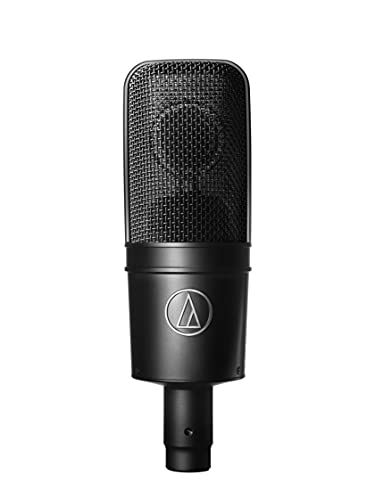
Mandrillis Research Score: 86/100
This is an editorial research score, not a customer rating or laboratory test score.
Who Should Buy It
- Vocalists and voice-over artists recording in a treated or quiet room
- Project studios upgrading from an entry-level condenser
- Engineers who need one microphone for vocals, guitar amps and overheads
- Buyers who value published design detail over marketing gloss
Skip It If
- You record in an untreated, noisy space where a dynamic would be more forgiving
- You need figure-eight or omnidirectional patterns
- You want a USB connection without an audio interface
Pros
- True externally polarized condenser with a large diaphragm
- Transformerless circuitry for low-frequency clarity and fast transients
- Described as exceptionally low noise with wide dynamic range
- High-SPL capability suits loud sources as well as vocals
- Nickel-plated brass baffle for element stability
- Long-established studio reputation at a lower mid-range price
Cons
- Frequency response, self-noise and max SPL figures not published in listing
- Accessories, mount and connector not stated
- Cardioid only, no multi-pattern option
- Requires phantom power and a quiet room to shine
Key Specs
Type: Large-diaphragm true condenser, externally polarized (DC bias)
Polar pattern: Cardioid
Frequency response: Not published in listing
Connection: Not published in listing
Phantom power: Required for an externally polarized condenser; voltage not published in listing
Max SPL or sensitivity: Not published in listing; described as high-SPL capable with exceptionally low noise
Controls: Not published in listing
Mount and stand: Not published in listing
Weight: Not published in listing
Included accessories: Not published in listing
Why We Picked It
The AT4040 is the best overall pick at a score of 86, a large-diaphragm true condenser with transformerless circuitry for low-frequency clarity and fast transients. Its nickel-plated brass baffle stabilizes the element, and the listing describes exceptionally low noise with high-SPL capability for loud sources, though frequency response, self-noise, max SPL, weight and accessories are not published.
Read our full Audio-Technica AT4040 review →
Check Price on AmazonWe may earn a commission at no extra cost to you.
Last verified: October 2026
Why This Product Ranks Best Overall
#2. Sennheiser Neumann TLM 102 MT (Best Value)

Mandrillis Research Score: 85/100
This is an editorial research score, not a customer rating or laboratory test score.
Who Should Buy It
- Vocalists stepping up from an entry-level condenser
- Voice-over artists and narrators wanting a clean, airy sound
- Multi-instrumentalists recording guitar cabinets, brass and acoustic sources
- Video creators who want a non-reflective studio microphone
Skip It If
- Your interface cannot supply phantom power
- You need a pad, low-cut switch or switchable patterns
- A dynamic would suit your noisy room better
Pros
- Large-diaphragm cardioid condenser with Neumann consistency
- 144 dB maximum sound pressure level handles loud sources
- Slight presence boost above 6 kHz flatters vocals
- Compact body fits tight spaces
- Matte black finish suits stage and video
Cons
- No pad or low-cut switch
- Connector, phantom power and self-noise not published in listing
- Accessories not confirmed
- Picks up more room sound than a dynamic
Key Specs
Type: Large-diaphragm condenser, pressure gradient transducer
Polar pattern: Cardioid
Frequency response: Not published in listing (slight presence boost above 6 kHz stated)
Connection: Not published in listing
Phantom power: Not published in listing
Max SPL or sensitivity: 144 dB maximum sound pressure level
Controls: Not published in listing
Mount and stand: Not published in listing
Weight: Not published in listing
Included accessories: Not published in listing
Why We Picked It
The TLM 102 MT earns best value at a score of 85, a compact large-diaphragm cardioid condenser rated to 144 dB maximum sound pressure level with a slight presence boost above 6 kHz. Its matte black finish suits stage and video use, though it has no pad or low-cut switch, and connector, phantom power and self-noise figures are not published.
Read our full Sennheiser Neumann TLM 102 MT review →
Check Price on AmazonWe may earn a commission at no extra cost to you.
Last verified: October 2026
Why This Product Ranks Best Value
#3. Shure SM57 SM58 (Best for Drums)

Mandrillis Research Score: 85/100
This is an editorial research score, not a customer rating or laboratory test score.
Who Should Buy It
- Singer-guitarists who record or perform with a vocal mic and an amp mic
- Small bands and rehearsal rooms starting a microphone locker
- Home studios adding two proven dynamics to a condenser
- Drummers and engineers who want a classic snare microphone plus a vocal spare
Skip It If
- You record quiet acoustic instruments and want detail and air
- You need a USB microphone for a desk
- You already own one of these and only need the other
Pros
- One instrument microphone and one vocal microphone in a single purchase
- Both are dynamic cardioid designs that resist feedback and handle high levels
- Two of the most widely used microphones in live and studio work
- Dynamic capsules work in untreated rooms without phantom power
- Covers a singer plus a guitar cabinet, snare or brass at a budget tier price
Cons
- Listing publishes almost no specifications beyond type and pattern
- No cables, clips or cases confirmed in the box
- Connector, weight and response not stated
- Not suited to quiet, detailed acoustic recording
Key Specs
Type: Set of two dynamic cardioid microphones: SM57 instrument microphone and SM58 handheld vocal microphone
Polar pattern: Cardioid (both microphones)
Frequency response: Not published in listing
Connection: Not published in listing
Phantom power: Not required (dynamic design); not published in listing
Max SPL or sensitivity: Not published in listing
Controls: None described in listing
Mount and stand: Not published in listing
Weight: Not published in listing
Included accessories: Not published in listing
Why We Picked It
The SM57 SM58 set scores 85 as Best for Drums, pairing one SM57 instrument microphone with one SM58 vocal microphone, both dynamic cardioid designs that resist feedback and need no phantom power in untreated rooms. It covers a singer plus a guitar cabinet, snare or brass in one budget tier purchase, though the listing publishes almost no specifications beyond type and pattern.
Read our full Shure SM57 SM58 review →
Check Price on AmazonWe may earn a commission at no extra cost to you.
Last verified: October 2026
Why This Product Ranks Best for Drums
#4. Electro-Voice RE320 (Best for Guitar Amps)

Mandrillis Research Score: 77/100
This is an editorial research score, not a customer rating or laboratory test score.
Who Should Buy It
- Engineers who want minimal tonal shift as a vocalist or instrumentalist moves around the microphone
- Buyers who want a dual-voicing switch for quick tonal adjustment between two curves
- Studios that want integrated pop filtering and humbucking noise rejection built in
- Buyers recording a variety of vocal and instrument sources with one versatile dynamic mic
Skip It If
- You need a confirmed polar pattern name before purchase
- You need a confirmed numeric frequency response or sensitivity figure before buying
- You need confirmed included accessories such as a mount before purchase
Pros
- Variable-D pattern control minimizes positional and off-axis tonal shifts
- Integrated humbucking coil for virtually noiseless performance
- Integral pop filters built directly into the microphone
- Dual-voicing switch selects from two response curves
- Suited to a variety of vocal and instrument sources
Cons
- No stated polar pattern name beyond the Variable-D control description
- No stated numeric frequency response, sensitivity or maximum SPL figures
- No stated included accessories or mount
- No stated microphone weight
Key Specs
Type: Professional-grade large diaphragm dynamic microphone designed for recording and sound reinforcement
Polar pattern: Not explicitly named in listing; a Variable-D pattern control is confirmed to minimize positional and off-axis tonal shifts
Frequency response: Not published in listing as a specific numeric range
Connection: Not published in listing as a specific connector type
Phantom power: Not required; this is a dynamic microphone design
Max SPL or sensitivity: Not published in listing as a specific numeric figure; the listing describes extremely low noise and the best possible tonal and transient response
Controls: A dual-voicing switch that selects from two response curves
Mount and stand: Integral pop filters are built into the microphone
Weight: Not published in listing
Included accessories: Not published in listing
Why We Picked It
The RE320 scores 77 as Best for Guitar Amps, a professional-grade dynamic microphone with Variable-D pattern control that minimizes positional and off-axis tonal shifts, plus an integrated humbucking coil for noiseless performance. A dual-voicing switch selects between two response curves, though polar pattern name, frequency response, SPL and weight figures are not published.
Read our full Electro-Voice RE320 review →
Check Price on AmazonWe may earn a commission at no extra cost to you.
Last verified: November 2026
Why This Product Ranks Best for Guitar Amps
#5. Lewitt LCT440PURE SP (Best for Acoustic)

Mandrillis Research Score: 74/100
This is an editorial research score, not a customer rating or laboratory test score.
Who Should Buy It
- Buyers who want two matched condensers for stereo recording techniques
- Engineers who value an exceptionally low self-noise figure for quiet source recording
- Producers who want to record loud sources up to 140 dB SPL without distortion
- Buyers who want a complete, travel-ready case with matched mounts and pop filters included
Skip It If
- You only need a single microphone rather than a matched set
- You need a confirmed polar pattern before purchase
- You need a confirmed numeric frequency response range before buying
Pros
- Very low self-noise of only 7 dB(A)
- High dynamic range of 133 dB(A)
- Handles sound pressure levels up to 140 dB SPL without distortion
- Comes in a mil-spec transport case with stereo bar, shock mounts, mic mounts, windscreens, transport bag and two magnetic pop filters
- Designed after Lewitt's top-of-the-line models
Cons
- No stated polar pattern
- No stated numeric frequency response range
- No stated connector type or phantom power voltage
- The listing title's stereo preamp phrasing sits awkwardly against the stereo pair style bundle contents described in the feature bullets
Key Specs
Type: Condenser microphone; the included stereo bar and paired accessories in this listing point to a matched stereo pair configuration, even though the listing title itself uses the phrase stereo preamp
Polar pattern: Not published in listing
Frequency response: Not published in listing as a specific numeric range
Connection: Not published in listing as a specific connector type
Phantom power: Not published in listing as a specific voltage figure
Max SPL or sensitivity: Maximum SPL of up to 140 dB SPL; self-noise of only 7 dB(A); dynamic range of 133 dB(A)
Controls: Not published in listing
Mount and stand: A mil-spec transport case including a stereo bar, shock mounts and microphone mounts is confirmed
Weight: Not published in listing
Included accessories: Mil-spec transport case, stereo bar, shock mounts, microphone mounts, windscreens, transport bag, and two magnetic pop filters
Why We Picked It
The LCT440PURE SP scores 74 as Best for Acoustic, a condenser configuration with self-noise of only 7 dB(A), a dynamic range of 133 dB(A) and handling up to 140 dB SPL. It ships in a mil-spec transport case with a stereo bar, shock mounts, windscreens and two magnetic pop filters, though polar pattern, frequency response and connector type are not published.
Read our full Lewitt LCT440PURE SP review →
Check Price on AmazonWe may earn a commission at no extra cost to you.
Last verified: November 2026
Why This Product Ranks Best for Acoustic
#6. Beyerdynamic M 160 (Best Build)

Mandrillis Research Score: 72/100
This is an editorial research score, not a customer rating or laboratory test score.
Who Should Buy It
- Project studio owners adding a ribbon color to a condenser and dynamic collection
- Guitarists recording amplifiers who find condensers too harsh
- Drummers and engineers wanting smoother overheads with directional control
- String and brass players recording at home with a capable preamp
Skip It If
- You need a first microphone for general home studio use
- Your interface preamp has limited clean gain
- You are not comfortable confirming the condition of a demo unit
Pros
- Double ribbon design with a smooth, detailed character
- Hypercardioid pattern is rare for a ribbon and improves isolation
- Excellent on guitar amps, overheads, strings and brass
- Compact body is easy to position close to sources
- Long professional track record
Cons
- Listing publishes almost no specifications
- Demo wording raises condition and warranty questions
- Low output needs a preamp with plenty of clean gain
- Ribbon element is fragile and sensitive to wind
- No included accessories confirmed
Key Specs
Type: Double ribbon microphone (listing title: Double Ribbon Microphone)
Polar pattern: Hypercardioid (listing bullet reads Hyper Double Ribbon Mic)
Frequency response: Not published in listing
Connection: Not published in listing
Phantom power: Not published in listing
Max SPL or sensitivity: Not published in listing
Controls: Not published in listing
Mount and stand: Not published in listing
Weight: Not published in listing
Included accessories: Not published in listing
Why We Picked It
The M 160 scores 72 as Best Build, a double ribbon microphone with a rare hypercardioid pattern well suited to guitar amplifiers, drum overheads, strings and brass, and a compact body that is easy to position close to a source. Its long professional track record backs the build quality score, though the listing publishes almost no specifications and its low output needs a preamp with plenty of clean gain.
Read our full Beyerdynamic M 160 review →
Check Price on AmazonWe may earn a commission at no extra cost to you.
Last verified: October 2026
Why This Product Ranks Best Build
#7. AKG C114 (Best Premium)

Mandrillis Research Score: 72/100
This is an editorial research score, not a customer rating or laboratory test score.
Who Should Buy It
- Singer-songwriters building a first XLR home studio
- Podcasters and streamers with a treated room and an interface
- Engineers who want figure-8 for mid-side or duet recording
- Students learning how polar patterns change a recording
Skip It If
- You need a plug-in USB microphone
- Your room is untreated and noisy
- You require confirmed specifications for a critical project
Pros
- Three polar patterns: cardioid, omni and figure-8
- Large-diaphragm condenser design for vocals and instruments
- Standard XLR connection for any interface or mixer
- Described as low noise in the listing
- Sustainable design highlighted by the listing
- Budget tier price for a multi-pattern studio microphone
Cons
- Frequency response, sensitivity and max SPL not published
- Phantom power requirement not stated in the listing
- No mount, shock mount or accessories confirmed
- Weight and housing material not published
- Condenser sensitivity exposes untreated rooms
Key Specs
Type: Large-diaphragm multi-pattern condenser microphone
Polar pattern: Cardioid, omnidirectional and figure-8 (switchable)
Frequency response: Not published in listing
Connection: XLR
Phantom power: Not published in listing (condenser design; phantom power is the normal requirement)
Max SPL or sensitivity: Not published in listing (described as low noise)
Controls: Pattern selection implied by multi-pattern design; switch details not published
Mount and stand: Not published in listing
Weight: Not published in listing
Included accessories: Not published in listing
Why We Picked It
The C114 scores 72 as Best Premium, a large-diaphragm condenser switchable between cardioid, omnidirectional and figure-8 patterns over a standard XLR connection. The listing describes it as low noise with a sustainable design, though frequency response, sensitivity, max SPL, weight and included accessories are not published.
Read our full AKG C114 review →
Check Price on AmazonWe may earn a commission at no extra cost to you.
Last verified: October 2026
Why This Product Ranks Best Premium
#8. Telefunken Elektroakustik M82 (Best Budget)

Mandrillis Research Score: 71/100
This is an editorial research score, not a customer rating or laboratory test score.
Who Should Buy It
- Engineers recording kick drum, bass or guitar amps who want a dynamic mic with built-in EQ
- Broadcasters and podcasters who want onboard mid cut and high boost switching for vocal clarity
- Buyers who want an end-address design for easy, intuitive microphone positioning
- Buyers who value a microphone designed and hand assembled in the USA
Skip It If
- You need a confirmed polar pattern before purchase
- You need a confirmed numeric frequency response or sensitivity figure in writing
- You need confirmed included accessories such as a mount before buying
Pros
- Large-diaphragm dynamic capsule for superior low frequency definition
- Balanced mid and high frequency response for clarity and intelligibility
- Independently switchable two-band EQ with a mid cut and high boost built in
- End-address design for easy positioning on most sound sources
- Designed and hand assembled in the USA
- Specifically recommended for kick drum, bass and guitar amps, and broadcast or podcast vocals
Cons
- No stated polar pattern
- No stated numeric frequency response, sensitivity or maximum SPL figures
- No stated included accessories or mount
- No stated microphone weight
Key Specs
Type: Large-diaphragm dynamic microphone with an end-address design
Polar pattern: Not published in listing
Frequency response: Not published in listing as a specific numeric range; the listing describes superior low frequency definition and a balanced mid and high frequency response
Connection: Not published in listing as a specific connector type; end-address design is confirmed
Phantom power: Not required; this is a dynamic microphone design
Max SPL or sensitivity: Not published in listing
Controls: Independently switchable two-band EQ featuring a mid cut and a high boost
Mount and stand: Not published in listing
Weight: Not published in listing
Included accessories: Not published in listing
Why We Picked It
The M82 is the Best Budget pick at a score of 71, a large-diaphragm dynamic microphone with an end-address design and an independently switchable two-band EQ offering a mid cut and a high boost. It is specifically recommended for kick drum, bass and guitar amps, though polar pattern, frequency response, max SPL, weight and accessories are not published.
Read our full Telefunken Elektroakustik M82 review →
Check Price on AmazonWe may earn a commission at no extra cost to you.
Last verified: November 2026
Why This Product Ranks Best Budget
Which One Should You Buy?
These eight microphones split between large-diaphragm condensers for detailed acoustic and vocal work and rugged dynamic or ribbon designs built for loud instrument sources. The Audio-Technica AT4040 leads at a score of 86 as a versatile condenser, with the Sennheiser Neumann TLM 102 MT close behind at 85 for high SPL handling in a compact body. The Shure SM57 SM58 set also scores 85, pairing a vocal and instrument mic in one purchase. The Electro-Voice RE320 scores 77 for guitar amps, the Lewitt LCT440PURE SP scores 74 as a low-noise pair with a full accessory case, and the Beyerdynamic M 160 and AKG C114 tie at 72, one a ribbon design and the other a multi-pattern condenser. The Telefunken Elektroakustik M82 rounds out the list at 71 with onboard EQ built for kick drum and bass amps.
Buy the Audio-Technica AT4040 if you want one versatile condenser for everything.
Choose this if you want a large-diaphragm true condenser with transformerless circuitry, low noise and high-SPL handling for vocals, acoustic instruments and loud sources alike. Frequency response, self-noise, weight and accessories are not published in the listing.
Buy the Sennheiser Neumann TLM 102 MT if you need high SPL handling in a compact body.
Pick this if you want a cardioid condenser rated to 144 dB maximum sound pressure level with a presence boost above 6 kHz for vocals. It has no pad or low-cut switch, and connector and self-noise figures are not published.
Buy the Shure SM57 SM58 set if you need one vocal mic and one instrument mic.
Get this if you want a dependable dynamic cardioid pair covering a singer plus a guitar cabinet, snare or brass source without needing phantom power at all. The listing publishes almost no specifications beyond type and pattern.
Buy the Electro-Voice RE320 if you record guitar amplifiers regularly.
Choose this if you want Variable-D pattern control for positional stability, a humbucking coil for noiseless performance, and a dual-voicing switch for two distinct tonal curves. Polar pattern name and SPL figures are not published.
Buy the Lewitt LCT440PURE SP if you want a low-noise pair with a full case.
Pick this if very low self-noise of 7 dB(A) and handling up to 140 dB SPL matter, and you want a mil-spec case with stereo bar and mounts included. Polar pattern and connector type are not published.
Buy the Beyerdynamic M 160 if you want a ribbon character on amps and overheads.
Choose this if a smooth, directional ribbon character with a rare hypercardioid pattern suits your guitar amps, overheads, strings or brass work. The listing publishes almost no specifications, and output is low, needing a strong preamp.
Buy the AKG C114 if you want to switch between three polar patterns.
Get this if you want one condenser that switches between cardioid, omni and figure-8 for vocals, instruments and stereo recording techniques over a standard XLR connection. Frequency response, sensitivity, weight and accessories are not published.
Buy the Telefunken Elektroakustik M82 if you need onboard EQ for kick drum or bass amps.
Choose this if you want a large-diaphragm dynamic microphone with switchable mid cut and high boost EQ, specifically recommended for kick drum, bass and guitar amps. Polar pattern and SPL figures are not published in the listing.
Buying Guide
Condenser, Dynamic or Ribbon
A condenser microphone, like the Audio-Technica AT4040 or AKG C114, captures fine detail and high frequencies well, which suits acoustic guitar, strings and quiet sources, but it needs phantom power and a controlled room. A dynamic microphone, like the Shure SM57 SM58 set or Electro-Voice RE320, handles loud sources such as guitar amps and drums without phantom power and tolerates a less treated room. A ribbon microphone, like the Beyerdynamic M 160, adds a smooth, detailed character prized on guitar amps and overheads, though its low output needs a strong preamp and the ribbon element is fragile.
Polar Pattern and Pickup Flexibility
Cardioid, used on most picks here, rejects sound from behind the capsule and suits close instrument miking in a typical room. The AKG C114 goes further with switchable cardioid, omnidirectional and figure-8 patterns, letting one microphone cover a solo instrument, a room sound, or a stereo pair without buying separate microphones. The Beyerdynamic M 160 uses a hypercardioid pattern that is unusual for a ribbon design and improves isolation on a loud source positioned close by. Several listings here, including the Electro-Voice RE320 and Telefunken M82, do not name their exact polar pattern despite describing directional behavior.
Maximum SPL and Self-Noise
Maximum sound pressure level describes how loud a source can get before a microphone distorts, which matters for guitar cabinets, kick drums and brass. The Sennheiser Neumann TLM 102 MT publishes a specific 144 dB maximum SPL figure, and the Lewitt LCT440PURE SP goes further with 140 dB SPL handling and a low self-noise of 7 dB(A), giving a wide 133 dB(A) dynamic range for quiet passages and loud peaks in the same take. Most other picks here do not publish numeric SPL or self-noise figures, so check a listing before placing a microphone in front of a loud amplifier.
Onboard EQ and Voicing Controls
A built-in tone control lets you shape a microphone's character for a specific instrument without reaching for a mixer EQ. The Electro-Voice RE320 includes a dual-voicing switch that selects between two distinct response curves for different sources, and the Telefunken Elektroakustik M82 adds an independently switchable two-band EQ with a mid cut and a high boost, aimed at kick drum, bass and guitar amp work. Most other microphones in this guide, including the Audio-Technica AT4040 and Shure SM57 SM58 set, publish no onboard controls at all, relying entirely on microphone placement and your mixer or interface for tone shaping.
Connectivity and Phantom Power
Condenser microphones, including the Audio-Technica AT4040, Sennheiser Neumann TLM 102 MT and AKG C114, require phantom power from a mixer or interface to operate, while dynamic and ribbon designs like the Shure SM57 SM58 set, Electro-Voice RE320, Telefunken M82 and Beyerdynamic M 160 need none. The AKG C114 confirms a standard XLR connection, but most other picks in this guide do not state their connector type or exact phantom power voltage. Confirm your interface or mixer actually supplies phantom power before buying a condenser, since plugging one into a channel without it will produce no usable signal at all.
Bundles, Pairs and Included Cases
Some instrument microphone purchases are not a single unit. The Shure SM57 SM58 set bundles one instrument microphone with one vocal microphone in a single budget tier purchase, and the Lewitt LCT440PURE SP ships as what the listing describes as a matched stereo pair style bundle, complete with a mil-spec transport case, stereo bar, shock mounts, windscreens and two magnetic pop filters. Most single-microphone picks in this guide, including the Audio-Technica AT4040 and AKG C114, do not confirm any included mount, cable or case, so factor in separate accessory purchases when comparing total cost.
How We Compared
- Each microphone was scored across six weighted categories: sound quality, pickup pattern and noise handling, build quality, connectivity and setup, features and extras, and value.
- Sound quality carried the heaviest weight at 30 points, since tonal accuracy and detail matter most for recording instruments and acoustic sources.
- Pickup pattern and noise handling scores rewarded confirmed polar patterns, multi-pattern switching, and published self-noise or maximum SPL figures.
- Features and extras scores weighed onboard EQ or voicing switches, bundled accessories and included cases against microphones with no stated extras.
- Connectivity and setup scores considered confirmed connector types and phantom power requirements, since these affect how quickly a microphone can be used.
- Listings with unpublished frequency response, SPL or weight were scored on confirmed features only, and those gaps are flagged in each pick's specifications.
FAQ
Related Guides


About This Guide
Mandrillis Team
The Mandrillis editorial team researches and compares audio and music gear using manufacturer documentation, verified specs and real buyer feedback, so you can make a confident purchase without wading through marketing claims.
Read our full research methodology.