Digital Pianos Review
Korg D1 Review: Flagship RH3 Action in a Slim Stage Piano
The D1 is Korg's minimalist stage piano: the RH3 hammer action from its Kronos and Grandstage keyboards, thirty sounds, balanced outputs and 5-pin MIDI in a cabinet only 266 mm deep, with no speakers and no USB. This review explains who that combination suits, where it beats the Roland FP-30X and Kawai ES120, and the two omissions to check before buying.
Our Verdict
Research Score 85/100The Korg D1 is the best action you can buy under four figures if you can live without speakers. RH3 is graded in four weight zones, repeats quickly and feels closer to an acoustic than anything from Roland or Kawai at this price. The thirty sounds are strong and the balanced outputs are stage-ready. It is the wrong piano for a bedroom with no monitors, and the lack of USB dates it, but for a gigging player or a producer with an interface it is a bargain.
Editorial research score based on published specifications and documented features, not a customer rating or lab test.
Korg
Korg D1
Best for: Gigging players and home producers who want Korg's RH3 action without speakers or bulk
Skip it if: you need speakers, USB or a piano that works without an amp or headphones
Check Price on AmazonWe may earn a commission at no extra cost to you.
Listing verified: October 2026
Who Should Buy It
Buy it if
- You play live and need line outputs, MIDI and a slim, stage-ready keyboard
- You want the RH3 action from the Kronos and Grandstage at a fraction of the price
- You already own monitors or an audio interface
Skip it if
- You practice at home without headphones or speakers
- You want to connect to a tablet or computer over USB
- You want Bluetooth for backing tracks
Key Specifications
| Key Action | RH3 (Real Weighted Hammer Action 3) |
| Sound Engine | Korg stereo piano samples |
| Voices | 30 |
| Polyphony | 120 notes |
| Speakers | None |
| Bluetooth | No |
| USB | No (5-pin MIDI in/out) |
| Pedals | Damper pedal included |
| Weight | 38.8 lb (17.6 kg) per listing |
| Form Factor | Slim stage piano, 266 mm deep |
A Stage Piano Stripped to the Essentials
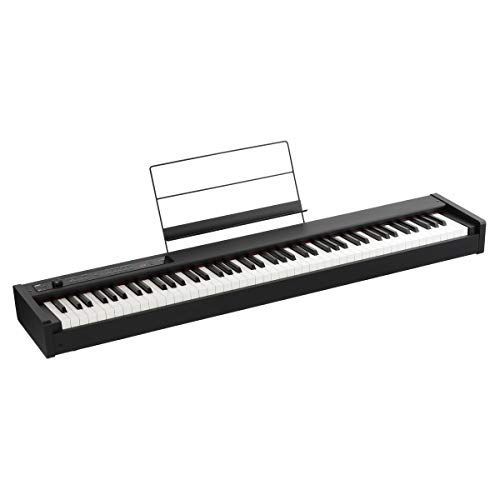
Korg designed the D1 around one component: the RH3 keyboard. It is the same action fitted to the Kronos workstation, the Grandstage and the SV-2, and it has a reputation among stage players for a solid, deliberate feel and reliable repetition. To bring it to this price, Korg removed the speakers, the USB port and the display, leaving a slim aluminum-fronted cabinet with a volume knob, sound buttons and a small set of rear connections.
That makes the D1 a different proposition from the Roland FP-30X or Kawai ES120. It is not a self-contained home piano. It is a keyboard that assumes you will plug it into something.
RH3 Action in Detail
RH3 grades the keyboard in four zones rather than the continuous grading of most actions, so the bass is noticeably heavier than the treble and the transitions are distinct. The keys are long, the pivot is deep, and the mechanism has a reassuring mass that makes fortissimo passages feel controlled. Repeated notes trigger cleanly thanks to a quick return, and the action is quiet.
Against the Roland PHA-4 Standard, RH3 feels heavier and more substantial but lacks the escapement click and textured key tops. Against the Kawai RHC on the ES120, it is clearly the more serious action. Players coming from acoustic pianos tend to prefer RH3 to anything else at this price; players who want a lighter, faster touch for synth and organ parts sometimes find it too much.
Sounds and Polyphony
Thirty sounds include Korg's German and Italian concert grands, an upright, several electric pianos including the classic tine and reed types, a clav, organs, strings, harpsichord and a handful of synth and bass sounds for splits. The grands are warm and detailed and the electric pianos are among the best in this price band, which makes sense given Korg's SV stage piano heritage.
Polyphony is 120 notes. On a stage piano used for piano and electric piano parts that is rarely a problem; it becomes one only when layering two sounds with heavy sustain. There is damper resonance modeling, reverb and chorus effects, and a Brilliance control for quick tonal adjustment.
Connections: What Is There and What Is Not
On the back are balanced left and right line outputs, a headphone jack, 5-pin MIDI in and out, a damper pedal input and the power inlet. The balanced outputs run long cables to a mixer without noise, which is a stage feature most portables lack. The 5-pin MIDI ports drive hardware synths and older interfaces directly.
There is no USB port. To connect the D1 to a computer or tablet you need an interface or a MIDI-to-USB cable, which costs little but is one more thing to carry. There is no Bluetooth, no audio input and, crucially, no speaker. Headphones or an external amplifier are required to hear anything.
Who the D1 Suits
Three kinds of player get the most from it. Gigging musicians who already own a keyboard amp or play through the venue PA, who want the best action they can carry in one hand. Home producers who play into a DAW through an audio interface and use studio monitors. And serious pianists on a budget who have good headphones and want RH3 under their fingers for practice.
It suits none of the usual beginner scenarios. A child learning in a bedroom needs speakers, and a parent wanting an app-connected piano needs USB or Bluetooth. The Roland FP-30X or Kawai ES120 cover those needs better.
Build, Size and Transport
At 266 mm deep the D1 is slimmer than every speaker-equipped portable, including the Casio PX-S1100, and its roughly 38 pound weight is spread across a long, rigid chassis with a brushed aluminum front panel. It fits a 88-key gig bag and sits on any X stand. Korg's matching ST-SV1 stand and SP-150 stand are the furniture options; the included damper pedal supports half-pedaling.
D1 Against the Alternatives
Compared with the Roland FP-30X, the D1 has the heavier, more acoustic action and balanced outputs but gives up speakers, USB audio, Bluetooth and 136 notes of polyphony. Compared with the Kawai ES120, the D1 wins decisively on action and loses on everything a home player needs. Compared with Korg's own LP-380U console, the D1 is the same RH3 action and sound set in a portable cabinet without speakers or a three-pedal base.
The honest summary is that the D1 is a keyboard for people who know exactly what they want. If that is RH3 at the lowest price, nothing else comes close.
Strengths and Limitations
Strengths
- RH3 action from Korg's flagship stage pianos, graded in four zones
- Thirty sounds including two grands, electric pianos and clavs
- Only 266 mm deep, the slimmest serious action available
- Balanced line outputs and 5-pin MIDI for stage use
Limitations
- No built-in speakers at all
- No USB port, MIDI is 5-pin only
- 120-note polyphony
How We Scored It
Scores reflect published specifications, documented features and value against the alternatives below. They are editorial research scores, not laboratory measurements.
Alternatives to Consider

Roland FP-30X
Anyone who wants the complete mid-range portable: realistic action, generous polyphony, every connection
Read the Roland FP-30X review →
Kawai ES120
Players who prize a warm, acoustic-like piano tone and a light, well-connected portable
Read the Kawai ES120 review →
Korg LP-380U
Pianists who want Korg's best action in a slim home cabinet with three pedals and real speakers
Read the Korg LP-380U review →Questions Buyers Ask
Korg D1
See the current listing, price and included accessories.
About This Review
Mandrillis Team
The Mandrillis editorial team researches and compares audio and music gear using manufacturer documentation, verified specs and real buyer feedback, so you can make a confident purchase without wading through marketing claims.
Read our full research methodology.