Best Digital Pianos: Eight Models That Earn Their Place
This guide is for anyone choosing a digital piano for serious practice, from a first instrument to a home console a family will keep for a decade. We researched 34 current models one by one and compared key action, sound engine, polyphony, speakers and connectivity against the published specifications to pick the eight that lead their price tiers. Every model here has its own full review on this site.
Quick Answer
The best digital piano for most people is the Roland FP-30X, because its PHA-4 Standard action with escapement is the most realistic in the mid-range, its 256-note polyphony and connectivity leave nothing missing, and it costs far less than a console. Choose the Kawai ES120 if tone matters more than touch, the Kawai CN201 for the best console action under four figures, and the Roland FP-10 if the budget stops at the entry level.
Why You Can Trust This Guide
We compared products using verified manufacturer specifications, available manuals and documentation, retailer listings, owner feedback, and editorial research.
We focus on measurable differences such as performance, compatibility, usability, build quality, features, and value.
Mandrillis presents editorial research as editorial research, not as laboratory testing, unless physical testing was actually performed.
Read our full research methodology.
Quick Picks
Comparison Table
| Model | Key Action | Polyphony | Speakers | Bluetooth | Best For | Main Advantage | Score |
|---|---|---|---|---|---|---|---|
| Roland FP-30X | PHA-4 Standard with escapement and Ivory Feel | 256 notes | 2 x 11 W | Audio and MIDI | Anyone who wants the complete mid-range portable: realistic action, generous polyphony, every connection | PHA-4 Standard action with escapement at a mid-range price | 90/100 |
| Kawai ES120 | Responsive Hammer Compact (RHC) | 192 notes | 2 x 10 W | Audio and MIDI | Players who prize a warm, acoustic-like piano tone and a light, well-connected portable | Warm, natural piano tone from 88-key sampling of Kawai grands | 87/100 |
| Yamaha P-225 | GHC (Graded Hammer Compact) | 192 notes | 2 x 7 W, two-way | Audio | Players who want Yamaha's flagship CFX tone in a slim portable with proper outputs | CFX concert grand sample with damper and string resonance from VRM Lite | 88/100 |
| Kawai CN201 | Responsive Hammer III with let-off and counterweights | 192 notes | 2 x 20 W | Audio and MIDI | Pianists who want the most authentic action and tone in an entry Kawai console | RHIII action with let-off, triple sensors and counterweights | 89/100 |
| Yamaha Arius YDP-184 | GH3 with synthetic ivory key tops | 256 notes | 2 x 30 W | No | Serious students and returning adults who want the most capable Arius without stepping up to Clavinova | GH3 three-sensor action with synthetic ivory tops, the best action in the Arius line | 89/100 |
| Casio Privia PX-870 | Tri-Sensor Scaled Hammer Action II | 256 notes | 4 speakers, 40 W total | No | Home players who want a console that sounds full through its own speakers for well under four figures | Four-speaker 40 watt system that projects up and out like an upright | 85/100 |
| Kawai ES920 | Responsive Hammer III with let-off and counterweights | 256 notes | 2 x 20 W | Audio and MIDI | Serious pianists who want the best action and sound in a portable before the price of a Kawai console | RHIII action with let-off, triple sensors and counterweights | 92/100 |
| Roland FP-10 | PHA-4 Standard with escapement and Ivory Feel | 96 notes | 2 x 6 W | MIDI only | Beginners who want the best key feel available under the entry price ceiling | PHA-4 Standard is the most realistic action at this price, with escapement and textured keys | 83/100 |
#1. Roland FP-30X (Best Overall)

Mandrillis Research Score: 90/100
This is an editorial research score, not a customer rating or laboratory test score.
Who Should Buy It
- You want the best action under the FP-60X without compromise elsewhere
- You stream backing tracks over Bluetooth and record over USB
- You gig and need line outs plus two headphone jacks
Skip It If
- Weight and depth are the constraint; the PX-S1100 is lighter and slimmer
- You prefer the Kawai sound signature
- You never leave the house and want a console with three pedals built in
Pros
- PHA-4 Standard action with escapement at a mid-range price
- 256-note polyphony and 56 tones
- Bluetooth audio and MIDI plus USB audio
- Quarter-inch line outputs and two headphone jacks
Cons
- Heavier than the slim Casio and Yamaha portables
- Included DP-2 pedal is a basic switch
- SuperNATURAL grand can sound bright next to the Kawai ES120
Key Specs
Key Action: PHA-4 Standard with escapement and Ivory Feel
Sound Engine: Roland SuperNATURAL Piano
Voices: 56
Polyphony: 256 notes
Speakers: 2 x 11 W
Bluetooth: Audio and MIDI
USB: USB audio and MIDI (Type B)
Pedals: DP-2 sustain switch included; KPD-70 triple pedal optional
Weight: 32.6 lb (14.8 kg)
Form Factor: Portable slab
Why We Picked It
PHA-4 Standard with escapement, 256-note polyphony, Bluetooth audio and MIDI, USB audio and line outputs: the mid-range portable with no weak link.
Read our full Roland FP-30X review →
Check Price on AmazonWe may earn a commission at no extra cost to you.
Last verified: October 2026
Why This Product Ranks Best Overall
#2. Kawai ES120 (Best Sound)

Mandrillis Research Score: 87/100
This is an editorial research score, not a customer rating or laboratory test score.
Who Should Buy It
- You prefer Kawai's rounder piano sound to Roland's brighter voicing
- You want Bluetooth MIDI and audio without buying an adapter
- You carry the piano and want line outs at a sensible weight
Skip It If
- You want a three-sensor action with escapement; try the FP-30X
- You record over USB audio
- You want the slimmest possible cabinet
Pros
- Warm, natural piano tone from 88-key sampling of Kawai grands
- Responsive Hammer Compact action with a smooth, even weight
- Bluetooth audio and MIDI built in, no adapter
- Light at 26.5 pounds with quarter-inch line outputs
Cons
- No escapement simulation and two sensors per key
- Plain matte key tops without texture
- No USB audio
Key Specs
Key Action: Responsive Hammer Compact (RHC)
Sound Engine: Harmonic Imaging with 88-key sampling
Voices: 25
Polyphony: 192 notes
Speakers: 2 x 10 W
Bluetooth: Audio and MIDI
USB: USB MIDI
Pedals: F-10H sustain pedal included; F-350 triple pedal optional
Weight: 26.5 lb (12 kg)
Form Factor: Portable slab
Why We Picked It
88-key sampled SK-EX and EX grands give it the warmest, most natural tone in the mid-range, with Bluetooth built in and six pounds less to carry than the Roland.
Read our full Kawai ES120 review →
Check Price on AmazonWe may earn a commission at no extra cost to you.
Last verified: October 2026
Why This Product Ranks Best Sound
#3. Yamaha P-225 (Best Slim Portable)

Mandrillis Research Score: 88/100
This is an editorial research score, not a customer rating or laboratory test score.
Who Should Buy It
- You want the best piano sound in Yamaha's portable range below the P-525
- You need line outs for a stand mixer, PA or interface
- You play layered or pedal-heavy pieces that exhaust 64-note pianos
Skip It If
- Key feel matters more to you than tone; try the FP-30X or ES120 first
- You want built-in speakers that can fill a room
- You are a complete beginner on a tight budget; the P-145 covers you
Pros
- CFX concert grand sample with damper and string resonance from VRM Lite
- 192-note polyphony handles layered, pedaled playing
- Dedicated line outputs plus a headphone jack
- Bluetooth audio and USB audio built in
Cons
- GHC action is lighter than the actions on the Roland FP-30X and Kawai ES120
- Speakers are small for the sound quality on offer
- Three-pedal unit and stand sold separately
Key Specs
Key Action: GHC (Graded Hammer Compact)
Sound Engine: Yamaha CFX sample with VRM Lite
Voices: 24
Polyphony: 192 notes
Speakers: 2 x 7 W, two-way
Bluetooth: Audio
USB: USB to Host (MIDI and audio)
Pedals: Sustain footswitch included; LP-1 triple pedal optional
Weight: 25.4 lb (11.5 kg)
Form Factor: Portable slab, slim depth
Why We Picked It
The CFX concert grand with VRM Lite in a 272 mm deep, 25 pound case, with 192-note polyphony and real line outputs.
Read our full Yamaha P-225 review →
Check Price on AmazonWe may earn a commission at no extra cost to you.
Last verified: October 2026
Why This Product Ranks Best Slim Portable
#4. Kawai CN201 (Best Console Action)

Mandrillis Research Score: 89/100
This is an editorial research score, not a customer rating or laboratory test score.
Who Should Buy It
- You want let-off and counterweights in a home console
- Kawai's warm SK-EX tone is the sound you prefer
- You want three pedals that feel like a grand's
Skip It If
- You want hundreds of tones and a screen; look at the Roland RP701
- Recording audio to USB matters; look at the Casio PX-870 or Yamaha YDP-184
- The cabinet finish matters as much as the playing
Pros
- RHIII action with let-off, triple sensors and counterweights
- SK-EX concert grand sampled across all 88 keys
- 2 x 20 W speakers and Bluetooth audio and MIDI
- Grand Feel pedal system with weighted, graded pedal resistance
Cons
- Nineteen sounds is modest for the price
- No USB audio recording
- Satin cabinet is plain next to Yamaha's gloss options
Key Specs
Key Action: Responsive Hammer III with let-off and counterweights
Sound Engine: Harmonic Imaging with 88-key sampling
Voices: 19
Polyphony: 192 notes
Speakers: 2 x 20 W
Bluetooth: Audio and MIDI
USB: USB MIDI
Pedals: 3 pedals, Grand Feel Pedal System
Weight: Not published in listing
Form Factor: Console with sliding key cover
Why We Picked It
Responsive Hammer III with let-off and counterweights and the SK-EX sampled on every key make it the console pianists choose under the CA series.
Read our full Kawai CN201 review →
Check Price on AmazonWe may earn a commission at no extra cost to you.
Last verified: October 2026
Why This Product Ranks Best Console Action
#5. Yamaha Arius YDP-184 (Best Home Speakers)

Mandrillis Research Score: 89/100
This is an editorial research score, not a customer rating or laboratory test score.
Who Should Buy It
- You play intermediate to advanced repertoire and need accurate repetition
- You want a console loud enough for a living room without external speakers
- You record practice to USB and want on-screen control
Skip It If
- Wireless streaming or app connection over Bluetooth is important
- You want wooden key construction; look at the Clavinova CLP-735 and up
- The piano has to go upstairs without professional help
Pros
- GH3 three-sensor action with synthetic ivory tops, the best action in the Arius line
- Full Virtual Resonance Modeling, not the Lite version
- 256-note polyphony and 60 watts of speaker power
- LCD screen makes settings and recording easy
Cons
- No Bluetooth on a piano at this price
- Heavy at 123 pounds
- Clavinova CLP models offer wooden keys for not much more
Key Specs
Key Action: GH3 with synthetic ivory key tops
Sound Engine: Yamaha CFX sample with VRM
Voices: 24
Polyphony: 256 notes
Speakers: 2 x 30 W
Bluetooth: No
USB: USB to Host (MIDI and audio)
Pedals: 3 pedals with GP Response damper
Weight: 123 lb (56 kg)
Form Factor: Upright console with key cover
Why We Picked It
GH3 action, full VRM, 256-note polyphony and 2 x 30 W speakers: the Arius that fills a living room and does not hold an advanced student back.
Read our full Yamaha Arius YDP-184 review →
Check Price on AmazonWe may earn a commission at no extra cost to you.
Last verified: October 2026
Why This Product Ranks Best Home Speakers
#6. Casio Privia PX-870 (Best Console Value)

Mandrillis Research Score: 85/100
This is an editorial research score, not a customer rating or laboratory test score.
Who Should Buy It
- The piano will be played through its speakers in a living room
- You want to record practice as audio without a computer
- You want 256-note polyphony for layered, pedaled playing
Skip It If
- Wireless streaming matters; look at the AP-S200 or Roland RP107
- Touch is the priority and the budget stretches to the YDP-184 or CN201
- You only practice on headphones; the PX-770 is the same touch for less
Pros
- Four-speaker 40 watt system that projects up and out like an upright
- 256-note polyphony
- Records audio to a USB flash drive
- Same three-sensor textured action as the PX-770
Cons
- No Bluetooth
- Cabinet is plainer than Yamaha and Kawai consoles at the price
- Action is a step below the Kawai CN201 and Yamaha YDP-184
Key Specs
Key Action: Tri-Sensor Scaled Hammer Action II
Sound Engine: Casio AiR with lid simulator
Voices: 19
Polyphony: 256 notes
Speakers: 4 speakers, 40 W total
Bluetooth: No
USB: USB to Host (MIDI); USB flash drive audio recording
Pedals: 3 pedals built in, half-damper
Weight: 75.6 lb (34.3 kg)
Form Factor: Console with sliding key cover
Why We Picked It
A 40 watt four-speaker system with a lid simulator, 256-note polyphony and USB audio recording for well under four figures.
Read our full Casio Privia PX-870 review →
Check Price on AmazonWe may earn a commission at no extra cost to you.
Last verified: October 2026
Why This Product Ranks Best Console Value
#7. Kawai ES920 (Best Premium Portable)
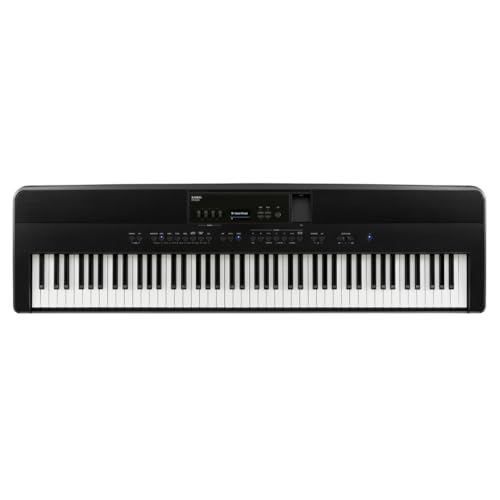
Mandrillis Research Score: 92/100
This is an editorial research score, not a customer rating or laboratory test score.
Who Should Buy It
- You want let-off, counterweights and a long pivot in a portable
- You perform and need strong onboard speakers and line outs
- You record over USB audio and use the Virtual Technician
Skip It If
- Weight matters; the ES120 and P-225 are far lighter
- You practice only on headphones and will not use the speakers
- You want a console with three pedals built in
Pros
- RHIII action with let-off, triple sensors and counterweights
- Harmonic Imaging XL with SK-EX and EX grands sampled across all 88 keys
- 2 x 20 W speakers, the most powerful in a portable at this price
- Bluetooth audio and MIDI plus USB audio and an OLED display
Cons
- Heavy at 37.5 pounds
- Costs roughly double the ES120
- Plain, utilitarian styling
Key Specs
Key Action: Responsive Hammer III with let-off and counterweights
Sound Engine: Harmonic Imaging XL with 88-key sampling
Voices: 38
Polyphony: 256 notes
Speakers: 2 x 20 W
Bluetooth: Audio and MIDI
USB: USB audio and MIDI
Pedals: F-10H pedal included; GFP-3 triple pedal optional
Weight: 37.5 lb (17 kg)
Form Factor: Portable with OLED display
Why We Picked It
RHIII with let-off and counterweights, two grands sampled across all 88 keys, 2 x 20 W speakers and USB audio: a console in a case without legs.
Read our full Kawai ES920 review →
Check Price on AmazonWe may earn a commission at no extra cost to you.
Last verified: October 2026
Why This Product Ranks Best Premium Portable
#8. Roland FP-10 (Best Budget)

Mandrillis Research Score: 83/100
This is an editorial research score, not a customer rating or laboratory test score.
Who Should Buy It
- Touch is your first priority and you will practice mostly on headphones
- You want wireless app connection for lessons
- You plan to keep the piano for years as a controller even after upgrading
Skip It If
- You want to perform through a PA from a dedicated output
- You layer sounds with heavy pedal and need more polyphony
- You want Bluetooth audio for play-along tracks
Pros
- PHA-4 Standard is the most realistic action at this price, with escapement and textured keys
- SuperNATURAL engine models the piano rather than looping samples
- Bluetooth MIDI connects to apps without a cable
- Compact 1284 mm width fits narrow spaces
Cons
- 96-note polyphony is low for layered playing
- Headphone jack is the only audio output
- Speakers are quiet and the included DP-2 pedal is a simple switch
Key Specs
Key Action: PHA-4 Standard with escapement and Ivory Feel
Sound Engine: Roland SuperNATURAL Piano
Voices: 15
Polyphony: 96 notes
Speakers: 2 x 6 W
Bluetooth: MIDI only
USB: USB MIDI (Type B)
Pedals: DP-2 sustain switch included
Weight: 27.1 lb (12.3 kg)
Form Factor: Portable slab
Why We Picked It
The same PHA-4 Standard action as the FP-30X at the entry price, with Bluetooth MIDI for apps; the best technique-building keyboard under the entry ceiling.
Read our full Roland FP-10 review →
Check Price on AmazonWe may earn a commission at no extra cost to you.
Last verified: October 2026
Why This Product Ranks Best Budget
Which One Should You Buy?
For most players the Roland FP-30X is the right digital piano because it combines the best action in its class with every connection a home or stage player needs, at a price that leaves money for a stand, pedals and good headphones. Buyers who want a console should choose between the Kawai CN201 for touch and the Yamaha YDP-184 for speakers and power; the Casio PX-870 is the value console for a living room. At the entry level the Roland FP-10 teaches the best technique, and at the top the Kawai ES920 is the portable serious pianists keep.
Buy the Roland FP-30X if...
you want the most realistic action and complete connectivity in a portable, and you will use the built-in speakers or an external one.
Buy the Kawai ES120 if...
the warmth of the piano tone matters more to you than the last degree of key feel, and you want Bluetooth without adapters in a light instrument.
Buy the Yamaha P-225 if...
space is tight and you want Yamaha's CFX concert grand sample with resonance in the slimmest serious portable.
Buy the Kawai CN201 if...
you want a console with let-off, counterweights and the SK-EX tone, and you would rather spend on keys than on features.
Buy the Yamaha YDP-184 if...
the piano will be heard through its own speakers in a living room and you want full VRM resonance, a display and USB recording.
Buy the Casio PX-870 if...
you want a console that sounds big in a room, 256-note polyphony and audio recording to USB for the least money.
Buy the Kawai ES920 if...
you want console-grade playing in a portable case and are prepared to pay for RHIII with let-off and 88-key sampling of two grands.
Buy the Roland FP-10 if...
the budget stops at the entry level and the action matters most; it shares its keyboard with the FP-30X.
Buying Guide
Key Action
The mechanism under the keys is the single biggest difference between pianos. Graded hammer actions weigh the bass keys heavier than the treble. Three sensors register fast repetition; escapement or let-off adds the grand's release notch at soft dynamics; counterweights and wooden keys refine control further. Compact actions in slim pianos trade some leverage for depth.
Sound Engine
Sampled engines record a real grand at many velocities; Kawai samples all 88 keys, Yamaha samples its CFX concert grand. Modeled engines such as Roland's SuperNATURAL compute tone continuously. Resonance modeling, whether Yamaha's VRM, Kawai's Harmonic Imaging or Casio's AiR, is what makes a pedaled chord bloom instead of simply ringing.
Polyphony
The number of notes that can sound at once, including those held by the pedal and those used by layered voices. 64 notes suits beginners; 128 covers most solo repertoire; 192 and 256 remove the ceiling for layered, pedal-heavy playing. Where a listing does not publish the figure, our review says so.
Speakers
Portables carry 12 to 22 watts of small speakers, enough for practice and not for a living room. Consoles range from 12 to 60 watts; the Casio PX-870's 40 watt four-speaker system and the Yamaha YDP-184's 60 watts fill a room, the rest suit headphones or external monitors.
Bluetooth Audio and MIDI
Bluetooth audio streams play-along music through the piano; Bluetooth MIDI connects lesson apps without a cable. Roland and Kawai build both in; Casio supplies an adapter; Yamaha's portables offer audio only and its 2025 Arius consoles offer both. USB audio, which records the piano's own sound into a computer, is a separate feature worth checking.
Portable or Console
A portable on a furniture stand with a three-pedal unit becomes a slim console for less than a true console costs, and it can leave the house. A console gives a sliding cover, larger speakers, a fixed pedal board and a piano's presence in a room. Choose on how the instrument will live, then compare actions within that form.
What We Left Out
Semi-weighted keyboards such as the Korg Liano and Alesis Recital are reviewed on this site but are not in this list, because a hammer action is the minimum for serious practice. Budget hammer-action pianos from Donner and Alesis are reviewed too; they trail the models here on action and tone and appear in our beginner guide where price is the deciding factor.
How We Compared
- Key action type, sensors, escapement and key surface checked against manufacturer specifications for all 131 models reviewed
- Sound engine, sampling method and resonance modeling compared from published documentation
- Polyphony, speaker power, connectivity and included accessories mapped side by side; unpublished figures marked as such
- Price tiers considered so that each pick leads its own bracket rather than competing across brackets
- Verified buyer feedback reviewed for reliability, key noise and support experience
- No fake hands-on testing claims; scores are editorial research scores
FAQ
Related Guides
About This Guide
Mandrillis Team
The Mandrillis editorial team researches and compares audio and music gear using manufacturer documentation, verified specs and real buyer feedback, so you can make a confident purchase without wading through marketing claims.
Read our full research methodology.