Best Dynamic Microphones: Eight Picks for Vocals, Podcasts and Live Sound
This guide is for podcasters, streamers, singers and live sound engineers choosing a dynamic microphone, from a broadcast standard vocal mic to a ribbon style option for instruments. The eight picks here were narrowed from 356 researched microphones using scores across sound quality, pickup pattern and noise handling, build quality, connectivity and setup, features and extras, and value. Picks range from bundled, ready to use broadcast kits with a preamp and cable included to a bare capsule that needs its own cable and interface, so match the pick to how much you want included.
Quick Answer
The Shure SM7B is the best overall pick at a score of 87, the broadcast standard cardioid dynamic microphone with bass rolloff and presence boost switches, a 20 ft XLR cable and a 2-year warranty included. The Electro-Voice RE20 is the best value pick at 85, an industry standard broadcast microphone bundled with a mic activator and cable for use straight out of the box. Vocalists on loud stages should consider the Sennheiser E 945 for its supercardioid isolation, and two-host podcasts should look at the Rode PodMic Dynamic Podcasting bundle, which pairs two microphones with boom arms and headphones. Budget buyers who record instruments can consider the Beyerdynamic M 160 ribbon microphone.
Why You Can Trust This Guide
We compared products using verified manufacturer specifications, available manuals and documentation, retailer listings, owner feedback, and editorial research.
We focus on measurable differences such as performance, compatibility, usability, build quality, features, and value.
Mandrillis presents editorial research as editorial research, not as laboratory testing, unless physical testing was actually performed.
Read our full research methodology.
Quick Picks
Comparison Table
| Model | Type | Polar pattern | Connection | Frequency response | Best For | Main Advantage | Score |
|---|---|---|---|---|---|---|---|
| Shure SM7B | Dynamic (XLR) | N/A | N/A | N/A | podcasters and streamers who want a broadcast-quality voice | Rejects room noise exceptionally well | 87/100 |
| Electro-Voice RE20 | Large-diaphragm dynamic broadcast announcer microphone, bundled with a mic activator and an XLR cable | Cardioid | XLR, with a cable included in this bundle | Not published in listing as a specific numeric range | Broadcasters and podcasters who want the industry standard RE20 dynamic microphone ready to use with a bundled mic activator and cable, plus a built-in tone-shaping switch. | An industry standard dynamic cardioid microphone, a firm favorite for broadcasting, podcasting and sound engineering worldwide | 85/100 |
| Sennheiser E 945 | Supercardioid dynamic vocal microphone | Supercardioid | Not published in listing | Not published in listing | Lead singers and vocalists on loud stages who want tighter isolation than a cardioid handheld and a microphone that resists handling noise and hum. | Supercardioid pattern isolates the voice from other stage signals | 83/100 |
| Rode PodMic Dynamic Podcasting | Two-host podcasting bundle: two Rode PodMic dynamic microphones, two broadcast boom arms with integrated cables, two closed-back headphones | Cardioid | XLR; each boom arm carries an integrated 10 ft XLR cable | Not published in listing | Two-person podcasts and interview shows that want matching broadcast microphones, arms and monitoring headphones in one purchase. | Two PodMics, two boom arms and two headphones for a complete two-host setup | 82/100 |
| Heil PR 40 | Large dynamic element microphone, Champagne finish, bundled with an inline mic preamp and a 20 foot XLR cable | Cardioid | 3-pin XLR, with a 20 foot cable included in this bundle | Not published in listing | Vocalists and drum recordists who want the Heil PR 40 ready to use with a bundled inline preamp and a 20 foot XLR cable, with no additional gear needed to get started. | Large dynamic element with a steel housing for durability | 79/100 |
| Audio-Technica 10 ATW-T1002 | Handheld digital wireless microphone transmitter with a unidirectional dynamic element (System 10, 2.4 GHz) | Cardioid | 2.4 GHz digital wireless link, 24-bit/48 kHz; receiver not described in listing | Not published in listing | Singers, speakers and presenters who already own or plan to buy a System 10 receiver and want a handheld dynamic transmitter with digital clarity and solid diversity. | 24-bit/48 kHz digital audio in the 2.4 GHz band, free from TV interference | 74/100 |
| Heil Sound PR40 | Large diaphragm dynamic microphone with a chrome body and grill | Cardioid | 3-pin XLR | 28Hz to 18kHz | Broadcasters, podcasters and multipurpose studio users who want a confirmed 28Hz to 18kHz cardioid dynamic microphone with a chrome finish, at a lower mid-range price tier. | Confirmed 28Hz to 18kHz frequency response | 73/100 |
| Beyerdynamic M 160 | Double ribbon microphone (listing title: Double Ribbon Microphone) | Hypercardioid (listing bullet reads Hyper Double Ribbon Mic) | Not published in listing | Not published in listing | Recording guitar amplifiers, drum overheads, strings and brass with a smooth, directional ribbon character. | Double ribbon design with a smooth, detailed character | 72/100 |
#1. Shure SM7B (Best Overall)
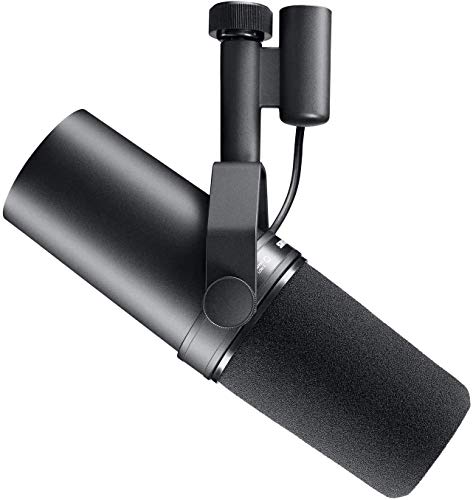
Mandrillis Research Score: 87/100
This is an editorial research score, not a customer rating or laboratory test score.
Who Should Buy It
- You want a broadcast-quality voice for podcasting or streaming
- You record in an untreated room and need strong noise rejection
- You have or plan to add a clean-gain boost like a Cloudlifter
Skip It If
- Your interface or preamp can't provide enough clean gain
- You want the most affordable entry point into XLR microphones
Pros
- Rejects room noise exceptionally well
- Smooth, broadcast-ready sound
- Built-in pop filter
- Industry standard for podcasting and streaming
Cons
- Needs a lot of clean gain, most interfaces need a boost like a Cloudlifter
- More expensive than entry mics
Key Specs
Type: Dynamic (XLR)
Connectivity: XLR, needs a strong preamp
Pattern: Cardioid
Why We Picked It
The SM7B is the best overall pick at a score of 87, the broadcast standard cardioid dynamic microphone with smooth, flat, wide-range sound, shock isolation and a built-in pop filter. Bass rolloff and presence boost switches shape tone on the fly, and a 20 ft XLR cable, windscreen and 2-year warranty are included, though its low output needs a strong preamp and weight is not published.
Check Price on AmazonWe may earn a commission at no extra cost to you.
Last verified: September 2026
Why This Product Ranks Best Overall
#2. Electro-Voice RE20 (Best Value)

Mandrillis Research Score: 85/100
This is an editorial research score, not a customer rating or laboratory test score.
Who Should Buy It
- Broadcasters and podcasters who want the industry standard RE20 with no additional accessory shopping
- Buyers who want a mic activator included to help drive this dynamic microphone with sufficient gain
- Voice talent who want a built-in mid-bass tone-shaping switch for on the fly tonal adjustment
- Buyers who value Variable-D design for minimizing proximity effect during close-in voice work
Skip It If
- You already own an RE20 and only need a mic activator or XLR cable separately
- You need a confirmed numeric frequency response or sensitivity figure before purchase
- You need the mic activator's specific power requirement confirmed before buying
Pros
- An industry standard dynamic cardioid microphone, a firm favorite for broadcasting, podcasting and sound engineering worldwide
- Variable-D design minimizes proximity effect for close-in voice work
- Heavy-duty internal pop filter and internal element shock mount built in
- Mid-bass tone-shaping switch to alter vocal tone on the go
- Bundle includes a mic activator and XLR cable, ready to use out of the box
Cons
- No stated numeric frequency response, sensitivity or maximum SPL figures
- No stated power requirement for the included mic activator
- No stated microphone weight
- As a dynamic microphone, it may still benefit from additional clean gain even with the bundled activator
Key Specs
Type: Large-diaphragm dynamic broadcast announcer microphone, bundled with a mic activator and an XLR cable
Polar pattern: Cardioid
Frequency response: Not published in listing as a specific numeric range
Connection: XLR, with a cable included in this bundle
Phantom power: Not required for the microphone itself; the included mic activator is an inline preamp booster whose own power requirement is not stated in the listing
Max SPL or sensitivity: Not published in listing as a specific numeric figure
Controls: A mid-bass tone-shaping switch built into the microphone
Mount and stand: An internal element shock mount is built in, along with a heavy-duty internal pop filter
Weight: Not published in listing
Included accessories: A mic activator and an XLR cable are included in this bundle
Why We Picked It
The RE20 earns best value at a score of 85 as an industry standard cardioid broadcast microphone with Variable-D design that minimizes proximity effect for close-in voice work. A heavy-duty internal pop filter and shock mount are built in, and the bundle includes a mic activator and XLR cable ready to use, though frequency response, sensitivity and weight figures are not published.
Read our full Electro-Voice RE20 review →
Check Price on AmazonWe may earn a commission at no extra cost to you.
Last verified: November 2026
Why This Product Ranks Best Value
#3. Sennheiser E 945 (Best for Vocals)

Mandrillis Research Score: 83/100
This is an editorial research score, not a customer rating or laboratory test score.
Who Should Buy It
- Lead vocalists competing with loud drums and amplifiers on stage
- Touring singers who need a microphone stable across climates and venues
- Worship leaders and presenters troubled by feedback with cardioid microphones
- Performers who move around and want low handling noise
Skip It If
- You need a microphone for podcasting with USB and monitoring
- Your stage monitors sit directly behind the microphone
- You want published specifications confirmed in the listing
Pros
- Supercardioid pattern isolates the voice from other stage signals
- Shock-mounted capsule keeps handling and impact noise low
- Hum compensating coil reduces electrical interference
- Neodymium ferrous magnet with boron stays stable across climates
- Rugged metal construction for touring and nightly use
Cons
- Listing does not publish frequency response, weight or connector
- No clip, pouch or cable confirmed in the listing
- Supercardioid rear lobe demands careful monitor placement
- Dynamic design needs close placement and a decent preamp
Key Specs
Type: Supercardioid dynamic vocal microphone
Polar pattern: Supercardioid
Frequency response: Not published in listing
Connection: Not published in listing
Phantom power: Not required (dynamic design); not published in listing
Max SPL or sensitivity: Not published in listing
Controls: None described in listing
Mount and stand: Not published in listing
Weight: Not published in listing
Included accessories: Not published in listing
Why We Picked It
The E 945 scores 83 as Best for Vocals, a supercardioid dynamic microphone that isolates the voice from other stage signals with a shock-mounted capsule and a hum compensating coil. Its neodymium ferrous magnet with boron stays stable across climates, though frequency response, weight and connector are not published, and the rear lobe demands careful monitor placement.
Read our full Sennheiser E 945 review →
Check Price on AmazonWe may earn a commission at no extra cost to you.
Last verified: October 2026
Why This Product Ranks Best for Vocals
#4. Rode PodMic Dynamic Podcasting (Best for Podcasting)

Mandrillis Research Score: 82/100
This is an editorial research score, not a customer rating or laboratory test score.
Who Should Buy It
- Co-hosted podcasts setting up a permanent two-seat studio
- Interview shows that need a guest position ready at all times
- Streamers moving from a USB microphone to an XLR dynamic on a boom
- Small offices and schools building a simple voice recording room
Skip It If
- You are a solo podcaster who only needs one microphone
- You do not own an interface or mixer with XLR inputs
- You prefer a USB microphone with no additional gear
Pros
- Two PodMics, two boom arms and two headphones for a complete two-host setup
- Broadcast dynamic cardioid design with built-in internal pop filter
- Solid metal body built for daily use
- Boom arms route the XLR cable internally for a tidy desk
- 35 inch arm reach with silent internal springs
- Rode warranty with a one-year extension on registration
Cons
- Needs an audio interface or mixer with two XLR inputs and plenty of gain
- Frequency response, SPL and weight not published in listing
- Headphone specifications are not detailed
- Internal cables mean an arm failure takes the cable with it
Key Specs
Type: Two-host podcasting bundle: two Rode PodMic dynamic microphones, two broadcast boom arms with integrated cables, two closed-back headphones
Polar pattern: Cardioid
Frequency response: Not published in listing
Connection: XLR; each boom arm carries an integrated 10 ft XLR cable
Phantom power: Not required (dynamic)
Max SPL or sensitivity: Not published in listing
Controls: None described on the microphone; internal pop filter built in
Mount and stand: Two broadcast boom arms with internal springs, 35 inch reach and desk mount clamps
Weight: Not published in listing
Included accessories: Two broadcast arms with 10 ft integrated XLR cables, two desk clamps, two closed-back studio monitor headphones
Why We Picked It
The Rode PodMic bundle scores 82 as Best for Podcasting, pairing two cardioid dynamic microphones with two broadcast boom arms carrying internal 10 ft XLR cables and two closed-back headphones for a complete two-host setup. A one-year warranty extension is available on registration, though frequency response, SPL and weight are not published, and headphone specifications are not detailed.
Read our full Rode PodMic Dynamic Podcasting review →
Check Price on AmazonWe may earn a commission at no extra cost to you.
Last verified: October 2026
Why This Product Ranks Best for Podcasting
#5. Heil PR 40 (Best for Live)

Mandrillis Research Score: 79/100
This is an editorial research score, not a customer rating or laboratory test score.
Who Should Buy It
- Vocalists and podcasters who want the PR 40 ready to use with a bundled gain-boosting preamp
- Drum recordists who want a durable, cardioid dynamic microphone specifically suited to kick drum
- Buyers who want a 20 foot XLR cable included rather than needing to source one separately
- Buyers who value an internal shock mount built directly into the microphone body
Skip It If
- You already own a PR 40 and only need the bundled preamp or cable separately
- You need a confirmed numeric frequency response or sensitivity figure before purchase
- You need the bundled preamp's power requirement confirmed before buying
Pros
- Large dynamic element with a steel housing for durability
- Internal Sorbothane shock mount built in
- Cardioid pattern confirmed, specifically recommended for vocals and kick drums
- Bundle includes an sE Electronics DM1 Dynamite mic preamp and a 20 foot XLR cable, ready to use
Cons
- No stated frequency response, sensitivity or maximum SPL figures
- No stated power requirement for the bundled DM1 preamp
- No stated microphone weight
- As a dynamic microphone, it still benefits from the bundled preamp's extra gain for optimal performance
Key Specs
Type: Large dynamic element microphone, Champagne finish, bundled with an inline mic preamp and a 20 foot XLR cable
Polar pattern: Cardioid
Frequency response: Not published in listing
Connection: 3-pin XLR, with a 20 foot cable included in this bundle
Phantom power: Not required for the microphone itself; the bundled sE Electronics DM1 Dynamite inline preamp is designed to boost gain for low-output dynamic microphones and its own power requirement is not stated in the listing
Max SPL or sensitivity: Not published in listing
Controls: Not published in listing
Mount and stand: An internal Sorbothane shock mount is built in
Weight: Not published in listing
Included accessories: An sE Electronics DM1 Dynamite mic preamp and a 20 foot XLR cable are included in this bundle
Why We Picked It
The Heil PR 40 scores 79 as Best for Live, a large dynamic element microphone in a steel housing with an internal Sorbothane shock mount, confirmed cardioid and recommended for vocals and kick drums. The bundle includes an sE Electronics DM1 Dynamite preamp and a 20 foot XLR cable ready to use, though frequency response, SPL and weight are not published.
Read our full Heil PR 40 review →
Check Price on AmazonWe may earn a commission at no extra cost to you.
Last verified: November 2026
Why This Product Ranks Best for Live
#6. Audio-Technica 10 ATW-T1002 (Best Broadcast)

Mandrillis Research Score: 74/100
This is an editorial research score, not a customer rating or laboratory test score.
Who Should Buy It
- Owners of a System 10 receiver adding a handheld channel
- Worship and school teams building a simple digital wireless setup
- Presenters who want a mute button and a visible battery indicator
- Performers who value a published weight and runtime
Skip It If
- You do not have a compatible System 10 receiver
- Your venue has heavy Wi-Fi congestion on stage
- You need a studio or desk microphone rather than a stage handheld
Pros
- 24-bit/48 kHz digital audio in the 2.4 GHz band, free from TV interference
- Frequency, time and space diversity for signal reliability
- Cardioid dynamic element rejects background noise
- Power/mute button, system ID display and battery indicator
- Up to 100 ft range and 7 plus hours on 2 AA batteries
- Published weight and dimensions
Cons
- Listing describes the transmitter only; receiver not confirmed
- Frequency response of the element not published
- 2.4 GHz band shares space with Wi-Fi and other devices
- Batteries and accessories not included or listed
Key Specs
Type: Handheld digital wireless microphone transmitter with a unidirectional dynamic element (System 10, 2.4 GHz)
Polar pattern: Cardioid
Frequency response: Not published in listing
Connection: 2.4 GHz digital wireless link, 24-bit/48 kHz; receiver not described in listing
Phantom power: Not applicable; powered by 2 AA alkaline batteries (not included)
Max SPL or sensitivity: Not published in listing; dynamic range exceeding 109 dB A-weighted, THD below 0.05 percent for the system
Controls: Adjustable input level control with dedicated screwdriver, power/mute button, digital system ID display, battery indicator
Mount and stand: Not published in listing
Weight: 9.9 oz without batteries; 10.03 x 1.97 inches (254.80 x 50.03 mm)
Included accessories: Not published in listing; batteries not included
Why We Picked It
The ATW-T1002 scores 74 as Best Broadcast, a handheld 2.4 GHz digital wireless transmitter with a cardioid dynamic element delivering 24-bit/48 kHz audio and over 100 ft of range on 2 AA batteries. Weight and dimensions are published at 9.9 ounces, though the receiver is not described, batteries are not included, and frequency response of the element is not published.
Read our full Audio-Technica 10 ATW-T1002 review →
Check Price on AmazonWe may earn a commission at no extra cost to you.
Last verified: October 2026
Why This Product Ranks Best Broadcast
#7. Heil Sound PR40 (Best Premium)

Mandrillis Research Score: 73/100
This is an editorial research score, not a customer rating or laboratory test score.
Who Should Buy It
- Broadcasters and podcasters who want a confirmed, specific frequency response range
- Multipurpose studio users who want one dynamic microphone for vocals, instruments and broadcast work
- Buyers who want a dynamic design that does not require phantom power
- Buyers who value a chrome finish and standard 3-pin XLR connection
Skip It If
- You need a confirmed sensitivity or maximum SPL figure before purchase
- You need an included shockmount or other mounting accessory confirmed as part of the purchase
- You need onboard controls such as a pad switch confirmed before buying
Pros
- Confirmed 28Hz to 18kHz frequency response
- Cardioid polar pattern confirmed
- Dynamic design, no phantom power needed
- Chrome body and grill construction
- Standard 3-pin XLR connection
Cons
- No stated sensitivity or maximum SPL figure
- No stated included accessories or mount
- No stated microphone weight
- No stated onboard controls, such as a pad or filter switch
Key Specs
Type: Large diaphragm dynamic microphone with a chrome body and grill
Polar pattern: Cardioid
Frequency response: 28Hz to 18kHz
Connection: 3-pin XLR
Phantom power: Not required; this is a dynamic microphone design
Max SPL or sensitivity: Not published in listing
Controls: Not published in listing
Mount and stand: Not published in listing
Weight: Not published in listing
Included accessories: Not published in listing
Why We Picked It
The Heil Sound PR40 scores 73 as Best Premium, a large diaphragm cardioid dynamic microphone with a chrome body and grill and a confirmed 28Hz to 18kHz frequency response. It needs no phantom power and connects over standard 3-pin XLR, though sensitivity, maximum SPL, weight, mount and included accessories are not published.
Read our full Heil Sound PR40 review →
Check Price on AmazonWe may earn a commission at no extra cost to you.
Last verified: November 2026
Why This Product Ranks Best Premium
#8. Beyerdynamic M 160 (Best Budget)

Mandrillis Research Score: 72/100
This is an editorial research score, not a customer rating or laboratory test score.
Who Should Buy It
- Project studio owners adding a ribbon color to a condenser and dynamic collection
- Guitarists recording amplifiers who find condensers too harsh
- Drummers and engineers wanting smoother overheads with directional control
- String and brass players recording at home with a capable preamp
Skip It If
- You need a first microphone for general home studio use
- Your interface preamp has limited clean gain
- You are not comfortable confirming the condition of a demo unit
Pros
- Double ribbon design with a smooth, detailed character
- Hypercardioid pattern is rare for a ribbon and improves isolation
- Excellent on guitar amps, overheads, strings and brass
- Compact body is easy to position close to sources
- Long professional track record
Cons
- Listing publishes almost no specifications
- Demo wording raises condition and warranty questions
- Low output needs a preamp with plenty of clean gain
- Ribbon element is fragile and sensitive to wind
- No included accessories confirmed
Key Specs
Type: Double ribbon microphone (listing title: Double Ribbon Microphone)
Polar pattern: Hypercardioid (listing bullet reads Hyper Double Ribbon Mic)
Frequency response: Not published in listing
Connection: Not published in listing
Phantom power: Not published in listing
Max SPL or sensitivity: Not published in listing
Controls: Not published in listing
Mount and stand: Not published in listing
Weight: Not published in listing
Included accessories: Not published in listing
Why We Picked It
The M 160 is the Best Budget pick at a score of 72, a double ribbon microphone with a rare hypercardioid pattern that improves isolation on guitar amps, overheads, strings and brass. Its compact body is easy to position close to sources, though the listing publishes almost no other specifications, and its low output needs a preamp with plenty of clean gain.
Read our full Beyerdynamic M 160 review →
Check Price on AmazonWe may earn a commission at no extra cost to you.
Last verified: October 2026
Why This Product Ranks Best Budget
Which One Should You Buy?
These eight dynamic microphones split between broadcast vocal mics, a stage vocal mic, a two-host podcasting bundle, a wireless handheld, and a ribbon mic for instruments, so the right pick depends on the setup you already have. The Shure SM7B leads at a score of 87 as the broadcast standard, with the Electro-Voice RE20 close behind at 85 as an industry standard bundled ready to use. The Sennheiser E 945 scores 83 for stage vocal isolation, and the Rode PodMic bundle scores 82 for two-host shows. The Heil PR 40 scores 79 with a bundled preamp, the Audio-Technica ATW-T1002 scores 74 as a wireless option, the Heil Sound PR40 scores 73 with a confirmed frequency response, and the Beyerdynamic M 160 rounds out the list at 72 as a ribbon microphone for instruments rather than vocals.
Buy the Shure SM7B if you want the broadcast standard vocal microphone.
Choose this if you want the broadcast standard cardioid dynamic microphone with bass rolloff and presence boost switches, a 20 ft cable and a 2-year warranty included. It needs a strong preamp for its low output, and weight is not published.
Buy the Electro-Voice RE20 if you want an industry standard bundle ready to use.
Pick this if you want the industry standard RE20 with Variable-D design for close-in voice work, plus a bundled mic activator and XLR cable ready to use. Frequency response, sensitivity and weight figures are not published.
Buy the Sennheiser E 945 if you sing on loud stages.
Get this if you need supercardioid isolation from stage monitors and a shock-mounted capsule with a hum compensating coil. Frequency response, weight and connector are not published, and the rear lobe needs careful monitor placement.
Buy the Rode PodMic Dynamic Podcasting bundle if you run a two-host show.
Choose this if you want two cardioid dynamic microphones, two broadcast boom arms with internal cables, and two closed-back headphones in one purchase. Frequency response, SPL and weight are not published, and headphone specifications are not detailed.
Buy the Heil PR 40 if you want a ready to use bundle with a preamp.
Pick this if you want a large dynamic element microphone with an internal Sorbothane shock mount, bundled with a preamp and a 20 foot cable so it works straight out of the box. Frequency response, SPL and weight are not published.
Buy the Audio-Technica ATW-T1002 if you need a wireless handheld transmitter.
Choose this if you want a 2.4 GHz digital wireless cardioid transmitter with over 100 ft of range and confirmed weight of 9.9 ounces. The receiver is not described and batteries are not included, and frequency response is not published.
Buy the Heil Sound PR40 if you want a confirmed frequency response at a lower price.
Get this if a stated 28Hz to 18kHz frequency response and a chrome cardioid dynamic design matter more to you than onboard controls or a bundled accessory kit. Sensitivity, maximum SPL, weight and included accessories are not published in the listing.
Buy the Beyerdynamic M 160 if you record guitar amps or strings, not vocals.
Choose this if you want a double ribbon microphone with a rare hypercardioid pattern for guitar amps, overheads, strings and brass. The listing publishes almost no specifications, and its low output needs a preamp with plenty of clean gain.
Buying Guide
Polar Pattern and Noise Rejection
A microphone's polar pattern decides how much sound it picks up from the sides and rear versus straight ahead. Cardioid, used on the Shure SM7B, Electro-Voice RE20 and most picks here, rejects sound from behind the capsule and suits close vocal work. Supercardioid, used on the Sennheiser E 945, narrows that rejection zone further for loud stages, though it adds a small rear lobe that needs careful monitor placement. Hypercardioid, as seen on the Beyerdynamic M 160 ribbon microphone, is rare on a ribbon design and improves isolation on loud instrument sources like guitar amps and drum overheads.
Frequency Response and Tone
Frequency response describes which pitches a microphone captures strongly and which it rolls off, shaping overall tone. The Heil Sound PR40 publishes a specific 28Hz to 18kHz range, giving a concrete reference point, while most dynamic microphones in this guide describe their sound only in general terms such as smooth, flat or wide-range rather than publishing numeric figures. Onboard tone controls, like the bass rolloff and presence boost switches on the Shure SM7B or the mid-bass tone-shaping switch on the Electro-Voice RE20, let a user adjust character for a specific voice or room without relying on published frequency charts alone.
Output Level and Gain Requirements
Dynamic microphones generally produce a lower output signal than condenser microphones, which means they need more clean gain from a preamp or audio interface to reach a usable recording level. The Shure SM7B and Beyerdynamic M 160 are both noted as needing a strong preamp or inline booster for this reason. Several picks solve this by bundling an inline preamp directly, such as the mic activator with the Electro-Voice RE20 or the sE Electronics DM1 Dynamite with the Heil PR 40, which boosts gain before the signal even reaches your interface, reducing the need for extra gear.
Build Quality and Shock Mounting
A dynamic microphone built for stage or daily studio use needs internal shock isolation to reject handling noise and vibration transmitted through a stand or boom arm. The Shure SM7B includes shock isolation and electromagnetic shielding against monitor hum, the Electro-Voice RE20 has an internal element shock mount and heavy-duty pop filter, and the Heil PR 40 uses an internal Sorbothane shock mount in a steel housing. Several listings in this guide do not publish microphone weight, so a confirmed shock mount or rugged metal construction, where stated, is one of the better durability signals available without a weight figure.
Connectivity: XLR, Wireless or Bundled Cable
Most dynamic microphones connect over a standard 3-pin XLR cable to an interface, mixer or wireless transmitter pack, and several picks here include that cable in the box, such as the 20 ft cable with the Shure SM7B and Heil PR 40. The Audio-Technica ATW-T1002 takes a different route entirely as a handheld wireless transmitter sending 24-bit/48 kHz digital audio over a 2.4 GHz link, which removes the cable but requires a separate receiver not included in the listing. Check whether a cable, activator or receiver ships with the microphone before assuming it is ready to record.
Included Accessories and Price Tier
What ships in the box changes how much extra you need to spend before recording anything. Bundled kits, like the Electro-Voice RE20 with its mic activator and cable, the Heil PR 40 with its DM1 preamp and cable, or the Rode PodMic bundle with two boom arms and headphones, cost more upfront but remove several separate purchases. A bare capsule with no stated accessories, like the Heil Sound PR40 or Beyerdynamic M 160, costs less on paper but assumes you already own a cable, stand and sufficient preamp gain, so compare total setup cost, not just the headline price tier.
How We Compared
- Each microphone was scored across six weighted categories: sound quality, pickup pattern and noise handling, build quality, connectivity and setup, features and extras, and value.
- Sound quality carried the heaviest weight at 30 points, since tone and clarity matter most for vocals, podcasting and live sound work.
- Pickup pattern and noise handling scores rewarded confirmed polar patterns and features like shock mounts or hum compensating coils.
- Connectivity and setup scores considered whether a cable, activator or receiver shipped with the microphone, reducing extra required purchases.
- Features and extras scores weighed onboard tone controls, warranty length and bundled accessories against microphones with no stated extras.
- Listings with unpublished frequency response, SPL or weight were scored on confirmed features only, and those gaps are flagged in each pick's specifications.
FAQ
Related Guides

About This Guide
Mandrillis Team
The Mandrillis editorial team researches and compares audio and music gear using manufacturer documentation, verified specs and real buyer feedback, so you can make a confident purchase without wading through marketing claims.
Read our full research methodology.