Best Studio Monitors Under $300: Eight Pairs for Home Studios
This guide is for home studio owners and content creators who want a genuine step up from computer speakers without spending much, covering nearfield pairs, a mountable install monitor, and options with Bluetooth or a dedicated ribbon tweeter. Picks were narrowed from 356 researched studio monitor listings by scoring accuracy and sound, drivers and power, room fit and controls, build and design, connectivity, and value, then checking each listing's published specs, pros, cons and best-fit notes so every recommendation rests on what each manufacturer actually states rather than assumed specifications.
Quick Answer
The JBL 308P MkII 8-Inch is the best overall pick, bringing an 8 inch woofer, Boundary EQ, and professional balanced inputs into a budget price tier, sold individually so a pair means two purchases. Buyers who want better value should look at the ADAM Audio T7V, which pairs a ribbon tweeter with a published 39Hz to 25kHz response. The PreSonus Eris 5BT 5.25-inch adds Bluetooth 5.0 and a front headphone jack for a shared desk, while the Kali Audio LP-6 V2 6.5-inch offers Boundary EQ and wall or ceiling mounting flexibility. The Yamaha HS5IW is the most affordable pick, built specifically for permanent wall or ceiling mounting.
Why You Can Trust This Guide
We compared products using verified manufacturer specifications, available manuals and documentation, retailer listings, owner feedback, and editorial research.
We focus on measurable differences such as performance, compatibility, usability, build quality, features, and value.
Mandrillis presents editorial research as editorial research, not as laboratory testing, unless physical testing was actually performed.
Read our full research methodology.
Quick Picks
Comparison Table
| Model | Woofer | Power | Frequency response | Inputs | Best For | Main Advantage | Score |
|---|---|---|---|---|---|---|---|
| JBL 308P MkII 8-Inch | 8 inch woofer | Not published in listing | Not published in listing | Balanced XLR and 1/4 inch TRS inputs, with a plus 4 dBu / minus 10 dBV input sensitivity switch and adjustable volume control | Producers who want a larger 8 inch professional near field monitor with boundary EQ and documented professional inputs. | 8 inch woofer for substantial low end at near field distances | 85/100 |
| ADAM Audio T7V | 7 inch woofer; cone material not published in listing | 70 W; 110 dB SPL per pair | 39 Hz to 25 kHz | XLR and RCA | Project studios that want ribbon tweeter detail and a published 39 Hz bass reach from a 7 inch monitor at a lower mid-range tier. | U-ART ribbon tweeter from ADAM's professional ranges | 84/100 |
| Kali Audio LP-6 V2 6.5-inch | 6.5-inch | Not published in listing | Not published in listing | Not published in listing | Best for a home studio or desk setup where the monitor will sit near a wall or shelf and benefits from the built-in LF and HF trims plus a Boundary EQ control. | 6.5-inch woofer and 1-inch soft dome tweeter in a standard two-driver layout | 76/100 |
| PreSonus Eris 5BT 5.25-inch | 5.25 inch woven-composite woofer | 100 watts of Class AB dual amplification, 50 watts per side | Not published in listing | Balanced quarter-inch TRS, unbalanced RCA, front-panel eighth-inch TRS stereo aux, Bluetooth 5.0, front headphone output | Producers and creators who want one white pair of near-field monitors to handle production, video work and Bluetooth listening on the same desk at a lower mid-range tier. | Bluetooth 5.0 plus balanced TRS, RCA and front aux inputs | 75/100 |
| Yamaha HS4 | 4.5 inch cone woofer | 26 W plus 26 W output power as published; the listing does not say whether that is per speaker or across the pair | 60 Hz to 22 kHz at minus 10 dB | XLR/TRS combo, RCA and stereo mini | Creators and producers on a small desk who want the Yamaha HS character in a compact white pair at a budget tier. | Honest HS family voicing in a compact cabinet | 75/100 |
| KRK Classic 7 | 7 inch woofer, material not specified in listing | 73 watts total, bi amped Class A/B | Not published in listing | Not published in listing | Home studio owners who want a documented wattage figure and physical room tuning controls on a larger 7 inch monitor. | Clearly published 73 watt total power rating | 72/100 |
| Yamaha HS3 | 3.5 inch cone woofer | Listing states 26 watts and above 26 watts output power; exact biamp wattage split not clearly stated | 70Hz to 22kHz at minus 10dB | XLR and TRS phone combo input, RCA input, and stereo mini input | Small desks and tight spaces where a compact pair of monitors with proper inputs and room control switches matters more than deep bass extension. | Sold as a matched pair, not a single unit | 71/100 |
| Yamaha HS5IW | 5 inch cone woofer for low frequencies | 70 watts total biamp output, 45 watts to the woofer and 25 watts to the tweeter | 54Hz to 30kHz at minus 10dB, 74Hz to 24kHz at minus 3dB | Not published in listing | Installers and studios that need to permanently mount a powered monitor to a wall, ceiling or baton rather than set it on a desk or stand. | Biamped 70 watt total output with a dedicated amplifier for each driver | 70/100 |
#1. JBL 308P MkII 8-Inch (Best Overall)

Mandrillis Research Score: 85/100
This is an editorial research score, not a customer rating or laboratory test score.
Who Should Buy It
- Home or project studio owners wanting a larger 8 inch woofer for fuller low end
- Buyers placing a monitor near a wall or on a desk, thanks to the boundary EQ
- Producers who want balanced professional inputs with a sensitivity switch
Skip It If
- You need confirmed wattage or frequency response before buying
- You want to receive a complete stereo pair in a single purchase
- You need published cabinet dimensions for a tight space
Pros
- 8 inch woofer for substantial low end at near field distances
- Patented technologies derived from JBL Master Reference Monitors
- Boundary EQ specifically for near wall or desktop placement
- Slip Stream low frequency port for bass performance at various playback levels
- Professional balanced XLR and TRS inputs with sensitivity switch
- Each unit undergoes a full power test as part of manufacturing, per the listing
Cons
- Sold individually, so a stereo pair requires two separate purchases
- No published wattage or frequency response figures
- No listed cabinet dimensions or weight
- Listing classifies price tier as budget despite professional grade feature language
Key Specs
Type: 2 way active near field professional studio monitor, sold individually
Woofer: 8 inch woofer
Tweeter: 1 inch tweeter
Power: Not published in listing
Frequency response: Not published in listing
Inputs: Balanced XLR and 1/4 inch TRS inputs, with a plus 4 dBu / minus 10 dBV input sensitivity switch and adjustable volume control
Room controls: Boundary EQ for neutral low frequency response near walls and work surfaces
Dimensions: Not published in listing
Weight: Not published in listing
Included accessories: Not published in listing
Why We Picked It
The JBL 308P MkII 8-Inch earns best overall for packing an 8 inch woofer, Boundary EQ for near-wall placement, and professional balanced XLR and TRS inputs with a sensitivity switch into a budget price tier, drawing on technology from JBL's Master Reference Monitors. It sells individually, so a stereo pair means two purchases. Wattage, frequency response, and cabinet dimensions are not published in the listing.
Read our full JBL 308P MkII 8-Inch review →
Check Price on AmazonWe may earn a commission at no extra cost to you.
Last verified: November 2026
Why This Product Ranks Best Overall
#2. ADAM Audio T7V (Best Value)

Mandrillis Research Score: 84/100
This is an editorial research score, not a customer rating or laboratory test score.
Who Should Buy It
- Mixers who want the ADAM treble character on a project budget
- Producers working on bright, dense or vocal-heavy material
- Anyone who wants 7 inch bass reach without a subwoofer
- Buyers who have heard ADAM professional monitors and want the family sound
Skip It If
- Your interface only outputs on TRS and you want a direct cable
- You need every cabinet specification published
- Your room is large and needs higher SPL
Pros
- U-ART ribbon tweeter from ADAM's professional ranges
- Published 39 Hz to 25 kHz response
- HPS waveguide widens the treble sweet spot
- DSP-based low and high shelf filters
- Beveled cabinet reduces edge diffraction
- Matched T10S subwoofer available
Cons
- No TRS input, only XLR and RCA
- Woofer material, dimensions and weight not published
- Shelf filter ranges not stated
- 70 W is modest for a large room
Key Specs
Type: Active 2-way nearfield studio monitor with rear-firing bass reflex port
Woofer: 7 inch woofer; cone material not published in listing
Tweeter: U-ART ribbon tweeter with HPS waveguide
Power: 70 W; 110 dB SPL per pair
Frequency response: 39 Hz to 25 kHz
Inputs: XLR and RCA
Room controls: DSP-based low shelf and high shelf filters
Dimensions: Not published in listing
Weight: Not published in listing
Included accessories: Not published in listing
Why We Picked It
The ADAM Audio T7V earns best value with a U-ART ribbon tweeter and HPS waveguide widening the sweet spot, plus a published 39Hz to 25kHz response and 110dB SPL per pair at 70 watts. DSP-based low and high shelf filters and a rear-firing bass reflex port round out the design. XLR and RCA cover inputs, but there is no TRS, and woofer material and dimensions are not published.
Read our full ADAM Audio T7V review →
Check Price on AmazonWe may earn a commission at no extra cost to you.
Last verified: October 2026
Why This Product Ranks Best Value
#3. Kali Audio LP-6 V2 6.5-inch (Best Pair)

Mandrillis Research Score: 76/100
This is an editorial research score, not a customer rating or laboratory test score.
Who Should Buy It
- Home studio owners who want Kali Audio's trim and Boundary EQ tuning tools
- Buyers who specifically want the white cabinet finish over the standard black
- Anyone planning to wall or ceiling mount a monitor in a fixed setup
- Shoppers comfortable buying without a published wattage or input type figure
Skip It If
- You need a monitor with a confirmed power output figure in watts
- You require a specific input type such as XLR or balanced TRS confirmed before purchase
- You need exact dimensions or weight for a tight desk or stand
Pros
- 6.5-inch woofer and 1-inch soft dome tweeter in a standard two-driver layout
- 3-D Imaging Waveguide aimed at a wider, more stable stereo sweet spot
- LF and HF trim controls for tuning output to the room
- Boundary EQ setting built for near-wall or corner placement
- Wall or ceiling mountable for setups beyond a desk stand
- Backed by Kali Audio, a brand built specifically around studio monitor design
Cons
- Power output in watts is not published in this listing
- Frequency response range is not stated
- Input connection types are not confirmed in this listing
- Dimensions and weight are not published
- No included accessories are confirmed in the listing
Key Specs
Type: Powered studio monitor, two-driver design
Woofer: 6.5-inch
Tweeter: 1-inch soft dome tweeter
Power: Not published in listing
Frequency response: Not published in listing
Inputs: Not published in listing
Room controls: LF and HF trim controls, Boundary EQ setting
Dimensions: Not published in listing
Weight: Not published in listing
Included accessories: Not published in listing
Why We Picked It
The Kali Audio LP-6 V2 6.5-inch stands out for its 3-D Imaging Waveguide, aimed at a wider and more stable stereo sweet spot, plus LF and HF trim controls and a Boundary EQ setting for near-wall or corner placement. It can also be wall or ceiling mounted. Power output, frequency response, input types, and dimensions are not published in the listing.
Read our full Kali Audio LP-6 V2 6.5-inch review →
Check Price on AmazonWe may earn a commission at no extra cost to you.
Last verified: November 2026
Why This Product Ranks Best Pair
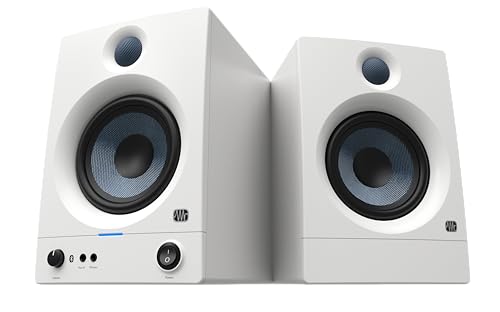
#4. PreSonus Eris 5BT 5.25-inch (Best for Small Rooms)
Mandrillis Research Score: 75/100
This is an editorial research score, not a customer rating or laboratory test score.
Who Should Buy It
- Desktop producers who also use the speakers for everyday listening
- Turntable and hi-fi listeners who want more neutral sound than a lifestyle speaker
- Content creators who switch between headphones and speakers often
- Buyers who want a matching subwoofer upgrade path
Skip It If
- Your interface only has XLR outputs
- You want a strictly flat mixing monitor with published measurements
- You need the speakers to never sleep during long idle periods
Pros
- Bluetooth 5.0 plus balanced TRS, RCA and front aux inputs
- Front headphone output with built-in amplifier
- 100 watts of Class AB amplification, 50 watts per side
- High and low frequency tuning controls
- Woven-composite woofer and silk-dome tweeter
- White finish suits shared living spaces
Cons
- Frequency response not published in the listing
- Dimensions and weight not published
- No XLR inputs
- Bluetooth path is not suitable for critical monitoring
- Power saver engages after 40 minutes idle
Key Specs
Type: Active near-field two-way media reference monitor pair with Bluetooth 5.0, white finish
Woofer: 5.25 inch woven-composite woofer
Tweeter: 1 inch ultra low-mass silk-dome tweeter
Power: 100 watts of Class AB dual amplification, 50 watts per side
Frequency response: Not published in listing
Inputs: Balanced quarter-inch TRS, unbalanced RCA, front-panel eighth-inch TRS stereo aux, Bluetooth 5.0, front headphone output
Room controls: High and low frequency tuning controls
Dimensions: Not published in listing
Weight: Not published in listing
Included accessories: Not published in listing
Why We Picked It
The PreSonus Eris 5BT 5.25-inch combines Bluetooth 5.0 with balanced TRS, unbalanced RCA, and a front-panel aux input, plus a front headphone output with its own amplifier. A 100 watt Class AB system split 50 watts per side drives a woven-composite woofer and silk-dome tweeter. There is no XLR input, frequency response is not published, and a power saver engages after 40 minutes idle.
Read our full PreSonus Eris 5BT 5.25-inch review →
Check Price on AmazonWe may earn a commission at no extra cost to you.
Last verified: October 2026
Why This Product Ranks Best for Small Rooms
#5. Yamaha HS4 (Best Compact)

Mandrillis Research Score: 75/100
This is an editorial research score, not a customer rating or laboratory test score.
Who Should Buy It
- Bedroom producers with limited desk space
- Podcasters and video editors who need an honest midrange reference
- Buyers connecting mixed sources such as an interface, a console and a phone
- Anyone who wants a white monitor pair for a shared room
Skip It If
- You mix bass-heavy music without a subwoofer
- Your room is medium sized or larger
- You want wireless or headphone convenience features
Pros
- Honest HS family voicing in a compact cabinet
- Published 60 Hz to 22 kHz response
- Room control and high trim switches
- Combo, RCA and stereo mini inputs
- Cables and anti-slip pad included
- White finish for shared spaces
Cons
- Power figure is ambiguous in the listing
- Dimensions, weight and port position not published
- Limited bass reach from a 4.5 inch woofer
- No headphone output or Bluetooth
Key Specs
Type: Active two-way bass-reflex powered studio monitor, sold as a pair, white finish
Woofer: 4.5 inch cone woofer
Tweeter: 1 inch dome tweeter
Power: 26 W plus 26 W output power as published; the listing does not say whether that is per speaker or across the pair
Frequency response: 60 Hz to 22 kHz at minus 10 dB
Inputs: XLR/TRS combo, RCA and stereo mini
Room controls: Room control and high trim response controls
Dimensions: Not published in listing
Weight: Not published in listing
Included accessories: Stereo mini to RCA cable, speaker cable and anti-slip pad
Why We Picked It
The Yamaha HS4 brings the honest Yamaha HS voicing to a compact white pair, with a published 60Hz to 22kHz response, room control and high trim switches, and XLR/TRS combo, RCA, and stereo mini inputs. Cables and an anti-slip pad are included. The published 26 watt plus 26 watt figure does not clarify whether that is per speaker, and dimensions and port position are not published.
Read our full Yamaha HS4 review →
Check Price on AmazonWe may earn a commission at no extra cost to you.
Last verified: October 2026
Why This Product Ranks Best Compact
#6. KRK Classic 7 (Best Bass)

Mandrillis Research Score: 72/100
This is an editorial research score, not a customer rating or laboratory test score.
Who Should Buy It
- Buyers who want a larger 7 inch woofer with a confirmed power rating
- Home studios placing a monitor close to a wall thanks to the front firing port
- Anyone who prefers physical level controls over a fixed voicing
Skip It If
- You need a tweeter specification before comparing against other monitors
- You require named input connector types
- You need published cabinet dimensions for a tight space
Pros
- Clearly published 73 watt total power rating
- Bi amped Class A/B design matched to the drivers
- Heavy duty enclosure described as durable
- Front firing port allows placement near walls
- Dedicated low and high frequency level adjustment controls
Cons
- No tweeter type or material listed
- No frequency response range published
- No input connector types named
- No cabinet dimensions or weight given
Key Specs
Type: Bi amped, 7 inch active professional studio monitor, Class A/B
Woofer: 7 inch woofer, material not specified in listing
Tweeter: Not published in listing
Power: 73 watts total, bi amped Class A/B
Frequency response: Not published in listing
Inputs: Not published in listing
Room controls: Dedicated low and high frequency level adjustment controls
Dimensions: Not published in listing
Weight: Not published in listing
Included accessories: Not published in listing
Why We Picked It
The KRK Classic 7 clearly states its power at 73 watts total in a bi amped Class A/B design matched to the drivers, with dedicated LF and HF level adjustment controls and a heavy duty enclosure described as durable. A front firing port allows placement near walls. Tweeter type, frequency response, input connectors, and cabinet dimensions are all left unpublished in the listing.
Read our full KRK Classic 7 review →
Check Price on AmazonWe may earn a commission at no extra cost to you.
Last verified: November 2026
Why This Product Ranks Best Bass
#7. Yamaha HS3 (Best Build)

Mandrillis Research Score: 71/100
This is an editorial research score, not a customer rating or laboratory test score.
Who Should Buy It
- Buyers with limited desk space who still want balanced inputs and room controls
- Yamaha HS family fans wanting the smallest model in the line
- Content creators and casual producers on a tight budget
- Buyers who want included cables and anti-slip pads out of the box
Skip It If
- You need deep low end extension for bass heavy mixing
- You want a monitor larger than a 3.5 inch woofer
- You need a tightly specified minus 3dB frequency response figure
Pros
- Sold as a matched pair, not a single unit
- XLR/TRS combo, RCA and stereo mini inputs cover most sources
- Room control and high trim response switches included
- Includes stereo mini to RCA cable, speaker cable and anti-slip pads
- Part of Yamaha's well regarded HS monitor family
Cons
- Smallest woofer in the HS line at 3.5 inches limits low end reach
- Power figure in the listing is ambiguous about the exact wattage split
- Frequency response only published at the lenient minus 10dB point
- No published dimensions or weight
- Compact size likely limits maximum volume compared to larger HS monitors
Key Specs
Type: Active two way bass reflex powered studio monitor, sold in black as a matched pair
Woofer: 3.5 inch cone woofer
Tweeter: 0.75 inch dome tweeter
Power: Listing states 26 watts and above 26 watts output power; exact biamp wattage split not clearly stated
Frequency response: 70Hz to 22kHz at minus 10dB
Inputs: XLR and TRS phone combo input, RCA input, and stereo mini input
Room controls: Room control and high trim response controls
Dimensions: Not published in listing
Weight: Not published in listing
Included accessories: Stereo mini to RCA cable, speaker cable, and anti-slip pads
Why We Picked It
The Yamaha HS3 is the smallest HS family monitor here, sold as a matched pair with XLR/TRS combo, RCA, and stereo mini inputs, room control and high trim switches, and included cables plus anti-slip pads. Its 3.5 inch woofer is the smallest in the HS line, limiting low end, the wattage split is not stated, and the published 70Hz to 22kHz response is measured at a lenient minus 10dB point.
Read our full Yamaha HS3 review →
Check Price on AmazonWe may earn a commission at no extra cost to you.
Last verified: November 2026
Why This Product Ranks Best Build
#8. Yamaha HS5IW (Best Budget)

Mandrillis Research Score: 70/100
This is an editorial research score, not a customer rating or laboratory test score.
Who Should Buy It
- Studios, venues and broadcast rooms installing monitors into walls or ceilings
- Buyers who want Yamaha's HS driver and biamp design in a mountable cabinet
- Installers planning a fixed, permanent monitor position
- Buyers comfortable sourcing mounting brackets separately
Skip It If
- You need a desktop or stand mounted monitor
- You require a published input list before buying
- You want room control switches included in the cabinet
Pros
- Biamped 70 watt total output with a dedicated amplifier for each driver
- Published frequency band reaching from 54Hz to 30kHz at minus 10dB
- Mounting threads on four sides for wall, ceiling or baton installation
- 5 inch woofer and 1 inch dome tweeter in a bass reflex cabinet
- Part of Yamaha's well known HS monitor family
Cons
- No published input connector type
- No stated room control or trim switches
- Mounting brackets sold separately, adding to total cost
- Dimensions and weight not published
- Not built for simple desktop placement
Key Specs
Type: Active two way bass reflex powered studio monitor built for wall, ceiling or baton mounting
Woofer: 5 inch cone woofer for low frequencies
Tweeter: 1 inch dome tweeter for high frequencies
Power: 70 watts total biamp output, 45 watts to the woofer and 25 watts to the tweeter
Frequency response: 54Hz to 30kHz at minus 10dB, 74Hz to 24kHz at minus 3dB
Inputs: Not published in listing
Room controls: Not published in listing
Dimensions: Not published in listing
Weight: Not published in listing
Included accessories: M5x8 mounting threads on top, bottom and both sides; speaker brackets sold separately, not included
Why We Picked It
The Yamaha HS5IW is the best budget pick because it is purpose-built for wall, ceiling, or baton mounting, with mounting threads on four sides, a biamped 70 watt system split 45 watts to the woofer and 25 to the tweeter, and a published 54Hz to 30kHz response at minus 10dB. Speaker brackets are sold separately, and input connector type and room controls are not published.
Read our full Yamaha HS5IW review →
Check Price on AmazonWe may earn a commission at no extra cost to you.
Last verified: November 2026
Why This Product Ranks Best Budget
Which One Should You Buy?
At under 300, the differences between studio monitors come down to what the listing actually confirms rather than raw driver size alone. The JBL 308P MkII 8-Inch leads with an 8 inch woofer and professional Boundary EQ, while the ADAM Audio T7V offers a ribbon tweeter and a clearly published 39Hz to 25kHz response for strong value. The PreSonus Eris 5BT 5.25-inch and Kali Audio LP-6 V2 6.5-inch suit shared desks and near-wall placement respectively, and the KRK Classic 7 stands out for a clearly stated 73 watt power figure. The Yamaha HS4 and Yamaha HS3 bring the familiar HS family voicing to smaller, budget-friendly cabinets, while the Yamaha HS5IW is the pick built specifically for permanent wall, ceiling, or baton mounting rather than desktop use.
Buy the JBL 308P MkII 8-Inch if you want a larger woofer with professional inputs
You want an 8 inch woofer, Boundary EQ for near-wall placement, and balanced XLR and TRS inputs with a sensitivity switch, drawing on JBL Master Reference Monitor technology. It sells individually, so a stereo pair means two purchases, and wattage and frequency response are not published.
Buy the ADAM Audio T7V if you want a ribbon tweeter and a confirmed bass floor
You want a U-ART ribbon tweeter, a published 39Hz to 25kHz response, and DSP-based low and high shelf filters at a lower mid-range price. There is no TRS input, only XLR and RCA, and woofer material and cabinet dimensions are not published.
Buy the Kali Audio LP-6 V2 6.5-inch if you plan to mount it near a wall or ceiling
You want LF and HF trim controls plus a dedicated Boundary EQ setting, a 3-D Imaging Waveguide for a wider sweet spot, and wall or ceiling mounting flexibility. Power output, frequency response, and input connector types are not published, so confirm those details separately.
Buy the PreSonus Eris 5BT 5.25-inch if you want Bluetooth plus a front headphone jack
You want Bluetooth 5.0 for casual listening alongside balanced TRS, RCA, and front aux inputs, plus a front headphone output with its own amplifier. A 100 watt Class AB system handles power, though there is no XLR input and frequency response is not published.
Buy the Yamaha HS4 if you want familiar HS voicing in a compact white pair
You want the recognizable Yamaha HS sound in a smaller cabinet, with a published 60Hz to 22kHz response, room control and high trim switches, and combo, RCA, and stereo mini inputs plus included cables. The power rating is ambiguous, and dimensions are not published.
Buy the KRK Classic 7 if you want a clearly documented power rating
You want a stated 73 watt bi amped Class A/B power figure, dedicated LF and HF level adjustment controls, and a front firing port that allows near-wall placement. Tweeter type, frequency response, input connectors, and dimensions are all left out of the listing.
Buy the Yamaha HS3 if you want the smallest true matched pair in the HS line
You want the most compact Yamaha HS pair, with combo, RCA, and stereo mini inputs, room control and high trim switches, and cables plus anti-slip pads included. Its 3.5 inch woofer is the smallest in the family, so expect the least low end reach of any Yamaha pick here.
Buy the Yamaha HS5IW if you need a monitor built for wall or ceiling mounting
You want a powered monitor designed for permanent installation, with mounting threads on four sides, a biamped 70 watt system, and a published 54Hz to 30kHz response. Mounting brackets are sold separately, and input types and room controls are not published.
Buying Guide
Driver Size at This Price Point
In this under 300 group, woofer size ranges from a compact 3.5 inches on the Yamaha HS3 up to 8 inches on the JBL 308P MkII 8-Inch, with most picks sitting between 5 and 7 inches. A bigger woofer generally moves more air and reaches lower without help, which is why the JBL 308P MkII 8-Inch and ADAM Audio T7V lead on stated low-frequency performance, but a larger cabinet also needs more desk or shelf space. Smaller woofers like the Yamaha HS3's 3.5 inch driver suit tight desks where footprint matters more than maximum bass extension.
Sold Individually or as a Matched Pair
The JBL 308P MkII 8-Inch is sold as a single unit, so a stereo setup means ordering the same listing twice, while the ADAM Audio T7V, PreSonus Eris 5BT 5.25-inch, and both Yamaha HS pairs ship as two matched monitors in one purchase. Buying two separate single-unit listings generally still gets a matched pair, since both come from the same production run, but it means double the shipping and unboxing, and double-checking that both units carry the same accessories described in the listing before treating the order as complete.
Bluetooth Convenience vs Wired Monitoring
The PreSonus Eris 5BT 5.25-inch is the only pick here with Bluetooth 5.0, letting a phone or tablet stream directly without a cable, which suits casual listening and video review more than critical mixing decisions. Every other monitor in this group relies on wired XLR, TRS, or RCA connections from an interface or mixer, which generally delivers a more consistent signal path for detailed work. A Bluetooth connection also adds a small amount of processing, so anyone doing precise editing should still connect through a wired input when accuracy matters most.
Room Controls and Mounting Options
Several picks here add physical switches to tune bass for placement near a wall or in a corner, including the Boundary EQ on the JBL 308P MkII 8-Inch and Kali Audio LP-6 V2 6.5-inch, and the room control and high trim switches shared across the Yamaha HS4 and Yamaha HS3. The Yamaha HS5IW takes this further with mounting threads on four sides built for wall, ceiling, or baton installation rather than a desk, though it sells its brackets separately. Matching these controls and mounting options to the actual room avoids boomy or thin sounding bass later.
Published Power Figures and How Consistent They Are
Power reporting varies widely across this group: the KRK Classic 7 states a clean 73 watt total, the Yamaha HS5IW specifies 70 watts split 45 to the woofer and 25 to the tweeter, and the PreSonus Eris 5BT 5.25-inch lists 100 watts split evenly across two channels. The Yamaha HS4 and Yamaha HS3, by contrast, publish a 26 watt figure without confirming whether that number applies per speaker or to the pair as a whole. Several other listings, including the JBL 308P MkII 8-Inch, do not publish wattage at all, so loudness should not be assumed from price tier alone.
Tweeter Type: Dome vs Ribbon
Most monitors in this range use a dome tweeter, a simple, durable design found on the JBL 308P MkII 8-Inch, PreSonus Eris 5BT 5.25-inch, and every Yamaha HS model here. The ADAM Audio T7V stands apart with a U-ART ribbon tweeter and HPS waveguide, a design generally associated with extended, detailed high frequency reproduction and a wider listening sweet spot. Ribbon tweeters can be more fragile than dome designs and sometimes cost more to replace, so buyers should weigh that detail accuracy against durability when deciding between the two tweeter types at this price point.
How We Compared
- Each of 356 researched studio monitor listings under 300 was scored on accuracy and sound, drivers and power, room fit, build, connectivity, and value.
- Specs, pros, cons, and best-fit notes were taken directly from each listing rather than from outside reviews or marketing claims.
- Power, frequency response, and dimension figures were recorded only when a listing stated them clearly, never estimated from similar models.
- Every candidate was verified as an actual studio monitor, removing any mismatched product categories before scoring and ranking.
- Picks were checked individually versus pair sold units so buyers know exactly how many monitors one purchase provides.
- Final order balances accuracy and power against room fit, build quality, connectivity, and value at this price tier.
FAQ
Related Guides

About This Guide
Mandrillis Team
The Mandrillis editorial team researches and compares audio and music gear using manufacturer documentation, verified specs and real buyer feedback, so you can make a confident purchase without wading through marketing claims.
Read our full research methodology.