Studio Gear Review
Allen & Heath Qu-5 Review: 38 Inputs Without Dante
The Allen & Heath Qu-5 is a 38-input digital mixer with 16 mic-line preamps, an AES3 digital output and a USB-C 32x32 interface, built without Dante networking. This research review covers its documented specifications and what the listing leaves unstated.
Our Verdict
Research Score 85/100The Allen & Heath Qu-5 confirms a substantial amount of specification directly in its listing: up to 38 inputs including 16 XLR/TRS combi mic-line preamps, 12 configurable mixes, 4 matrix outputs, 12 XLR outputs, an AES3 digital output, and SD card support for up to 32-channel capture. A USB-C 32x32 interface, 6 multi-FX engines and a motorized fader control surface add further depth. The clearest difference from its Qu-5D sibling in this same catalog is the absence of Dante networking, which matters for venues planning networked audio across multiple rooms or consoles. Phantom power, exact preamp gain and chassis dimensions remain unpublished, but overall this listing supports a strong score for live sound and installed audio use.
Editorial research score based on published specifications and documented features, not a customer rating or lab test.

Allen & Heath
Allen & Heath Qu-5
Best for: Live sound engineers and installers who want a documented up to 38-input digital console with AES3 digital output and high-channel-count SD recording but do not need Dante networking.
Skip it if: You need Dante networking for a multi-console or networked venue setup, since this model does not mention it, unlike the related Qu-5D in the same catalog.
Check Price on AmazonWe may earn a commission at no extra cost to you.
Listing verified: November 2026
Who Should Buy It
Buy it if
- Live sound engineers who need up to 38 inputs with 16 mic-line preamps on one console
- Installers who want an AES3 digital output alongside standard XLR outputs
- Engineers who want high-channel-count SD card recording without extra hardware
- Operators who prefer motorized faders and a touchscreen over menu-based control
Skip it if
- You specifically need Dante networking across a venue
- You require a confirmed phantom power specification before purchasing
- You need chassis weight and dimensions confirmed for a fixed installation
Key Specifications
| Type | 96 kHz digital mixing console with built-in USB-C 32x32 audio interface, Allen & Heath Qu-5 |
| Inputs | Up to 38 inputs as stated in the listing, including 16 XLR/TRS combi mic-line inputs |
| Outputs | 12 configurable mixes, 4 matrix outputs, 12 XLR outputs and an AES3 digital output, plus a 128x128 SLink expansion port |
| Preamps | 16 XLR/TRS combi mic-line preamps as part of the up to 38-input platform. An exact gain range is not published |
| Resolution | 96 kHz XCVI FPGA processing, described in the listing as delivering exceptional audio quality with ultra-low latency. A specific bit depth is not stated |
| Phantom power | Not published in listing |
| Connection | USB-C 32x32 multichannel audio interface, USB-A stereo recording and playback, an AES3 digital output and a 128x128 SLink expansion port. Dante networking is not mentioned for this model |
| Monitoring | Chromatic channel metering and a 7-inch capacitive touchscreen for monitoring mix status. A dedicated monitor output section is not described separately |
| Bundled software | Remote control apps for Windows, macOS, iOS and Android, plus 6 built-in multi-FX engines with dedicated return channels |
| Included accessories | Not published in listing |
Overview
The Allen & Heath Qu-5 is a 96 kHz digital mixing console built around an up to 38-input platform, with a USB-C 32x32 audio interface built directly into the chassis. The listing positions it for live sound, recording and installed audio applications, matching the professional focus of its Qu-5D sibling in this same catalog.
What sets this listing apart is the specific connectivity detail it chooses to highlight: 12 XLR outputs, an AES3 digital output and a 128x128 SLink expansion port, none of which are described with the same numbers in the related Qu-5D listing. Dante networking, by contrast, is not mentioned here at all.
This review works strictly from those published bullets. Where a figure such as phantom power or preamp gain range is not stated, that gap is flagged clearly rather than assumed from general knowledge of digital mixers in this class. Readers comparing this listing against the Qu-5D should treat the Dante omission as the single clearest differentiator between the two, since nearly everything else described reads as functionally equivalent.
Preamps and Sound Quality
The listing confirms 16 XLR/TRS combi mic-line inputs as part of the up to 38-input platform, giving a clear picture of how many channels carry a dedicated mic-line preamp. No specific gain range in decibels is stated for those preamps.
Overall processing quality is described through the same 96 kHz XCVI FPGA architecture used across this product family, which the listing says delivers exceptional audio quality with ultra-low latency. That claim is tied to a named processing platform rather than a generic phrase, though no bit depth figure is given.
Six built-in multi-FX engines with dedicated return channels add processing depth beyond the preamp stage, letting engineers apply effects without outboard hardware. The listing does not name the specific effect types available within those engines. Having dedicated return channels for each engine suggests independent routing per effect rather than a single shared bus, which is a more flexible design for live mixing.
Inputs, Outputs and Routing
The listing states up to 38 inputs, including 16 XLR/TRS combi mic-line inputs, matching the scale of its Qu-5D sibling in this catalog. That gives buyers a concrete basis for planning a channel layout before purchase.
On the output side, this listing is unusually specific, naming 12 configurable mixes, 4 matrix outputs, 12 XLR outputs and a dedicated AES3 digital output. That AES3 output in particular is a detail not mentioned in the related Qu-5D listing, making this a genuinely useful option for venues with existing AES3 digital infrastructure.
A 128x128 SLink expansion port extends the console's effective I/O for larger systems, though with no Dante connection mentioned, networked audio distribution across multiple consoles would need to rely on SLink or analog and digital outputs instead. For a single-room venue that does not plan to network several consoles together, that limitation is unlikely to matter much in daily use.
Features, Monitoring and Software
Recording options are described with more specific detail than in some related listings: SD card support for up to 32-channel capture, USB-A stereo recording and playback, and a USB-C 32x32 audio interface for full multichannel capture to a computer. That 32-channel SD figure is a concrete number worth noting for engineers who want multitrack backups without a computer.
Six multi-FX engines with dedicated return channels are built in, reducing the need for outboard effects processors during a live mix or recording session. That matches the feature set described for the Qu-5D in this same catalog.
Remote control is available through apps for Windows, macOS, iOS and Android, letting an engineer adjust the mix from a tablet rather than standing at the console for every change, paired with chromatic channel metering for quick visual status checks. That cross-platform support means a crew is less likely to be blocked by a specific device requirement during a show.
- Up to 38 inputs with 16 XLR/TRS combi mic-line inputs
- 12 configurable mixes, 4 matrix outputs and 12 XLR outputs
- AES3 digital output and 128x128 SLink expansion
- SD card support for up to 32-channel capture
- 6 multi-FX engines with dedicated return channels
- Remote control apps for Windows, macOS, iOS and Android
Build, Design and Controls
The control surface is well documented in this listing, naming a 7-inch capacitive touchscreen, 17 motorized faders and 8 programmable SoftKeys. That matches the control layout described for the Qu-5D, suggesting a shared chassis design across the two models in this family.
Motorized faders support scene recall, where fader positions move automatically when switching between stored mix settings. That is a feature valuable for venues running repeat events with different input configurations each time.
Chassis weight and physical dimensions are not published in this listing. Installers planning a fixed location or touring engineers planning case space should confirm those figures separately before committing to a purchase. Given the console shares its control layout with the Qu-5D, buyers can reasonably expect a similar physical footprint, though this review will not state a specific figure the listing does not provide.
Connectivity, Drivers and Latency
Connectivity here centers on a USB-C 32x32 multichannel audio interface, USB-A stereo recording, an AES3 digital output and a 128x128 SLink expansion port. Compared to the Qu-5D in this same catalog, the clearest omission is Dante networking, which is not mentioned anywhere in this listing's bullets.
Latency is addressed through the 96 kHz XCVI FPGA processing architecture, described as delivering ultra-low latency performance. That is consistent with the claim made for the Qu-5D, though again without a specific millisecond figure given.
Operating system compatibility for the remote apps is confirmed across Windows, macOS, iOS and Android, matching the cross-platform support described for its sibling model. That consistency across the product family suggests a shared software platform behind both consoles rather than two separately maintained control systems.
Setup and Daily Use
In a live sound or installed audio setting, an engineer would likely patch microphones and line sources into the up to 38-input platform, route them through the 12 configurable mixes and 4 matrix outputs, and send a digital feed out through the AES3 output where the venue's existing infrastructure supports it. Scene recall through the motorized faders would then let the same setup be restored quickly for a repeat event the following week.
During recording, the same console could capture up to 32 channels to an SD card directly or stream a full 32 channels over USB-C to a computer, while the six multi-FX engines handle reverb or other processing live without separate outboard units patched in. A venue with existing AES3 digital equipment could also feed that output directly into a broadcast or recording chain without an extra conversion step.
Who Should Buy It
This console suits live sound engineers and installers who need a documented up to 38-input platform with AES3 digital output and high-channel-count SD recording. It is particularly suited to venues that do not already rely on Dante networking.
It is a weaker fit for venues that specifically need Dante for multi-console or networked audio setups, buyers who need a confirmed phantom power specification, or installers who need chassis weight and dimensions confirmed before planning a fixed installation. Those buyers are better served checking the Qu-5D listing in this same catalog before deciding.
Alternatives Worth Considering
Within this same product group, the Allen & Heath Qu-5D covers very similar ground but adds 16x16 Dante networking. That makes it the more relevant choice for venues that need networked audio distribution across multiple rooms or consoles.
Studios that want a dedicated recording interface rather than a full live mixing console might instead look at a Thunderbolt based studio interface. That trades the Qu-5's motorized faders and AES3 output for a smaller footprint focused purely on tracking and mixing in a DAW.
Venues with existing AES3 digital infrastructure should weigh this console's direct AES3 output against alternatives that only offer analog or Dante connectivity. That specific digital output is one of this listing's more distinctive confirmed features.
Verdict
The Allen & Heath Qu-5 confirms a substantial amount of specification directly in its listing: up to 38 inputs including 16 XLR/TRS combi mic-line preamps, 12 configurable mixes, 4 matrix outputs, 12 XLR outputs, an AES3 digital output, and SD card support for up to 32-channel capture. A USB-C 32x32 interface, 6 multi-FX engines and a motorized fader control surface add further depth.
The clearest difference from its Qu-5D sibling in this same catalog is the absence of Dante networking, which matters for venues planning networked audio across multiple rooms or consoles. Phantom power, exact preamp gain and chassis dimensions remain unpublished, but overall this listing supports a strong score for live sound and installed audio use.
Strengths and Limitations
Strengths
- Up to 38 inputs with 16 XLR/TRS combi mic-line preamps
- 12 XLR outputs plus a dedicated AES3 digital output
- USB-C 32x32 multichannel audio interface built in
- SD card support for up to 32-channel capture
- 6 multi-FX engines with dedicated return channels
- 7-inch touchscreen with 17 motorized faders and 8 SoftKeys
Limitations
- No Dante networking is mentioned, unlike the related Qu-5D model
- No exact gain range is published for the 16 mic-line preamps
- Phantom power is not mentioned anywhere in the listing
- Chassis weight and dimensions are not published
How We Scored It
Scores reflect published specifications, documented features and value against the alternatives below. They are editorial research scores, not laboratory measurements.
Alternatives to Consider

Pioneer DJ XDJ-RX3
DJs who want club-standard standalone playback from USB with a large touchscreen and a familiar two-channel layout.
Read the Pioneer DJ XDJ-RX3 review →
Yamaha DM3-D 22
Small venues, houses of worship and production companies that want a compact 96 kHz digital console with Dante networking for stage boxes and multitrack recording.
Read the Yamaha DM3-D 22 review →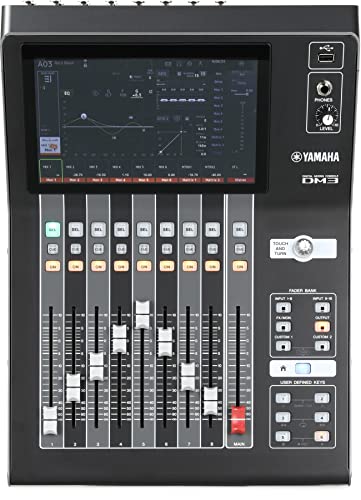
Yamaha DM3
Bands, small venues and project studios that want a compact 96 kHz digital console that doubles as an 18x18 USB recording interface.
Read the Yamaha DM3 review →Questions Buyers Ask
Allen & Heath Qu-5
See the current listing, price and included accessories.
About This Review
Mandrillis Team
The Mandrillis editorial team researches and compares audio and music gear using manufacturer documentation, verified specs and real buyer feedback, so you can make a confident purchase without wading through marketing claims.
Read our full research methodology.