Studio Gear Review
Behringer XENYX QX1204USB 12-Input 2/2-Bus Review: Compact Klark Teknik FX
The Behringer XENYX QX1204USB 12-Input 2/2-Bus combines four phantom-powered XENYX preamps, four one-knob compressors, a Klark Teknik effects processor with an LCD and dual-parameter editing, a wireless-ready receiver slot and a USB interface in a compact frame. This research review covers what the listing documents and the specs it leaves out.
Our Verdict
Research Score 72/100The Behringer XENYX QX1204USB 12-Input 2/2-Bus gives solo performers, small acts and podcasters more effects depth than most compact mixers. The listing documents twelve inputs, a 2/2-bus subgroup path, four phantom-powered XENYX mic preamps, four one-knob compressors with control LEDs, a Klark Teknik effects processor with an LCD display, dual-parameter editing, tap and storable settings, a wireless-ready slot for a separately sold Behringer digital receiver and a USB audio interface. It does not publish phantom voltage, fader type, EQ details, outputs, monitoring, USB resolution, software, dimensions or weight. For live use with up to four microphones and a stereo USB feed, it is a reasonable lower mid-range buy. Multitrack recording users should choose a dedicated interface.
Editorial research score based on published specifications and documented features, not a customer rating or lab test.

Behringer
Behringer XENYX QX1204USB 12-Input 2/2-Bus
Best for: Solo performers, small acts and podcasters who want four good mic channels, simple compression, editable Klark Teknik effects and a wireless microphone option in a compact lower.
Skip it if: You need per-channel multitrack recording, more than four microphones or a fully documented specification before buying.
Check Price on AmazonWe may earn a commission at no extra cost to you.
Listing verified: October 2026
Who Should Buy It
Buy it if
- Solo performers and duos who carry their own compact PA
- Podcasters with two to four voices who want analog compression
- Small cafes and worship teams with a few microphones
- Streamers who want hardware effects editing on their voice
Skip it if
- You record each channel separately to a DAW
- You need five or more microphone preamps
- You expect a wireless microphone in the box
Key Specifications
| Type | 12-input 2/2-bus analog mixer with Klark Teknik multi-effects processor, wireless-ready slot and USB audio interface |
| Inputs | 12 inputs in total, including 4 XENYX mic preamp channels (line and stereo channel breakdown not published in listing) |
| Outputs | 2/2-bus main and subgroup architecture (connector types not published in listing) |
| Preamps | 4 phantom-powered XENYX mic preamps (gain range and noise figures not published in listing) |
| Resolution | Not published in listing |
| Phantom power | Yes, phantom-powered preamps (voltage not published in listing) |
| Connection | USB audio interface (resolution, channel count and connector type not published in listing); wireless-ready slot for a Behringer digital wireless receiver, not included |
| Monitoring | Not published in listing |
| Bundled software | Not published in listing |
| Included accessories | Not published in listing; wireless receiver not included |
Overview
The Behringer XENYX QX1204USB 12-Input 2/2-Bus is the compact member of Behringer's QX series, pairing four phantom-powered XENYX mic preamps and four one-knob compressors with a Klark Teknik effects processor, a wireless-ready receiver slot and a built-in USB audio interface. It sits in the lower mid-range tier and targets small bands, solo performers, podcasters and streamers.
Twelve inputs with a subgroup pair is a size that fits a cafe stage or a home studio desk. Where the QX1204USB earns its place over a plain Xenyx is the effects section: the listing describes an LCD display, dual-parameter editing, a tap function and storable settings, which is more editing depth than most mixers at this size provide.
This is a research review based only on the published listing. Input count, bus layout, preamp count, compressor count, effects brand and editing features, the wireless-ready slot and the presence of USB are documented. Phantom voltage, fader type, EQ details, output connectors, monitoring, USB resolution, software, dimensions and weight are not, and those gaps are noted where they matter.
Preamps and Sound Quality
The four XENYX mic preamps are phantom-powered, so condenser microphones are supported on those channels, though the voltage is not stated. The listing compares them with stand-alone boutique preamps, which is positioning rather than measurement, since no gain, noise or distortion figures accompany the claim.
In practical terms the XENYX preamps have earned a reputation among buyers for clean, quiet performance with dynamic and condenser microphones at normal stage and podcast levels. They are not documented as thoroughly as the D-PRE preamps in a Yamaha MG10XU, whose listing publishes noise figures, but for a four-microphone setup in a small room the difference is unlikely to be decisive.
Channel EQ is not described in this listing at all, which is a notable gap given that sibling Xenyx listings specify a British-style 3-band design. Buyers should assume a 3-band EQ is present, as is standard on the range, but confirm the band count and whether the mid is sweepable from the manual before purchase.
Inputs, Outputs and Routing
Twelve inputs counts every jack, so the figure includes stereo line pairs and returns alongside the four microphone channels. The listing does not publish the breakdown, so a buyer who needs a fifth microphone should confirm whether any line channel accepts one. For most small acts, four mic channels plus stereo inputs for keyboards and playback is the right balance.
The 2/2-bus architecture supplies a main stereo output and a two-channel subgroup, which lets a set of channels be balanced together and brought to the mains on one fader pair. On a twelve-input frame that is a slightly unusual luxury and a useful one for a band that wants drums or backing vocals grouped. Output connectors, aux sends and control room feeds are not stated.
The wireless-ready slot is a routing convenience aimed at performers. It accepts a Behringer digital wireless receiver, sold separately according to the listing, so a wireless microphone arrives on a channel without an external receiver and cable. Which channel the receiver feeds and whether it bypasses a preamp is not described.
Features, Monitoring and Software
The Klark Teknik effects processor is the centerpiece. Klark Teknik is a long-standing British pro-audio brand within the same group as Behringer, and the listing describes an LCD display, dual-parameter editing, a tap function and storable user parameter settings. Being able to see and adjust two parameters per effect on a screen is a genuine step beyond the single-knob effects on entry-level mixers.
The four one-knob compressors with control LEDs handle dynamics on the microphone channels. For a podcaster with two or three voices, or a singer whose level varies, a single knob that holds the level steady is more useful than a full compressor nobody has time to set. The LED confirms when gain reduction is happening.
Monitoring, metering, a headphone output and bundled software are not mentioned in the listing. A USB-equipped mixer in this class would normally include a headphone jack and often a DAW download code, but neither is confirmed, so buyers should plan to supply their own recording or streaming application.
- Klark Teknik effects processor with LCD display and dual-parameter editing
- Tap function and storable effect settings
- Four one-knob compressors with control LEDs
- Wireless-ready slot for a separate Behringer digital receiver
- 2/2-bus routing with subgroup pair
- USB audio interface built in
Build, Design and Controls
Fader type, chassis material, dimensions and weight are not published for this model. Buyers report Behringer's QX series as competently built for the price, and the larger X2222USB listing specifies 60 mm faders and sealed rotary controls, but none of that is stated here and should not be assumed.
The control surface is more involved than a basic mixer because of the effects section's display and editing controls, which sit in the master area alongside the USB section and the wireless receiver bay. Channel strips follow the standard gain, compressor, EQ, aux, pan and level order, so the learning curve lives in the master section.
A twelve-input frame is small enough for a desk or a keyboard stand tray, which makes this model attractive for solo performers who carry their own sound. Without published dimensions the exact footprint must come from the manual, and the receiver bay adds a little depth to the master section.
Connectivity, Drivers and Latency
A USB audio interface is confirmed in the title, but sample rate, bit depth, channel count and connector type are not published. QX series mixers are generally understood to send the main stereo mix to the computer and return a stereo playback feed, which suits podcasts and streams but not per-channel multitrack recording. That is context rather than a documented fact for this unit.
Driver and operating system support are not described. Stereo USB mixers in this class are usually class compliant on Mac and Windows with optional ASIO drivers for Windows, but the listing does not confirm either, and streamers who monitor through the computer should check the latency arrangement in the manual.
Beyond USB and the wireless microphone slot there is no Bluetooth or digital input, so music from a phone or laptop goes in through a cable to a stereo channel. The wireless-ready slot is for a microphone receiver only, not for audio playback.
Setup and Daily Use
Setup is standard: microphones into the four XENYX channels, instruments and playback into the line and stereo inputs, main outputs to powered speakers, and a USB cable to the computer for recording or streaming. If a Behringer wireless receiver is fitted, the microphone pairs with it and appears on its assigned channel. Phantom power goes on only after condensers are connected.
In regular use the effects display is the daily touchpoint. A solo performer can dial a reverb and a delay with tap tempo, store them, and recall them at the next show, while the compressors keep vocal levels steady. For a podcaster the compressors and the USB feed are the whole workflow.
The daily constraints are the four-preamp limit and the probable stereo USB feed. Groups with more microphones or anyone who wants each voice on a separate track should confirm the channel layout and USB channel count before buying, or pair the mixer with a multichannel interface.
Who Should Buy It
Solo performers and duos who want a compact mixer with serious effects editing and the option of a slot-in wireless microphone are the clearest buyers. Podcasters with two to four voices who want analog compression and a simple stereo USB feed are the second group.
Small cafes, rehearsal rooms and worship teams with a handful of microphones and a keyboard or playback source will find the input count and the subgroup pair sufficient. Streamers who prefer hardware effects on their voice have a clear case for the Klark Teknik section.
It is not the right choice for multitrack studio recording, for bands with five or more microphones, or for buyers who need published phantom voltage, fader, monitoring and USB specifications before ordering. Those users should look at a larger frame or a dedicated interface.
Alternatives Worth Considering
Within the Xenyx range, the X1222USB and X1622USB add four more inputs with four preamps and a sixteen-preset effects engine, and the QX1222USB adds a graphic EQ, feedback detection and a voice canceller for entertainment use. The QX1204USB is the smallest frame with the Klark Teknik effects editing.
The Yamaha MG10XU is the closest rival at this size, with D-PRE preamps, published noise figures, one-knob compressors, SPX effects and USB, though without a wireless slot or an effects display. The Mackie ProFX10v3 offers Onyx preamps, twenty-four GigFX effects and USB in a similar footprint.
For recording rather than live mixing, a Behringer UMC202HD, Focusrite Scarlett 2i2 or PreSonus AudioBox puts each input on its own DAW track and includes software, which this mixer does not document. A mixer only wins when live mixing and USB capture must happen together.
Verdict
The Behringer XENYX QX1204USB 12-Input 2/2-Bus packs an unusual amount of effects capability into a compact frame. The listing documents four phantom-powered XENYX preamps, four one-knob compressors with LEDs, a Klark Teknik effects processor with an LCD, dual-parameter editing, tap and memory, a wireless-ready receiver slot, a subgroup pair and a USB interface.
The omissions are typical of the family: phantom voltage, fader type, EQ details, output connectors, monitoring, USB resolution, software, dimensions and weight are all unpublished, and the wireless receiver is a separate purchase. Live users can work around those gaps; studio users should treat the USB as a stereo convenience.
Scored at 72, it earns a mid-range placing for its documented effects and dynamics features and its brand track record, with points withheld for the thin core specification. For solo performers, small acts and podcasters who want effects depth and a wireless option in a small lower mid-range mixer, it is a reasonable buy.
Strengths and Limitations
Strengths
- Four phantom-powered XENYX mic preamps
- Four one-knob compressors with control LEDs
- Klark Teknik effects with LCD display and dual-parameter editing
- Wireless-ready slot for a Behringer digital receiver
- 2/2-bus subgroup routing in a compact frame
- USB audio interface built in
Limitations
- Wireless receiver is not included
- USB resolution and channel count are not published
- EQ, fader, monitoring and output details are unstated
- No bundled software mentioned
How We Scored It
Scores reflect published specifications, documented features and value against the alternatives below. They are editorial research scores, not laboratory measurements.
Alternatives to Consider
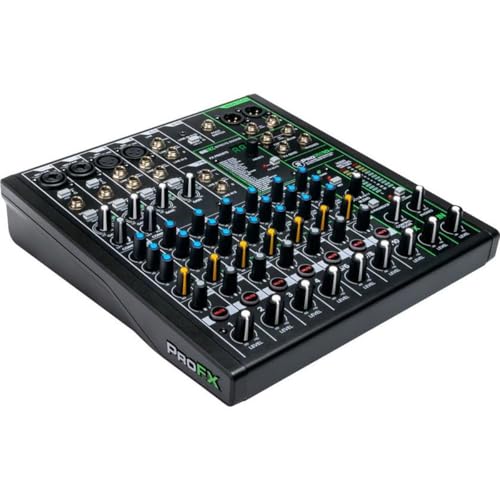
Mackie ProFX10v3 10-Channel
Singer-songwriters, duos, podcasters and streamers who want Onyx preamps, onboard effects and USB capture in one compact lower mid-range mixer for small gigs and home streams.
Read the Mackie ProFX10v3 10-Channel review →
Yamaha MG12 12-Input 4-Bus
Lecture halls, worship rooms, schools and home recordists who want a durable analog mixer with clean D-PRE preamps and group routing and do not need USB or effects.
Read the Yamaha MG12 12-Input 4-Bus review →
Behringer Xenyx X1622USB 16-Input 2/2-Bus
Small bands, worship teams and solo performers who want to shape vocals precisely with a sweepable mid EQ, simple compression and recallable effects in a lower mid-range analog mixer.
Read the Behringer Xenyx X1622USB 16-Input 2/2-Bus review →Questions Buyers Ask
Behringer XENYX QX1204USB 12-Input 2/2-Bus
See the current listing, price and included accessories.
About This Review
Mandrillis Team
The Mandrillis editorial team researches and compares audio and music gear using manufacturer documentation, verified specs and real buyer feedback, so you can make a confident purchase without wading through marketing claims.
Read our full research methodology.