Studio Gear Review
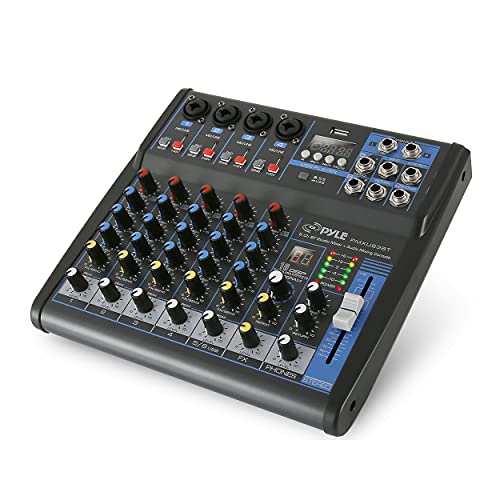
Pyle PMXU63BT 6-Channel Audio Mixer Review: Built-In Playback
The Pyle PMXU63BT is a 6-channel analog DJ mixer combining microphone inputs with built-in USB, flash drive, MP3 and Bluetooth playback in a steel chassis. This research review checks those playback and mixing claims against the preamp, output and build details the listing does not publish.
Our Verdict
Research Score 56/100The Pyle PMXU63BT packs a lot of playback convenience into a budget mixer: built-in USB, flash drive and MP3 playback with transport controls, Bluetooth streaming from a phone or tablet, and phantom-powered mic inputs with an LED peak indicator, all inside a steel chassis with sealed rotary controls. For karaoke, small DJ sets or casual live use, that combination covers a lot of ground without needing a laptop onstage. The listing does not publish preamp gain, noise figures or output connector types, so buyers with specific speaker or recording requirements should verify those details first. As a rugged, feature-dense mixer for playback-heavy small events, it represents reasonable value, with the unpublished specifications being the main reason the score stays in the budget range rather than higher.
Editorial research score based on published specifications and documented features, not a customer rating or lab test.
Pyle
Pyle PMXU63BT 6-Channel Audio Mixer
Best for: DJs, karaoke hosts and small venue operators who want onboard USB, MP3 and Bluetooth playback combined with basic microphone mixing in one rugged unit.
Skip it if: You need a confirmed multitrack recording interface or published preamp specifications, because the listing emphasizes playback and streaming features rather than detailed recording.
Check Price on AmazonWe may earn a commission at no extra cost to you.
Listing verified: November 2026
Who Should Buy It
Buy it if
- DJs who want built-in USB, flash drive and Bluetooth playback on the mixer itself
- Karaoke hosts who need phantom-powered mic inputs plus wireless music streaming
- Small venue operators who value a steel chassis over delicate plastic construction
- Buyers who travel internationally and need a multi-voltage power supply
Skip it if
- You need confirmed preamp gain or noise specifications before buying
- You need a multitrack USB recording path rather than playback features
- You require stated output connector types for your existing speaker setup
Key Specifications
| Type | 6-channel analog DJ mixer with USB, flash drive, built-in MP3 player and Bluetooth streaming |
| Inputs | Mic and stereo line inputs supporting XLR and unbalanced 1/4 inch plugs. The exact channel-by-channel breakdown beyond the 6-channel count is not itemized in the bullets |
| Outputs | Not published in listing |
| Preamps | Not published in listing. The bullets describe an ultra-low noise, high headroom mixer but give no gain or noise figure |
| Resolution | Not published in listing |
| Phantom power | A +48V phantom power button is confirmed for the microphone inputs |
| Connection | USB connection for a computer, plus a flash drive reader, a built-in MP3 player and Bluetooth wireless streaming |
| Monitoring | Not published in listing |
| Bundled software | Not applicable. No software is mentioned, only onboard playback controls for USB and flash media |
| Included accessories | Multi-voltage power adapter rated for 100V to 240V; no other accessories are published |
Overview
The Pyle PMXU63BT is a 6-channel analog mixer built around playback and streaming convenience as much as raw mixing power. The listing describes built-in USB, flash drive and MP3 player functionality, Bluetooth wireless streaming, microphone inputs with phantom power, 3-band EQ and a rugged steel chassis.
Pyle positions this as a professional DJ sound board, aimed at karaoke, live gigs and studio-adjacent use, though the brand sits in the budget tier of audio gear rather than among the established professional mixer makers. The feature list leans heavily toward convenience functions that reduce the need for extra playback hardware onstage.
This review relies only on the five feature bullets published for this listing. Preamp gain, output connector types and build weight are not stated anywhere in that data, and each of those gaps is called out directly rather than filled in with assumptions about similar mixers.
Preamps and Sound Quality
The listing describes an ultra-low noise, high headroom mixer with mic and stereo line inputs accepting XLR and unbalanced 1/4 inch plugs. No specific gain range, equivalent input noise or maximum headroom figure is published, so that general claim cannot be checked against a number.
A highly accurate LED peak level indicator is confirmed, which gives an operator a visual way to manage gain staging even without a published specification sheet. That kind of indicator is a practical substitute for guessing at levels by ear alone, especially in a loud room.
Budget mixers in this general class, including other Pyle products, tend to prioritize feature breadth over measured preamp performance. Buyers report them as usable for karaoke and casual DJ work, though anyone with strict fidelity requirements should treat the sound quality claims here as marketing language rather than confirmed specifications.
Inputs, Outputs and Routing
Mic and stereo line inputs are confirmed, supporting both XLR and unbalanced 1/4 inch plug connections, with a +48V phantom power button for condenser microphones. The listing identifies this as a 6-channel mixer overall, though the bullets do not break down exactly how those 6 channels split between microphone and line sources.
No output connector type, main output count or aux send is described anywhere in the published data. Buyers planning to connect this mixer to a specific powered speaker or PA system should confirm the rear panel layout directly rather than assume a particular connector.
That gap is worth closing before a show rather than during one. Discovering a connector mismatch on site leaves little room for a quick fix without a spare adapter cable on hand.
Routing beyond the main mix is handled largely through the built-in USB, flash drive and Bluetooth sources rather than through a traditional aux send system. That design favors simple source switching over complex live-sound routing, which suits the mixer's karaoke and small-DJ target audience.
Features, Monitoring and Software
The standout feature set here is built-in media playback: a USB port, a flash drive reader and an onboard MP3 player, all controlled through play, pause, skip and mode-switching buttons on the mixer itself. That lets an operator run music without a separate laptop or media player connected.
Bluetooth wireless streaming adds a second playback path, letting a phone or tablet stream directly from services like Pandora or Spotify without a cable. Combined with the USB and flash drive support, this gives the mixer three separate ways to introduce music into the mix.
No software or driver applies here, since this is a standalone hardware mixer rather than a computer-connected interface. The 3-band EQ on all channels is the main tone-shaping feature, giving each input independent control over low, mid and high frequencies.
- Built-in USB, flash drive and MP3 player with transport controls
- Bluetooth wireless streaming from phones and tablets
- Mic and stereo line inputs with plus 48V phantom power
- 3-band EQ on all channels with LED peak level indicator
- Rugged steel chassis with sealed rotary controls
Build, Design and Controls
The listing specifically confirms a rugged steel chassis, which is a meaningful build detail compared to listings that state nothing about construction at all. Sealed rotary controls are also confirmed, designed to resist dust and grime during live use.
No weight or physical dimensions are published, so buyers planning transport to gigs should treat the size as unknown until confirmed elsewhere. The steel chassis description does suggest a heavier, more durable build than an all-plastic mixer in the same price range.
Controls are described generally as providing total dynamic control for live performance, karaoke and stage use. The listing does not itemize each knob, fader or switch individually beyond the EQ, phantom power button and LED peak indicator already confirmed.
Connectivity, Drivers and Latency
This mixer offers three distinct connectivity paths: a USB connection for a computer or flash drive, Bluetooth wireless streaming, and the standard analog mic and line inputs. That range of options is broader than most mixers at this price typically offer.
No driver installation is implied for the USB or Bluetooth functions, since both appear to work through the mixer's own onboard playback system rather than through computer-side software. That reduces setup complexity compared to a USB recording interface that depends on operating system drivers.
Latency is not a meaningful concern for playback functions like USB, flash drive or Bluetooth streaming, since those are not live-recording paths. No latency figure is published, and none would be expected for a device built around media playback rather than real-time computer recording.
Buyers who also want to record a live set from this mixer should remember that none of its connectivity features are described as a recording path back to a computer. A separate audio interface would still be needed to capture the mixed signal for later editing.
Setup and Daily Use
Setting up the PMXU63BT for a karaoke night or small DJ set involves connecting microphones to the mic inputs, loading a flash drive or pairing a phone over Bluetooth, and adjusting the 3-band EQ and phantom power as needed. There is no software to install, which keeps setup fast for a mobile operator.
Daily use centers on switching between the built-in playback sources and live microphone input, using the onboard transport controls to manage tracks without a separate device. The LED peak indicator helps avoid clipping while juggling multiple sources during a live event.
The multi-voltage power supply, rated for 100V to 240V, is a practical detail for anyone who travels internationally for gigs. It removes the need for a separate voltage converter in most countries, which simplifies packing for touring work.
Who Should Buy It
This mixer suits a mobile DJ, karaoke host or small venue operator who wants built-in playback flexibility, phantom-powered mic inputs and a durable chassis, all without needing a laptop onstage. The combination of USB, flash drive and Bluetooth sources covers most casual playback needs.
Buyers who value physical durability, given the confirmed steel chassis and sealed rotary controls, over refined preamp specifications will likely be satisfied with what this mixer offers for its price. That tradeoff is explicit in how the listing presents its features.
Anyone needing confirmed output connector types, published preamp specifications, or a true multitrack recording path should look elsewhere. None of those points are addressed in the available listing data for this model.
Alternatives Worth Considering
Buyers who want a smaller, similarly equipped mixer should consider the 4-channel Pyle PMXU43BT.5, which shares the same USB, flash drive, MP3 and Bluetooth feature set in a more compact 4-channel format. That trades some input capacity for a smaller footprint.
For buyers who specifically need confirmed preamp specifications and a true recording interface, established brands such as Behringer with its U-Phoria line offer more conservative, better-documented feature sets. What they do not offer is the built-in media playback this Pyle mixer provides.
Anyone running a larger event with more than 6 channels or needing dedicated aux sends for monitor mixes should look toward a larger live-sound mixer instead. This model's channel count and routing options are built for smaller-scale use rather than big stage productions.
Verdict
The Pyle PMXU63BT earns its place as a feature-dense budget mixer: built-in USB, flash drive and MP3 playback, Bluetooth streaming, phantom-powered mic inputs with an LED peak indicator, and a steel chassis with sealed rotary controls. For karaoke nights, small DJ sets and casual live use, that is a genuinely useful combination.
Silence in the published data on preamp gain, output connectors and physical dimensions keeps this from scoring higher, since those gaps matter for anyone with specific technical requirements. None of them, however, undermine the core playback and mixing functions the listing does confirm.
For a mobile operator who wants one rugged box that handles microphones, playback and wireless streaming together, the PMXU63BT is a sensible budget choice. That holds provided the unpublished specifications are acceptable for the intended use.
Strengths and Limitations
Strengths
- Built-in USB, flash drive and MP3 playback with play, pause and skip controls
- Bluetooth wireless streaming from phones and tablets
- Plus 48V phantom power with an LED peak level indicator
- 3-band EQ on all channels
- Rugged steel chassis with sealed rotary controls
Limitations
- No gain, noise or headroom figures are published
- Output connector types are not stated
- No bundled software, since this is a standalone hardware mixer
- Weight and dimensions are not stated beyond a general steel chassis description
How We Scored It
Scores reflect published specifications, documented features and value against the alternatives below. They are editorial research scores, not laboratory measurements.
Alternatives to Consider

Pioneer DJ XDJ-RX3
DJs who want club-standard standalone playback from USB with a large touchscreen and a familiar two-channel layout.
Read the Pioneer DJ XDJ-RX3 review →
Yamaha DM3-D 22
Small venues, houses of worship and production companies that want a compact 96 kHz digital console with Dante networking for stage boxes and multitrack recording.
Read the Yamaha DM3-D 22 review →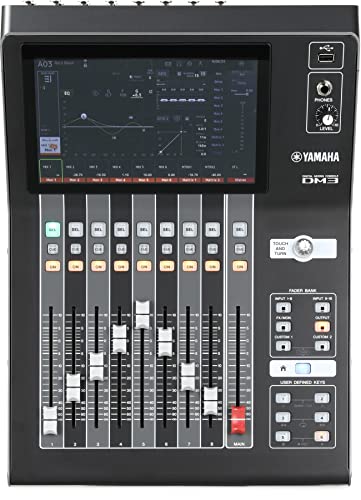
Yamaha DM3
Bands, small venues and project studios that want a compact 96 kHz digital console that doubles as an 18x18 USB recording interface.
Read the Yamaha DM3 review →Questions Buyers Ask
Pyle PMXU63BT 6-Channel Audio Mixer
See the current listing, price and included accessories.
About This Review
Mandrillis Team
The Mandrillis editorial team researches and compares audio and music gear using manufacturer documentation, verified specs and real buyer feedback, so you can make a confident purchase without wading through marketing claims.
Read our full research methodology.