Studio Gear Review
Lewitt PURE TUBE Review: Proximity Control Done Right
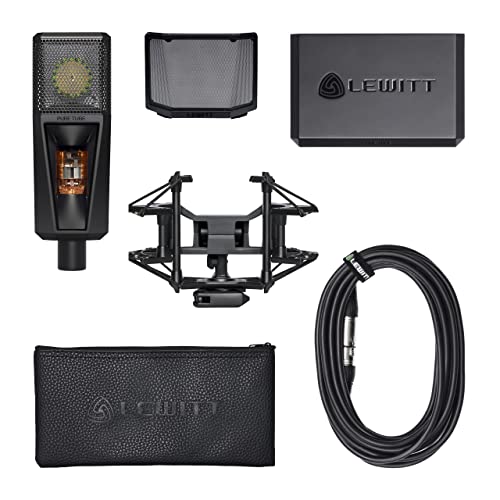
The Lewitt PURE TUBE is a studio tube condenser built around a transformer based filter that the listing says musically balances proximity effect. It ships with a magnetic pop filter, shock mount, transport bag and mil spec case, though the polar pattern and several core specifications are not published.
Our Verdict
Research Score 77/100The Lewitt PURE TUBE stands out for one specific engineering choice: a transformer based filter the listing describes as musically balancing the proximity effect, a detail few competing tube condensers call out directly. The accessory set, including a magnetic pop filter, shock mount, transport bag and mil spec case, is generous for the upper mid range price tier. What holds this review back from full confidence is the amount left unstated, including the polar pattern, frequency response and whether a power supply ships in the box. For a vocalist who specifically fights proximity effect on close mic work, the PURE TUBE is worth investigating further, but buyers who want every detail confirmed in advance should ask Lewitt directly before ordering.
Editorial research score based on published specifications and documented features, not a customer rating or lab test.
Lewitt
Lewitt Pure Tube Condenser Microphone
Best for: Vocalists and studios who want a tube condenser specifically engineered around proximity effect control for close mic recording.
Skip it if: You need a confirmed polar pattern, published specifications, or certainty that a power supply is included before you buy.
Check Price on AmazonWe may earn a commission at no extra cost to you.
Listing verified: November 2026
Who Should Buy It
Buy it if
- Vocalists who record close to the capsule and fight proximity effect buildup
- Studios that want a tube condenser with a magnetic pop filter and mil spec case included
- Buyers drawn to a capacitor and semiconductor free signal path for vocal work
- Engineers comfortable confirming missing details directly with Lewitt before purchase
Skip it if
- You need the polar pattern confirmed in writing before ordering
- You require a guaranteed included power supply with no follow up questions
- You want a fully specified microphone with published frequency response figures
Key Specifications
| Type | Studio tube condenser; the listing describes a signal path free from capacitors and semiconductors |
| Polar pattern | Not published in listing |
| Frequency response | Not published in listing |
| Connection | 7 pin XLR cable; an external power supply is implied by tube designs of this type but is not listed among included accessories |
| Phantom power | Not stated in listing; tube condensers typically run from a dedicated external supply rather than phantom power |
| Max SPL or sensitivity | Not published in listing |
| Controls | Transformer based filter that the listing says musically balances the proximity effect; not described as a user operated switch |
| Mount and stand | Shock mount included |
| Weight | Not published in listing |
| Included accessories | Magnetic pop filter, shock mount, 7 pin XLR cable, transport bag, mil spec transport case |
Overview
The Lewitt PURE TUBE is a studio tube condenser microphone that the listing describes as having a signal path free from capacitors and semiconductors, a design choice aimed squarely at professional vocal recording. It sits in the upper mid range price tier, positioned as a serious tool rather than a casual upgrade.
What separates this listing from most tube condensers is its emphasis on a transformer based filter that Lewitt says musically balances the proximity effect, the bass buildup that happens when a vocalist leans in close to any large diaphragm microphone. That is a specific, engineering led claim rather than general marketing language, and it shapes much of what this review focuses on.
The accessory list is generous: a magnetic pop filter, a shock mount, a 7 pin XLR cable, a transport bag and a mil spec transport case are all included. What the listing does not confirm is the polar pattern, frequency response, maximum SPL or whether a dedicated power supply ships alongside the 7 pin cable.
Sound Quality
Tube condensers built with a signal path the listing describes as free from capacitors and semiconductors are generally chasing a particular kind of purity, trading some convenience for a more direct route from capsule to output. Buyers report this style of circuit tends to retain more of the capsule's natural character before any coloration from supporting electronics is added.
The standout claim in the listing is the transformer based filter that musically balances proximity effect, language that suggests Lewitt engineered a specific solution rather than leaving bass buildup to the performer's technique alone. On paper that should make the PURE TUBE more forgiving for vocalists who like to work close to the capsule than a typical large diaphragm condenser.
No frequency response or sensitivity figures are published, so this review cannot describe the exact tonal balance in numbers. Compared with a general purpose condenser such as an Audio-Technica AT2020, the PURE TUBE is clearly aimed at a narrower, vocal specific use case rather than broad instrument duty.
Pickup Pattern and Noise Handling
The listing does not name a polar pattern for the PURE TUBE, which is an unusual gap for a microphone this specialized. Studio vocal microphones in this price tier are most commonly cardioid, but this review cannot confirm that assumption from the published data alone.
Because the pattern is not confirmed, this review also cannot describe off axis rejection or how the microphone handles reflections from the side or rear of a vocal booth. Buyers who need that detail before purchase should request it directly from Lewitt rather than assume a standard cardioid behavior.
Self noise and maximum SPL are likewise absent from the listing. What is documented is the proximity effect filter, which addresses a specific noise and balance issue at close range rather than overall self noise performance across the frequency spectrum.
Build Quality
The mil spec transport case is the most notable build related detail in the listing, suggesting Lewitt engineered the PURE TUBE's packaging to survive travel between studios rather than sit permanently on one desk. A transport bag is included alongside the case, giving two levels of protection for different situations.
A shock mount ships with the microphone as well, reducing stand borne vibration and handling noise, a standard requirement for any sensitive tube condenser. The magnetic pop filter is a less common inclusion and suggests Lewitt expects this microphone to be used for close, breath heavy vocal work by default.
Weight, body material and capsule diameter are not published in the listing, so this review cannot describe the physical microphone with precision. The accessory choices, particularly the mil spec case, imply a build quality consistent with a serious studio tool even without those numbers confirmed, and they suggest Lewitt expects this microphone to travel between sessions rather than stay bolted to one stand.
Connectivity and Setup
The PURE TUBE connects through a 7 pin XLR cable, which is included in the listing. That cable design is standard for tube condensers that separate the microphone body from external power electronics, though the listing does not explicitly list a power supply as an included accessory.
That gap matters for setup planning. If a power supply is not included, buyers would need to source one separately before the microphone can be powered at all, since a 7 pin cable alone cannot connect to a standard phantom powered interface. This review recommends confirming that detail with Lewitt before finalizing a purchase.
Assuming the standard tube microphone workflow applies, setup would involve connecting the 7 pin cable, powering the supply, allowing warm up time, and then setting gain on a preamp. That is a slower process than a phantom powered or USB microphone offers, and buyers should budget for it.
Features, Controls and Extras
The transformer based proximity effect filter is the headline feature on the PURE TUBE, and the listing frames it as a built in solution rather than something the performer manages through technique alone. That is a meaningful differentiator in a category where most microphones leave proximity effect entirely up to microphone placement.
A magnetic pop filter is included, which is a thoughtful pairing for a microphone the listing says is optimized for professional vocal recording. Many competing tube condensers require a separate pop filter purchase, so this inclusion is a real value add at the upper mid range price.
Beyond the proximity filter and the pop filter, the listing does not describe any pad switches, high pass filters or other controls. Buyers who need those features for a specific workflow should confirm their presence with Lewitt directly rather than assume them from this listing.
Use Cases: Vocals, Streaming, Podcasting and Instruments
Vocals are explicitly the intended use case, with the listing stating the PURE TUBE is optimized for professional vocal recordings. The proximity effect filter should be most valuable here, for performers who like to sing or speak close to the capsule for intimacy without the bass buildup that normally comes with it.
Instrument use is not emphasized in the listing. With no confirmed polar pattern or frequency response, this review cannot recommend it confidently for acoustic guitar, strings or drum overheads the way a general purpose condenser would be.
Streaming and podcasting are possible in principle but are not the listing's stated focus. The uncertainty around power supply inclusion makes this a less practical choice than a simpler phantom powered or USB microphone for a daily talk show.
Who Should Buy It
Vocalists who specifically struggle with proximity effect on close mic work are the clearest audience for the PURE TUBE, since that is the one feature the listing documents in detail. Studios that value the included pop filter, shock mount and mil spec case as a complete vocal recording kit will also find value here.
Buyers who need every specification confirmed before purchase, including polar pattern and power supply inclusion, should contact Lewitt directly first. This is not a microphone to buy on assumption alone given how much of the listing's technical data is unpublished.
Alternatives Worth Considering
Telefunken's TF39 and TF47 are tube condensers at a similar or higher price tier with confirmed multi pattern switching and a complete power supply bundle. That makes them worth a look for buyers who want fewer unanswered questions about included hardware.
A solid state large diaphragm condenser such as an Audio-Technica AT2020 or a Rode NT1 sidesteps the proximity effect question differently, relying on cardioid directionality and careful mic placement rather than a built in filter. Either one is a simpler, phantom powered alternative.
For vocalists who want proximity control without a tube microphone at all, standard technique remains a traditional low cost option. Working slightly off axis or using a pop filter with distance markers can manage the same bass buildup the PURE TUBE's filter targets.
Verdict
The Lewitt PURE TUBE earns attention for a genuinely specific engineering feature, a transformer based filter built to manage proximity effect. That sits alongside a strong accessory kit that includes a pop filter, shock mount, transport bag and mil spec case.
The unanswered questions, particularly around polar pattern and power supply inclusion, keep this from being an easy recommendation without further confirmation. Vocalists drawn to its specific proximity handling should verify the missing details with Lewitt before committing to the upper mid range price.
Strengths and Limitations
Strengths
- Signal path described as free from capacitors and semiconductors for a purer tube character
- Built in transformer based filter aims to tame proximity effect automatically
- Generous accessory set: magnetic pop filter, shock mount, transport bag and mil spec case
- Optimized specifically for professional vocal recording according to the listing
- Upper mid range price undercuts several flagship tube condensers
Limitations
- Polar pattern is not named in the listing
- No published frequency response, sensitivity or maximum SPL
- Listing does not confirm whether a power supply ships with the microphone
- Weight and body material are not stated
How We Scored It
Scores reflect published specifications, documented features and value against the alternatives below. They are editorial research scores, not laboratory measurements.
Alternatives to Consider

Beyerdynamic M 160
Recording guitar amplifiers, drum overheads, strings and brass with a smooth, directional ribbon character.
Read the Beyerdynamic M 160 review →
Shure BLX288/SM58 Dual Vocal
Bands, worship teams and event companies that need two dependable wireless SM58 vocal channels in one simple package.
Read the Shure BLX288/SM58 Dual Vocal review →
Sennheiser XSW 1-835
Worship teams, schools and gigging duos who want two wireless e835 vocal channels with the simplest possible setup.
Read the Sennheiser XSW 1-835 review →Questions Buyers Ask
Lewitt Pure Tube Condenser Microphone
See the current listing, price and included accessories.
About This Review
Mandrillis Team
The Mandrillis editorial team researches and compares audio and music gear using manufacturer documentation, verified specs and real buyer feedback, so you can make a confident purchase without wading through marketing claims.
Read our full research methodology.