Digital Pianos Review
Alesis Recital Pro Review: Hammer Action for the Least Money
The Recital Pro is the Alesis Recital with a hammer-action keyboard, twelve voices, a screen and 40 watts of speakers. This review looks at what the action feels like against Casio and Yamaha entry pianos that cost more, what the loud speakers and line outputs add, and who should choose it over the CDP-S160 and P-145.
Our Verdict
Research Score 76/100The Alesis Recital Pro is the cheapest way to put hammer-action keys and genuinely loud speakers in front of a beginner, and it is a far better lesson instrument than the semi-weighted Recital. Its action is heavier and less graded than the Casio CDP-S160 and Yamaha P-145, and it has no Bluetooth, so buyers who can stretch to either of those get a more refined piano. On a strict budget, the Recital Pro is the one to buy.
Editorial research score based on published specifications and documented features, not a customer rating or lab test.

Alesis
Alesis Recital Pro
Best for: Beginners who want hammer-action keys and loud speakers for the least money
Skip it if: you want a refined, graded action or app connectivity
Check Price on AmazonWe may earn a commission at no extra cost to you.
Listing verified: October 2026
Who Should Buy It
Buy it if
- You want weighted keys on a strict budget
- You need speakers loud enough for a living room
- You want a screen rather than hold-and-press settings
Skip it if
- Touch quality matters; the Casio CDP-S160 and Yamaha P-145 feel more refined
- You want Bluetooth or USB audio
- You need a slim, light piano
Key Specifications
| Key Action | Hammer action, 88 full-size keys |
| Sound Engine | Sampled voices |
| Voices | 12 |
| Polyphony | 128 notes |
| Speakers | 2 x 20 W |
| Bluetooth | No |
| USB | USB MIDI |
| Pedals | Sustain input (pedal not included) |
| Weight | 23.1 lb (10.5 kg) per listing |
| Form Factor | Portable, battery capable |
Recital to Recital Pro: What Changes
Four things. The semi-weighted keys become a hammer action with adjustable touch response. The five voices become twelve, adding more pianos, electric pianos, organs, strings and a choir. The two 10 watt speakers become two 20 watt speakers. And a backlit LCD replaces the row of LEDs, so settings and voices are visible at a glance. The USB MIDI port, Lesson mode, headphone output, line outputs, battery operation and bundled lesson subscriptions carry over.
The listing reviewed here is the current Recital Pro, which Alesis's model code identifies as a Mark II revision; the features above match what Alesis publishes for it.
The Hammer Action
The Recital Pro's keys are genuinely hammer-weighted, which makes it the least expensive hammer-action 88 we have researched. The weight is on the heavy side and the grading from bass to treble is subtle, so the keyboard feels more uniform than a Yamaha GHC or Casio Scaled Hammer action. Key return is a little slower than those rivals, and the key tops are plain plastic.
For a beginner it does the essential job: it builds finger strength and it feels enough like a piano that technique transfers. For an intermediate player the heaviness and slower repetition become noticeable, and the Casio CDP-S160, Yamaha P-145 and Roland FP-10 all feel more refined for a modest premium.
Sound and Speakers
The grand piano voice is serviceable and the electric pianos and organs are pleasant; none of the twelve voices embarrass the instrument, though the piano sample has less depth than Korg's or Casio's at the next price step. Layer and split modes, reverb, chorus and a metronome are all easy to reach on the screen.
Speakers are where the Recital Pro over-delivers. Two 20 watt amplifiers make it louder than every entry portable from Yamaha, Casio, Roland and Korg, and loud enough for a living room or a classroom. Combined with the quarter-inch line outputs, it is a practical keyboard for a church hall or a school as well as a home.
Connectivity and Power
USB MIDI links the Recital Pro to apps and computers by cable. Quarter-inch left and right line outputs feed an amplifier or interface, and a quarter-inch headphone jack mutes the speakers. There is no Bluetooth and no USB audio. Power comes from the included adapter or six D batteries, which makes it one of the few hammer-action pianos that can run away from an outlet.
Setup and Accessories
A music rest is included; a sustain pedal is not, and buying one is essential. The Recital Pro suits any X or Z stand and Alesis sells a matching stand and bench bundle. At about 23 pounds it is a comfortable one-person carry.
Recital Pro Against the Alternatives
Against the Casio CDP-S160, the Alesis is louder and cheaper, while the Casio's action is more graded and refined, its case is slimmer and it accepts a three-pedal unit. Against the Yamaha P-145, the Yamaha's GHC action and app support are better and it is lighter; the Alesis has louder speakers, a screen and line outputs. Against the Donner DEP-20, a direct budget rival, the Recital Pro has the stronger brand support and a simpler panel, while the Donner offers more voices and similar speaker power.
If the budget allows the Casio or Yamaha, buy one of those. If it does not, the Recital Pro is the best hammer-action piano at its price.
Who It Suits Long Term
Families who need a loud, weighted piano for a child's first years of lessons, adult beginners on a budget, and teachers equipping a classroom tend to keep the Recital Pro and find it reliable. Students who progress to intermediate repertoire usually want a more refined action within two or three years, at which point the Roland FP-30X or Kawai ES120 are the natural upgrades and the Recital Pro becomes a spare or a controller.
Strengths and Limitations
Strengths
- Hammer action at the lowest price in this guide
- Powerful 2 x 20 W speakers
- LCD screen makes settings easy
- Quarter-inch line outputs and battery operation
Limitations
- Action is heavier and less refined than Yamaha, Casio or Roland
- Only twelve voices and no Bluetooth
- No pedal in the box
How We Scored It
Scores reflect published specifications, documented features and value against the alternatives below. They are editorial research scores, not laboratory measurements.
Alternatives to Consider

Casio CDP-S160
Beginners and casual players who need a light, slim piano that can run anywhere
Read the Casio CDP-S160 review →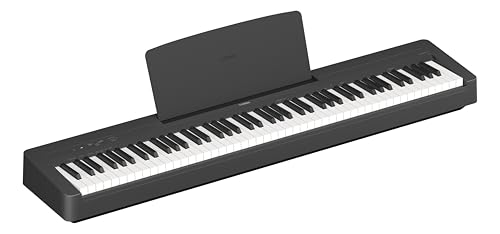
Yamaha P-145
Beginners who want the current Yamaha entry model with app control and a slim footprint
Read the Yamaha P-145 review →
Donner DEP-20
Budget buyers who want weighted keys, loud speakers and a large sound library in one box
Read the Donner DEP-20 review →Head-to-Head Comparisons
Questions Buyers Ask
Alesis Recital Pro
See the current listing, price and included accessories.
About This Review
Mandrillis Team
The Mandrillis editorial team researches and compares audio and music gear using manufacturer documentation, verified specs and real buyer feedback, so you can make a confident purchase without wading through marketing claims.
Read our full research methodology.